

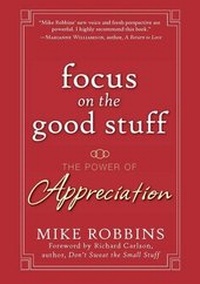
Focus on the Good Stuff
The Power of Appreciation
Published on 14. December 2010
240 pages
978-1-118-04108-6 (ISBN)
Description

Written by a former professional baseball player whose career was ended with an injury to his pitching arm in the middle of his third season, Focus on the Good Stuff is filled with passion, authenticity, and humor. Author Mike Robbins offers a step-by-step program with exercises for overcoming negative influence and obstacles, creating a truly grateful approach to life, and establishing an environment that can support success and peace of mind.
More details
Other editions
Additional editions
Book
09/2007
1st Edition
Jossey-Bass
€26.50
Shipment within 10-20 days
Persons
Mike Robbins, former pitcher with the Kansas City Royals organization, is a sought-after keynote speaker, consultant, and coach. His clients include AT&T, Chevron, the U.S. Department of Labor, Kaiser Permanente, New York Life Insurance, and Stanford University. To find out about his speaking, products, and services, visit www.mike-robbins.com.
Content
Foreword.
Richard Carlson.
Acknowledgments.
Introduction.
PART ONE: OUR OBSESSION WITH BAD STUFF.
1. What's Wrong out There?
2. What's Wrong with Me?
PART TWO: THE FIVE PRINCIPLES OF APPRECIATION.
3. Principle 1: Be Grateful.
4. Principle 2: Choose Positive Thoughts and Feelings.
5. Principle 3: Use Positive Words.
6. Principle 4: Acknowledge Others.
7. Principle 5: Appreciate Yourself.
PART THREE: APPRECIATION IN ACTION.
8. It's Not What We Know, but What We Do That Matters.
Resources.
About the Author.
Richard Carlson.
Acknowledgments.
Introduction.
PART ONE: OUR OBSESSION WITH BAD STUFF.
1. What's Wrong out There?
2. What's Wrong with Me?
PART TWO: THE FIVE PRINCIPLES OF APPRECIATION.
3. Principle 1: Be Grateful.
4. Principle 2: Choose Positive Thoughts and Feelings.
5. Principle 3: Use Positive Words.
6. Principle 4: Acknowledge Others.
7. Principle 5: Appreciate Yourself.
PART THREE: APPRECIATION IN ACTION.
8. It's Not What We Know, but What We Do That Matters.
Resources.
About the Author.
introduction Many of us are walking around in a dark cloud of negativity. We focus much of our attention on the most stressful aspects of our lives, the things we don't like about others, and our own perceived weaknesses. To make matters worse, we live in a culture that has an obsession with the "bad stuff." Television news broadcasters assault us with story after story of violence, war, and fear. Even programs designed to entertain seem obsessed with negativity; by age eighteen the average person has already seen 200,000 violent acts on television, including 16,000 murders. The Internet, podcasts, print magazines, and other media likewise barrage us with bad news. "If it bleeds, it leads" is the mantra. Advertisers constantly remind us that we're not beautiful enough, strong enough, or fashionable enough. There's so much more we need to buy, but we'll never have enough stuff to be perfect; there's always more. Each of us deals every day with what we perceive to be negative aspects of our relationships with partners and children, with our families, and in our situation at the workplace with coworkers and bosses. Many of us are concerned about the intense economic competition we face today. Millions of layoffs and rising costs have made our private lives a constant scramble for the resources we need to nourish our families and ourselves. Most of us obsess about our shortcomings and problems in such a disproportionate way that we end up feeling flawed, as though there were something wrong with us. We're hypercritical of ourselves. This pervasive environment of negativity often causes us, as well as our families, groups, teams, and organizations, to focus on the bad stuff. As we breathe in this atmosphere of alarming news reports, fear-based commercials, and scary statistics, as well as the complaints, gossip, and frustration of the people around us, we tend to turn this negativity against others in the form of judgments or against ourselves as self-criticism. Collectively-in business, within families, and among communities-we seem to focus a great deal on problems, issues, and complaints. In Focus on the Good Stuff, I'll show you how to move beyond this cycle of negativity, to focus on what is working and what you appreciate about yourself, others, and the world around you. This book offers simple, effective, and powerful ways to raise your levels of appreciation, gratitude, and fulfillment, teaching you to dispel this culture of negativity and its cloud over your life. By reading this book, engaging in its exercises, and practicing the suggested tips and techniques, you'll begin to move beyond negativity and to harness the incredible power of appreciation. Focusing on the good stuff in a genuine way allows you to improve your relationships, create greater success and fulfillment, and experience a deep sense of gratitude for yourself, for others, and for life.
Have you ever found yourself waiting for something "good" to happen so that you could be stress free and happy? "When I fall in love [get that promotion, lose those ten pounds, graduate from school, pay off my debt, have a baby, buy a house, accomplish that big goal, get to retirement . . .], I'll be happy!" Sound familiar? Many of us think like this all the time. But it never quite works out, does it? Either we do accomplish our goal, only to find out that in and of itself the accomplishment didn't make us genuinely happy, or we don't achieve what we're after, and we use our failure as evidence for our unhappiness. It's a classic lose-lose situation. Having goals and pursuing them is a wonderfully important and exciting aspect of life and growth. Goals are essential to our ability to create success. However, we must remember that fulfillment and happiness come from a deep sense of appreciation and gratitude, not from achievement. Even our biggest accomplishments are meaningless if we don't appreciate them and appreciate ourselves in the process. Underneath every dream or goal we have is a desire for appreciation. We want to feel good about ourselves and our lives. Focus on the Good Stuff is about getting to this deeper level of appreciation, which is what each of us is truly after. From my own life experience and from working with thousands of people over the past seven years as a motivational speaker, seminar leader, and personal coach, I've learned that appreciation is the most important aspect of fulfillment and happiness. It's the key to real success.
On Thursday, June 5, 1997, in the middle of my third season as a minor league player in the Kansas City Royals organization, I blew out my elbow and threw my last pitch as a professional baseball player. I was twenty-three years old. As a result of my injury, the next Sunday morning found me sitting on the floor of our locker room early in the morning before our game soaking my left elbow in a bucket of ice. Soon, some of my teammates came in and sat down on the couches close to me. I was confused, and wondered what all of them were doing there so many hours before the game. Then I remembered that these guys were coming to participate in "baseball chapel," a short bible study and prayer service led by a local minister a few hours prior to our game each Sunday. Baseball chapel was optional and somewhat informal, but many players attended regularly. I sometimes went, not really out of any devout religious faith, but because it was a break from the monotony of the activities and conversations that went on every day at the ballpark. That morning there was little choice; I was sitting there on the floor in the middle of the clubhouse, and the trainer had told me not to move my arm while icing it. Furthermore, I couldn't really get up and leave without disrupting what was about to take place. I stayed where I was. I was annoyed and definitely not interested in listening to this minister preach to us. As he began to talk, I ignored him. Instead, I focused on the pain in my arm and the anxiety I felt about it. I'd been dealing with arm injuries since I was seventeen, but this one felt different. An appointment with the team doctor was scheduled for the following day, and way deep down in my gut I feared the worst: my baseball career was going to be over. After the first few moments of chapel, however, the minister's story got my attention. Despite myself, I actually began to listen to him. The story he was telling took place many years ago and was about a young baseball player who was said to be phenomenally talented. At the tender age of only nineteen he'd made it all the way to the major leagues. That season, his very first in the majors, the young ball player struggled mightily. By the end of the first month he could no longer stand it; he walked into his manager's office and quit. He said baseball was no longer fun for him. He was frustrated because the fans were booing him, the newspaper reporters were writing negative things about him, and he couldn't hit a curve ball to save his life. He wanted to go home. His manager looked at him, put an arm around his shoulder, and told him that he understood. He realized that the young man was frustrated and was uncomfortable facing public failure-and the resulting ridicule-for probably the first time in his life. The manager said, "I know it's no fun to fail. But this game is hard, and sometimes you struggle. One of the hardest parts of playing baseball is that it's done publicly. When you fail, people see it, talk about it, and write about it. I know how difficult that can be. Unfortunately, it goes with the territory. Hang in there. You have the talent, son; you just have to believe in yourself. I believe in you.You can be a star here in the big leagues." The ball player listened to his manager, whom he respected, and accepted his praise. He decided he would stay with it for the rest of the season. He went back out and began to improve. He started to hit those curve balls, and by and by the newspaper reporters began to write some positive things about his game. By the end of the season he was playing pretty well. He decided to come back and play again the following year. The minister paused for a moment and looked around the locker room at each of us sitting there. Slowly and dramatically he said, "And Willie Mays went on to become one of the greatest players of all time." Then the minister asked us, "What if Willie Mays had quit? What if he'd given up and given in to his fears and doubts? We would have lost not only one of the greatest baseball players that ever lived but also an American icon." The part of his story that resonated most with me was that even though we all fail, we all worry, and we all have times we want to quit, there is an incredible amount of power when we have the courage to believe in ourselves and appreciate our gifts and talents. Sometimes we just need a nudge in a positive direction, like the one Mays got from his manager. Listening to this story, so many emotions welled up inside me. Right there, in the middle of the clubhouse with my teammates around me, I began to cry. I felt embarrassed. Crying in the locker room was definitely not cool, but I couldn't control myself. These tears flowed because I could relate completely with how Willie Mays felt when he wanted to quit. Moreover, it hit me that in my effort to be a great ball player all...
Don't Put Off Being Happy
Have you ever found yourself waiting for something "good" to happen so that you could be stress free and happy? "When I fall in love [get that promotion, lose those ten pounds, graduate from school, pay off my debt, have a baby, buy a house, accomplish that big goal, get to retirement . . .], I'll be happy!" Sound familiar? Many of us think like this all the time. But it never quite works out, does it? Either we do accomplish our goal, only to find out that in and of itself the accomplishment didn't make us genuinely happy, or we don't achieve what we're after, and we use our failure as evidence for our unhappiness. It's a classic lose-lose situation. Having goals and pursuing them is a wonderfully important and exciting aspect of life and growth. Goals are essential to our ability to create success. However, we must remember that fulfillment and happiness come from a deep sense of appreciation and gratitude, not from achievement. Even our biggest accomplishments are meaningless if we don't appreciate them and appreciate ourselves in the process. Underneath every dream or goal we have is a desire for appreciation. We want to feel good about ourselves and our lives. Focus on the Good Stuff is about getting to this deeper level of appreciation, which is what each of us is truly after. From my own life experience and from working with thousands of people over the past seven years as a motivational speaker, seminar leader, and personal coach, I've learned that appreciation is the most important aspect of fulfillment and happiness. It's the key to real success.
My Story
On Thursday, June 5, 1997, in the middle of my third season as a minor league player in the Kansas City Royals organization, I blew out my elbow and threw my last pitch as a professional baseball player. I was twenty-three years old. As a result of my injury, the next Sunday morning found me sitting on the floor of our locker room early in the morning before our game soaking my left elbow in a bucket of ice. Soon, some of my teammates came in and sat down on the couches close to me. I was confused, and wondered what all of them were doing there so many hours before the game. Then I remembered that these guys were coming to participate in "baseball chapel," a short bible study and prayer service led by a local minister a few hours prior to our game each Sunday. Baseball chapel was optional and somewhat informal, but many players attended regularly. I sometimes went, not really out of any devout religious faith, but because it was a break from the monotony of the activities and conversations that went on every day at the ballpark. That morning there was little choice; I was sitting there on the floor in the middle of the clubhouse, and the trainer had told me not to move my arm while icing it. Furthermore, I couldn't really get up and leave without disrupting what was about to take place. I stayed where I was. I was annoyed and definitely not interested in listening to this minister preach to us. As he began to talk, I ignored him. Instead, I focused on the pain in my arm and the anxiety I felt about it. I'd been dealing with arm injuries since I was seventeen, but this one felt different. An appointment with the team doctor was scheduled for the following day, and way deep down in my gut I feared the worst: my baseball career was going to be over. After the first few moments of chapel, however, the minister's story got my attention. Despite myself, I actually began to listen to him. The story he was telling took place many years ago and was about a young baseball player who was said to be phenomenally talented. At the tender age of only nineteen he'd made it all the way to the major leagues. That season, his very first in the majors, the young ball player struggled mightily. By the end of the first month he could no longer stand it; he walked into his manager's office and quit. He said baseball was no longer fun for him. He was frustrated because the fans were booing him, the newspaper reporters were writing negative things about him, and he couldn't hit a curve ball to save his life. He wanted to go home. His manager looked at him, put an arm around his shoulder, and told him that he understood. He realized that the young man was frustrated and was uncomfortable facing public failure-and the resulting ridicule-for probably the first time in his life. The manager said, "I know it's no fun to fail. But this game is hard, and sometimes you struggle. One of the hardest parts of playing baseball is that it's done publicly. When you fail, people see it, talk about it, and write about it. I know how difficult that can be. Unfortunately, it goes with the territory. Hang in there. You have the talent, son; you just have to believe in yourself. I believe in you.You can be a star here in the big leagues." The ball player listened to his manager, whom he respected, and accepted his praise. He decided he would stay with it for the rest of the season. He went back out and began to improve. He started to hit those curve balls, and by and by the newspaper reporters began to write some positive things about his game. By the end of the season he was playing pretty well. He decided to come back and play again the following year. The minister paused for a moment and looked around the locker room at each of us sitting there. Slowly and dramatically he said, "And Willie Mays went on to become one of the greatest players of all time." Then the minister asked us, "What if Willie Mays had quit? What if he'd given up and given in to his fears and doubts? We would have lost not only one of the greatest baseball players that ever lived but also an American icon." The part of his story that resonated most with me was that even though we all fail, we all worry, and we all have times we want to quit, there is an incredible amount of power when we have the courage to believe in ourselves and appreciate our gifts and talents. Sometimes we just need a nudge in a positive direction, like the one Mays got from his manager. Listening to this story, so many emotions welled up inside me. Right there, in the middle of the clubhouse with my teammates around me, I began to cry. I felt embarrassed. Crying in the locker room was definitely not cool, but I couldn't control myself. These tears flowed because I could relate completely with how Willie Mays felt when he wanted to quit. Moreover, it hit me that in my effort to be a great ball player all...
