

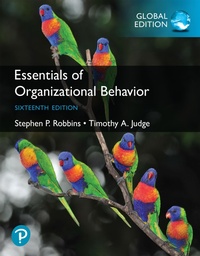
Essentials of Organizational Behavior, Global Edition
16th Edition
Published on 4. August 2025
1570 pages
978-1-292-48766-3 (ISBN)
Description

Essentials of Organizational Behavior provides the basic core of knowledge in organizational behavior (OB). With complete yet concise coverage, it focuses on translating theory and research into actionable practice. In use at hundreds of colleges and universities worldwide, the text uses relatable scenarios and a conversational style to make lessons engaging, relevant and easy to absorb.
The 16th Edition features up-to-date research, discussion and examples of current issues related to all aspects of organizational behavior, including AI, diversity, communication and remote work. This edition also includes new coverage of stress and health in organizations, as well as organizational change.
The 16th Edition features up-to-date research, discussion and examples of current issues related to all aspects of organizational behavior, including AI, diversity, communication and remote work. This edition also includes new coverage of stress and health in organizations, as well as organizational change.
More details
Edition
16th edition
Language
English
Place of publication
Harlow
United Kingdom
Target group
College/higher education
File size
9,49 MB
ISBN-13
978-1-292-48766-3 (9781292487663)
Copyright in bibliographic data and cover images is held by Nielsen Book Services Limited or by the publishers or by their respective licensors: all rights reserved.
Schweitzer Classification
Other editions
Additional editions
Stephen Robbins | Stephen P. Robbins | Timothy A. Judge
Essentials of Organizational Behavior, Global Edition
Book
09/2025
16th Edition
Pearson Education Limited
€78.99
Available immediately
Persons
About our authors Stephen P. Robbins received his PhD from the University of Arizona. He previously worked for the Shell Oil Company and Reynolds Metals Company and has taught at the University of Nebraska at Omaha, Concordia University in Montreal, the University of Baltimore, Southern Illinois University at Edwardsville and San Diego State University. He is currently professor emeritus in management at San Diego State.
Dr. Robbins's research interests have focused on conflict, power and politics in organizations, behavioral decision-making and the development of effective interpersonal skills. His articles on these and other topics have appeared in such journals as Business Horizons, the California Management Review, Business and Economic Perspectives, International Management, Management Review, Canadian Personnel and Industrial Relations and The Journal of Management Education.
Dr. Robbins is the world's best-selling textbook author in the areas of management and organizational behavior. His books have sold more than 14 million copies and have been translated into 20 languages. His books are currently used at more than 1,500 US colleges and universities, as well as hundreds of schools throughout Canada, Latin America, Australia, New Zealand, Asia, Europe and the Arab World.
Dr. Robbins also participates in masters' track competition. Since turning 50 in 1993, he's won 23 national sprint championships and 14 world sprint titles. He was inducted into the U.S. Masters Track & Field Hall of Fame in 2005.
Timothy A. Judge is the Joseph A. Alutto Chair in Leadership Effectiveness in the Fisher College of Business, The Ohio State University. In the past, Dr. Judge has been a Fellow of the Cambridge Judge Business School, University of Cambridge, and Visiting Professor, Division of Psychology & Language Sciences, University College London. He has held academic positions at the University of Notre Dame, University of Florida, University of Iowa, Cornell University and Charles University in the Czech Republic.
Dr. Judge's primary research interests are in (1) personality, moods, and emotions; (2) job attitudes; (3) leadership; and (4) careers. Dr. Judge has published more than 155 articles in these and other major topics in refereed journals. He is a fellow of several professional societies, including the American Psychological Association, the Academy of Management and the International Association of Applied Psychology.
Among the many professional acknowledgments of his work, Dr. Judge has received the Heneman Career Achievement Award, the Mahoney Doctoral Mentoring Award and the Scholarly Achievement Award, all from the Human Resources Division of the Academy of Management. In addition, a 2017 study identified him as the most cited out of more than 8,000 scholars in applied psychology. Dr. Judge is a co-author of Organizational Behavior with Stephen P. Robbins and Staffing Organizations with John Kammeyer-Mueller.
Judge's primary non-work passion revolves around rock climbing and mountaineering. He has climbed the three highest peaks in the United Kingdom and nearly half of the highest peaks in the lower 48 states. He and his wife, Jill, are the parents of three children.
Dr. Robbins's research interests have focused on conflict, power and politics in organizations, behavioral decision-making and the development of effective interpersonal skills. His articles on these and other topics have appeared in such journals as Business Horizons, the California Management Review, Business and Economic Perspectives, International Management, Management Review, Canadian Personnel and Industrial Relations and The Journal of Management Education.
Dr. Robbins is the world's best-selling textbook author in the areas of management and organizational behavior. His books have sold more than 14 million copies and have been translated into 20 languages. His books are currently used at more than 1,500 US colleges and universities, as well as hundreds of schools throughout Canada, Latin America, Australia, New Zealand, Asia, Europe and the Arab World.
Dr. Robbins also participates in masters' track competition. Since turning 50 in 1993, he's won 23 national sprint championships and 14 world sprint titles. He was inducted into the U.S. Masters Track & Field Hall of Fame in 2005.
Timothy A. Judge is the Joseph A. Alutto Chair in Leadership Effectiveness in the Fisher College of Business, The Ohio State University. In the past, Dr. Judge has been a Fellow of the Cambridge Judge Business School, University of Cambridge, and Visiting Professor, Division of Psychology & Language Sciences, University College London. He has held academic positions at the University of Notre Dame, University of Florida, University of Iowa, Cornell University and Charles University in the Czech Republic.
Dr. Judge's primary research interests are in (1) personality, moods, and emotions; (2) job attitudes; (3) leadership; and (4) careers. Dr. Judge has published more than 155 articles in these and other major topics in refereed journals. He is a fellow of several professional societies, including the American Psychological Association, the Academy of Management and the International Association of Applied Psychology.
Among the many professional acknowledgments of his work, Dr. Judge has received the Heneman Career Achievement Award, the Mahoney Doctoral Mentoring Award and the Scholarly Achievement Award, all from the Human Resources Division of the Academy of Management. In addition, a 2017 study identified him as the most cited out of more than 8,000 scholars in applied psychology. Dr. Judge is a co-author of Organizational Behavior with Stephen P. Robbins and Staffing Organizations with John Kammeyer-Mueller.
Judge's primary non-work passion revolves around rock climbing and mountaineering. He has climbed the three highest peaks in the United Kingdom and nearly half of the highest peaks in the lower 48 states. He and his wife, Jill, are the parents of three children.
Content
PART 1: UNDERSTANDING YOURSELF AND OTHERS
What Is Organizational Behavior?
Diversity and Inclusion in Organizations
Job Attitudes
Emotions and Moods
Personality and Individual Differences
PART 2: MAKING AND IMPLEMENTING DECISIONS
Perception and Individual Decision Making
Motivation Concepts
Motivation: From Concepts to Applications
PART 3: COMMUNICATING IN GROUPS AND TEAMS
Foundations of Group Behavior
Understanding Work Teams
Communication
PART 4: NEGOTIATING POWER AND POLITICS
Leadership
Power and Politics
Conflict and Negotiation
PART 5: LEADING, UNDERSTANDING, AND TRANSFORMING THE ORGANIZATION SYSTEM
Foundations of Organization Structure
Organizational Culture and Change
Stress and Health in Organizations
What Is Organizational Behavior?
Diversity and Inclusion in Organizations
Job Attitudes
Emotions and Moods
Personality and Individual Differences
PART 2: MAKING AND IMPLEMENTING DECISIONS
Perception and Individual Decision Making
Motivation Concepts
Motivation: From Concepts to Applications
PART 3: COMMUNICATING IN GROUPS AND TEAMS
Foundations of Group Behavior
Understanding Work Teams
Communication
PART 4: NEGOTIATING POWER AND POLITICS
Leadership
Power and Politics
Conflict and Negotiation
PART 5: LEADING, UNDERSTANDING, AND TRANSFORMING THE ORGANIZATION SYSTEM
Foundations of Organization Structure
Organizational Culture and Change
Stress and Health in Organizations
