

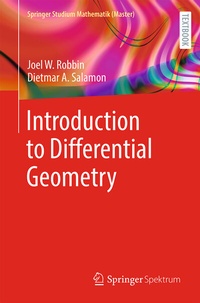
Introduction to Differential Geometry
Description

The first chapters give a historical overview of the field and contain an introduction to basic concepts such as manifolds and smooth maps, vector fields and flows, and Lie groups, leading up to the theorem of Frobenius. Subsequent chapters deal with the Levi-Civita connection, geodesics, the Riemann curvature tensor, a proof of the Cartan-Ambrose-Hicks theorem, as well as applications to flat spaces, symmetric spaces, and constant curvature manifolds. Also included are sections about manifolds with nonpositive sectional curvature, the Ricci tensor, the scalar curvature, and the Weyl tensor.
An additional chapter goes beyond the scope of a one semester lecture course and deals with subjects such as conjugate points and the Morse index, the injectivity radius, the group of isometries and the Myers-Steenrod theorem, and Donaldson's differential geometric approach to Lie algebra theory.
Reviews / Votes
"As the series title suggests, this is a graduate level introduction to differential geometry . . The book is also thorough, providing background material, results and proofs as well as a steady development of the main material. . as an advanced introduction or second pass, as a reference resource, and as a prelude to further more abstract study, this is a fine addition to the differential geometry literature." (Peter Giblin, The Mathematical Gazette, Vol. 108 (573), November, 2024)
More details
Other editions
Additional editions
Persons
Joel Robbin began his research in mathematical logic (and wrote a text book on this subject) and later moved on to dynamical systems and symplectic topology. In 1970 he proved a conjecture by Stephen Smale which asserts that Axiom A implies structural stability. His publications include a book on "Matrix Algebra" and joint book with Ralph Abraham on "Transversal Mappings and Flows".
He is a Fellow of the American Mathematical Society.
Dietmar Salamon was born in Bremen in 1953 and completed his PhD at the University of Bremen in 1982 under the direction of Diederich Hinrichsen. After postdoctoral positions in Madison and Zurich, hetook up a position at the University Warwick in 1986, and moved to ETH Zurich in 1998, where he has been emeritus since 2018. His field of research is symplectic topology and related subjects.
He was an invited speaker at the ECM 1992 in Paris, at the ICM 1994 in Zurich, and at the ECM 2000 in Barcelona. He delivered the Andrejewski Lectures in Goettingen (1998) and at the Humboldt Unversity Berlin (2005), and the Xth Lisbon Summer Lectures in Geometry (2009).
He is the author of several textbooks and research momgraphs including two joint books with Dusa McDuff entitled "Introduction to Sympectic Topology" and "J-holomorphic Curves and Symplectic Topology" for which they were jointly awarded the 2017 Leroy P Steele Prize for Mathematical Exposition. He is a Fellow of the American Mathematical Society and a member of the Academia Europaea.
