

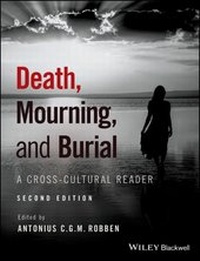
Death, Mourning, and Burial
Description

Reviews / Votes
"Robben has produced an outstanding collection of classic and contemporary essays on death and mourning. The carefully balanced selection and lucid introduction make this a superb teaching text." Michael Lambek, University of Toronto Scarborough, Canada "This impressive combination of classic and very recent studies of how humans respond to death demonstrates anthropology's vibrant contribution to this field." Tony Walter, University of Bath, UMore details
Other editions
Additional editions
Person
Content
Death and Anthropology: An Introduction
Antonius C. G. M. Robben
Every autumn, men and women in the United Kingdom wear red paper poppies to commemorate the British troops who died in World War I and later armed conflicts. Adopted in 1921, the modest symbol was inspired by the first two lines of a poem written in 1915 by John McCrea, a medical officer of the Canadian Expeditionary Force: "In Flanders fields the poppies blow/Between the crosses, row on row" (McCrae 1919). The poppy was only one of many reminders in the decade after the carnage of the Great War. More than nine hundred British military cemeteries dotted the landscapes of Belgium and France in 1918 (Hurst 1929). A Tomb of the Unknown Warrior was placed in Westminster Abbey in 1920 to honor unidentified soldiers. There were hundreds of thousands of psychiatric casualties, and many families continued to mourn their dead loved ones. Spirit photographs were taken on Remembrance Day in 1922 that showed the ghosts of fallen soldiers, and artists grappled in the interwar years with the sense of it all (Eksteins 1989; Mosse 1990; Winter 1995).
In 2014, a remarkable bed of red poppies sprouted at the foot of the Tower of London. Two artists had created the installation Blood Swept Lands and Seas of Red to mark the one-hundredth anniversary of the British entry into World War I. The field of 888,246 hand-made ceramic poppies represented the number of British fatalities.1 I visited the display on a Saturday afternoon in October 2014, and saw thousands of people lining the ramparts that surround the grounds. I struck up a conversation with a middle-aged couple from Cheshire. They had made the journey to London to see the open-air installation, and pay tribute to the relatives who had sacrificed their lives in the Great War. The woman's grandfather had served as a young paramedic. He survived the war but never recovered from the mental shocks received across the Channel. Even though there was no one left in 2014 with a living memory of fighting the war, still nearly 4 million people came from all over Great Britain to see the display.2 The annual commemorations, the works of art, and the personal mementos gave the century-old dead a presence in people's consciousness which meant deceased relatives and compatriots continued to be remembered.
One of the casualties of World War I was the French anthropologist Robert Hertz. He was stationed near Verdun and died on April 13, 1915, after volunteering for an offensive mission towards Marchéville-en-Woëvre across open terrain defended by German machine guns (Parkin 1996: 13). Hertz (1905-6) had written what has become the single most influential text in the anthropology of death, of which large portions are reproduced in this anthology. The elaborate death rituals of the Dayak in Kalimantan, Indonesia, may seem far removed from the hasty burial of massive numbers of dead in World War I and the collective prayers said for their souls at public war funerals (Capdevila and Voldman 2006). Yet, the two mortuary practices share a general concern for carrying out society's social and moral obligations to the dead, and show analogies in the representation and destiny of the lamented souls. Hertz writes that the soul's departure for the land of the dead after reburial is not necessarily permanent: "In certain Indonesian societies the appeased souls are actually worshipped, and they then settle near the domestic hearth in some consecrated object or in a statuette of the deceased which they animate: their presence, duly honoured, guarantees the prosperity of the living" (see Chapter 1). Are the paper and ceramic poppies not also imbued with the souls and memories of the dead, and does the playing of the "Last Post" in the Belgian town of Ypres - every day since 1928 - not only pay homage to the dead but remind us also of the tolls of war and the value of peace?
The anthropology of death has been struggling with the cultural diversity and structural similarity of mortuary rituals since the discipline's early days. Anthropologists and sociologists around the turn of the nineteenth century, such as Tylor (1930), Durkheim (1995), Hertz (1960), and Van Gennep (1960), compared funerary rituals and death cultures through their overarching evolutionary, functionalist, and structuralist approaches. This period ended when anthropologists like Malinowski (1954), Radcliffe-Brown (1933), Goody (1962), and Evans-Pritchard (1968) began to conduct long-term fieldwork. They revealed the varying collective responses to death, and showed that the Western understandings and scholarly interpretations of death and ritual differed significantly from those of other cultures. The analytical pendulum swung back towards more comparative approaches during the 1970s and 1980s in such works as Rosenblatt, Walsh, and Jackson (1976), Huntington and Metcalf (1979), Bloch and Parry (1982), and Palgi and Abramovitch (1984). At the same time, anthropologists continued to conduct ethnographic fieldwork but their studies differed from the earlier ethnographies because of the influence of postmodern, reflexive and deconstructive approaches in American anthropology. Without trying to be exhaustive, the most important monographs are Badone (1989), Cátedra (1992), Clark-Decès (2005), Conklin (2001), Danforth (1982), Desjarlais (2003), Green (2008), Hinton (2005), Hockey (1990), Kan (1989), Klima (2002), Kwon (2006), Lock (2002), Nelson (2008), Parry (1994), Robben (2005), Rosaldo (1980), Sanford (2003), Scheper-Hughes (1992), Seremetakis (1991), Suzuki (2000), Verdery (1999), Vitebsky (1993), and Whitehead (2002). This rich ethnographic harvest from the 1990s and 2000s has been spurring renewed efforts to formulate more general models and comparative approaches to the study of death, as will be shown in Part I of this volume.
This cross-cultural reader combines foundational texts in the anthropology of death with enduring texts from the 1970s to the 1990s and recent works from the 2000s and 2010s. The latter texts have been selected because of their innovative contribution to the field by benefiting from insights developed in medical anthropology, the anthropology of violence and trauma, and memory studies. The Reader's first edition was organized along a trajectory from dying to afterlife (Robben 2004). This new edition pays closer attention to fields of interest in the anthropology of death that have the promise of opening future lines of research.
Conceptualizations of Death
At the turn of the nineteenth century, anthropologists were looking for universal features in the diverse cultural responses to death, particularly in funerary rituals and expressions of mourning. Later generations became absorbed in the mortuary practices themselves through meticulous ethnographies and sophisticated interpretations without trying to formulate the type of generalizing statements of their predecessors. Conceptualizing death, grief, and mourning was so daunting in the face of the tremendous variation of funerary rituals that anthropologists shied away from general models and frameworks, with only few exceptions in the 1970s and 1980s as was mentioned above. In the early 1970s, Johannes Fabian (2004) bemoaned anthropology's parochialization, folklorization, and exoticization of death. An obsessive concern for cultural variation, the folkloric isolation of death as a self-contained experience, and a fascination with exotic mortuary practices inhibited the formulation of generalizations that transcended local peculiarities. This situation did not change in the following decades, but the need for general concepts and models was nevertheless felt as the ethnographies of death multiplied. In search of theoretical inspiration, anthropologists harked back to the work of Hertz and Van Gennep, often refreshing their models but only seldom engaging them critically. Some anthropologists, however, attempted to develop new concepts, models, and comparative frameworks. This section includes five comparative studies in the anthropology of death, namely two key articles by Hertz and Van Gennep from the 1900s, a text by Lifton and Olson from the 1970s, and two recent examples of comparative approaches by Hallam and Hockey, and Robben from the 2000s and 2010s.
The chapter by Robert Hertz, "A Contribution to the Study of the Collective Representation of Death," was published originally in 1905-6, and endures as a key text in the anthropology of death because of its comparative appeal. Hertz argued forcefully that the death of a human being is not exclusively a biological reality or confined to the individual sorrow of the bereaved relatives, but that death evokes moral and social obligations expressed in culturally determined funeral practices. Although Hertz restricts his analysis largely to the mortuary practices of South Asian tribal societies, he reveals a structure of great cross-cultural significance. In the excerpts included in this Reader, Hertz isolates the key elements in the secondary burials among the Dayak of Kalimantan, Indonesia. He points out that the inert body, the deceased's soul, and the surviving relatives play changing roles during the time between death and secondary burial; a time that he subdivides into two periods. First, there is the intermediary period during which (a) the inert body is temporarily stored or buried, (b) the soul of the deceased remains near the corpse, and (c) the bereaved relatives are separated from society and enter into mourning. Clearly, death does not occur...
