

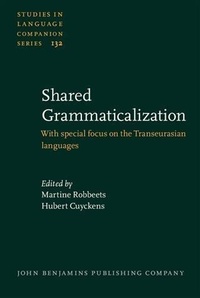
Shared Grammaticalization
With special focus on the Transeurasian languages
1st Edition
Published on 28. February 2013
XV, 360 pages
978-90-272-7214-0 (ISBN)
Description

This book offers fresh perspectives on "shared grammaticalization", a state whereby two or more languages have the source and the target of a grammaticalization process in common. While contact-induced grammaticalization has generated great interest in recent years, far less attention has been paid to other factors that may give rise to shared grammaticalization. This book intends to put this situation right by approaching shared grammaticalization from an integrated perspective, including areal as well as genealogical and universal motivations and by searching for ways to distinguish between these factors. The volume offers a wealth of empirical facts, presented by internationally renowned specialists, on the Transeurasian languages (i.e. Japonic, Koreanic, Tungusic, Mongolic, and Turkic) - the languages in focus -as well as on various other languages. Shared Grammaticalization will appeal to scholars and advanced students concerned with linguistic reconstruction, language contact and linguistic typology, and to anyone interested in grammaticalization theory.
More details
Other editions
Additional editions
Martine Robbeets | Hubert Cuyckens
Shared Grammaticalization
With special focus on the Transeurasian languages
Book
02/2013
John Benjamins Publishing Co
€104.94
Shipment within 10-15 days
Persons
Content
- Shared Grammaticalization
- Editorial page
- Title page
- LCC data
- Table of contents
- List of tables
- List of figures
- List of contributors
- Acknowledgements
- Towards a typology of shared grammaticalization
- 1. Introduction
- 2. Shared grammaticalization resulting from universal principles of grammatical change
- 3. Shared grammaticalization through language contact
- 4. Shared grammaticalization through language contact reinforced by coincidence in form (coincidence with contact)
- 5. Shared grammaticalization through common ancestorship
- 5.1 Inherited grammaticalization
- 5.2 Parallelism in drift
- 6. Organization of the volume
- References
- Shared grammaticalization: Typological and theoretical aspects
- Areal diffusion and parallelism in drift
- 1. The problem: Why and how can languages develop along similar pathways?
- 2. Grammaticalization in the Middle Sepik area of Papua New Guinea
- 2.1 Grammaticalization and language contact: Kwoma impact on Manambu
- 2.2 Grammaticalization and parallel development
- 2.3 Interim conclusion
- 3. Grammaticalization in northwest Amazonia
- 3.1 The Wapuí subgroup within the North Arawak languages
- 3.2 Tariana: The odd one out?
- 3.3 Grammaticalization and the impact of language contact on Tariana
- 3.4 Parallel development: Reinforcing similarities
- 4. Shared grammaticalization patterns: Conclusions and challenges
- Abbreviations
- References
- Demystifying drift
- 1. Introduction: A recurring problem in historical linguistics
- 2. Drift as a solution
- 3. Demystifying drift
- 4. Variation versus traditional reconstruction methodology
- 5. Case studies
- 5.1 Germanic fricative voicing
- 5.2 Indo-Iranian final -s developments
- 5.3 Indo-Iranian vowel length
- 5.4 Some morphological cases from Indo-Iranian
- 6. Conclusion
- References
- Contact-induced replication
- 1. Introduction
- 2. Grammatical replication
- 3. Diagnostics for identifying grammatical replication
- 4. Diagnostics for identifying contact-induced grammaticalization
- 5. Diagnostics for determining the direction of transfer
- 6. Conclusions
- Abbreviations
- References
- Isomorphic processes
- 1. Isomorphism
- 2. Grammaticalization
- 3. Code-Copying
- 4. Combined schemes
- 5. Lexical and grammatical Targets of Copying
- 6. Copying grammaticalization processes
- 7. Awareness of sources
- 8. Life after copying
- 9. "Inherited grammaticalization"
- 10. Summing up
- References
- Shared grammaticalization in the Transeurasian languages
- Scalar additive operators in Transeurasian languages
- 1. Introduction
- 2. The semantics of scalar additive operators
- 3. A distributional typology of scalar additive operators
- 3.1 Major types of scalar additive operators
- 3.2 General additive operators
- 4. Patterns of polysemy in European languages
- 5. General additive operators in Transeurasian languages
- 5.1 Polarity properties
- 5.2 A glance at contact languages and the question of shared grammaticalization
- 6. Bimorphemic scalar additive operators in Transeurasian languages
- 6.1 Structural types of bimorphemic operators
- 6.2 Polarity properties of bimorphemic operators
- 7. Monomorphemic scalar additive operators
- 8. Some typological implications
- 8.1 General additive operators
- 8.2 Patterns of polysemy and context classifications
- Abbreviations
- References
- Verbalization and insubordination in Siberian languages*
- 1. Introducing insubordination
- 2. Scenarios of insubordination
- 2.1 Shared grammaticalization through universal principles: Selective
- 2.2 Shared grammaticalization through contact: Selective
- 2.3 Shared grammaticalization through contact reinforced by coincidence: Selective
- 2.4 Inherited polysemy: Global
- 2.5 Sapirian drift: Global or selective
- 3. The noun-verb continuum in Tungusic
- 3.1 Clines of nominalization in Even
- 3.2 Diachronic and areal dimensions of the noun-verb continuum in Tungusic
- 3.3 The globally shared grammaticalization concerns two or more instances
- 3.4 The globally shared grammaticalization is not restricted to contact zones
- 3.5 The globally shared grammaticalization involves the development of a less grammaticalized to a more grammaticalized bound morpheme
- 3.6 The globally shared grammaticalization spreads over more than two (proto-) languages
- 3.7 A specific pathway of grammaticalization is recurrent in more than one cognate set
- 4. Verbalization and insubordination in Paleosiberian languages
- 4.1 Chukchi
- 4.2 Yukaghir
- 4.3 Ket
- 4.4 Eskimo
- 4.5 Nivkh
- 5. Conclusions
- Abbreviations
- References
- Shared grammaticalization in the Altaic languages
- Personal pronouns in Core Altaic*
- 1. Introduction
- 2. General aspects of the M-T system
- 3. Mongolic 1SG *bi vs. 2SG *ci & *ti vs. 3SG *i
- 4. Tungusic 1SG *bi vs. 2SG *si ~ *ti vs. 3SG *i
- 5. Turkic 1SG *bi vs. 2SG *si vs. ?3SG *i-
- 6. Explaining the Core Altaic pronouns
- 7. Direct borrowing vs. shared drift
- Abbreviations
- References
- Postposed indefinite articles in Mongolic and Turkic languages of the Qinghai-Gansu Sprachbund
- 1. Introduction
- 2. Origin and morphological status
- 3. Functions
- 4. The use of the indefinite article with various case endings
- 4.1 Nouns with unmarked case
- 4.2 Indefinite article with case endings
- 4.3 Indefinite article followed by the accusative
- 5. The indefinite article on special nominal categories
- 5.1 Adjectives
- 5.2 Participles
- 6. The indefinite article followed by numerals/quantifiers
- 7. The indefinite article and the possessive
- 8. Approximate quantification
- 9. Homophonous modal adverb
- 10. Use in narratives
- 11. Conclusion
- Abbreviations
- Nonstandard symbols
- References
- Appendix
- Growing apart in shared grammaticalization
- 1. Introduction: Morphological isomorphism in Turkic
- 2. Turkic indirectives
- 2.1 The definition of indirectivity
- 2.2 Source of grammaticalization
- 2.3 Grammaticalization paths
- 3. Cyclicity of grammaticalization of indirectives
- 3.1 Indirectives in historical perspectives
- 3.2 Growing apart: Renewal of the focal postterminals
- 4. The indirective copula
- 5. The role of contact between the cognates
- 6. The loss of the category
- 7. Conclusions
- References
- Incipient grammaticalization of a redundant purpose clause marker in Lamunxin Even
- 1. Introduction
- 2. Purpose clauses in Even and Sakha
- 3. SAY.cvb-marked purpose clauses as a contact-induced feature?
- 4. Some problems with the contact scenario
- 4.1 Range of contexts in which the construction is used
- 4.2 Crosslinguistic frequency of SAY to mark purpose
- 4.3 Eastern Evenki purpose clauses in comparison to Lamunxin Even
- 5. Purposive constructions in Sakha revisited
- 6. Discussion
- Abbreviations
- References
- Shared grammaticalization in Japanese and Korean
- Grammaticalization of space in Korean and Japanese
- 1. Introduction
- 2. Particles in the noun phrase
- 2.1 Japanese
- 2.2 Korean
- 2.3 Short comparison
- 3. Relational nouns
- 3.1 Relational nouns in Japanese
- 3.2 Relational nouns in Korean
- 3.3 Short comparison
- 4. Postpositional verbs
- 4.1 Postpositional verbs in Japanese
- 4.2 Postpositional verbs in Korean
- 4.3 Short comparison
- 5. Demonstratives
- 5.1 Japanese demonstratives
- 5.2 Korean demonstratives
- 5.3 Short comparison
- 6. Summary
- Abbreviations
- References
- Grammaticalization of allocutivity markers in Japanese and Korean in a crosslinguistic perspective*
- 1. Allocutivity and its sources
- 2. Allocutivity in Japanese
- 2.1 In synchrony
- 2.2 In diachrony
- 3. Allocutivity in Korean
- 3.1 In synchrony
- 3.2 In diachrony
- 3.2.4 In Early Modern Korean
- 3.2.5 Evolution of allocutive markers in Korean
- 4. Japanese -(i)mas- & Korean -(su)pni-: A case of shared grammaticalization?
- 4.1 Typology of allocutive systems in diachrony
- 4.2 Grammaticalization path for Japanese -(i)mas- and Korean -(su)pni-
- Abbreviations
- References
- A possible grammaticalization in Old Japanese and its implications for the comparison of Korean and Japanese
- 1. Introduction
- 2. Japanese and Korean necessitives
- 3. Old Japanese be- as a grammaticalization
- 4. Diachronic implications of the theory
- 5. Concluding thoughts
- Abbreviations
- References
- Language index
- Subject index
