

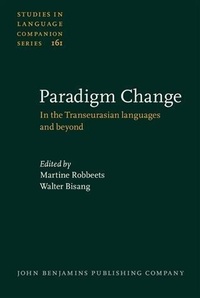
Paradigm Change
In the Transeurasian languages and beyond
1st Edition
Published on 8. October 2014
XIX, 345 pages
978-90-272-6973-7 (ISBN)
Description

This book is concerned with comparing morphological paradigms between languages in order to establish areal and genealogical relationships. The languages in focus are the Transeurasian languages: Japanese, Korean, Tungusic, Mongolic, and Turkic languages. World-eminent experts in diachronic morphology and typology interact with specialists on Transeurasian languages, presenting innovative theoretical analyses and new empirical facts. The stress on the importance of paradigmatic morphology in historical linguistics contrasts sharply with the paucity of existing literature on the topic. This volume partially fills this gap, by shifting focus from Indo-European to other language families. "Paradigm change" will appeal to scholars and advanced students concerned with linguistic reconstruction, language contact, morphology and typology, and to anyone interested in the Transeurasian languages.
More details
Other editions
Additional editions
Book
10/2014
John Benjamins Publishing Co
€104.94
Shipment within 10-15 days
Persons
Content
- Paradigm Change
- Editorial page
- Title page
- LCC data
- Table of contents
- List of tables
- List of figures
- List of contributors
- Acknowledgements
- Chapter 1. When paradigms change
- 1. Changing research paradigms
- 1.1 Paradigm change in Transeurasian linguistics
- 1.2 Paradigm change in comparative historical morphology
- 2. Change in morphological paradigms
- 2.1 Definitions
- 2.2 Changes in paradigms and their stability
- 3. The organization of this volume
- References
- Part I. Paradigm change
- Chapter 2. On the strength of morphological paradigms
- 1. Introduction - the basic idea of this paper
- 2. Radical pro-drop - a comparison of West Africa and East and mainland Southeast Asia
- 2.1 West African languages
- 2.2 East and mainland Southeast Asian languages
- 3. Radical pro-drop and morphology from a theoretical perspective
- 4. Radical pro-drop and the strength of morphological paradigms
- 4.1 On frequency and the diffusion of language change
- 4.2 Inflectional paradigms in Niger-Congo and the absence of radical pro-drop
- 4.3 East and mainland Southeast Asian languages and the lack of morphological paradigms
- 4.4 Factors that prevent the development of morphological paradigms at later stages
- 5. Conclusion
- Abbreviations
- References
- Chapter 3. Derivational paradigms in diachrony and comparison
- 1. Introduction
- 2. Wordlists and language sample
- 3. The causative alternation: Subgrouping
- 4. Posture verbs: Subgrouping
- 5. External comparison
- 5.1 Theoretical issues
- 5.2 A combined grammatical tree
- 5.3 Derivational type and lexical stability
- 6. Conclusions
- References
- Chapter 4. On arguing from diachrony for paradigms
- 1. Introduction
- 2. What is a paradigm?
- 3. Some non-evidence from language change
- 4. Positive evidence for paradigms from analogical change
- 5. An extended sense of 'Paradigm' and its value here
- 6. Conclusion - A cautionary note with further positive indications for the paradigm
- Abbreviations
- References
- Chapter 5. Reconstructing the Niger-Congo Verb Extension Paradigm
- 1. Introduction
- 2. Niger-Congo verb extensions
- 3. Verb extensions in Afro-Asiatic, Nilo-Saharan and "Khoisan"
- 4. Renewed and borrowed extensions
- 5. Extension stacking
- 6. Verb extensions in Bantoid
- 7. Summary and conclusion
- Abbreviations
- Languages
- Linguistic forms
- References
- Appendix: Table of Verb Extensions in Bantoid
- Part II. The continuation of paradigms
- Chapter 6. Perceived formal and functional equivalence
- 1. Indirect insertion of West Old Turkic verb stems in Late Ancient Hungarian
- 2. Hungarian verbal conjugational paradigms
- 3. The cuckoo's nest: The ik-conjugation
- 4. Copied Turkic verbs in the ik-conjugation (Róna-Tas & Berta 2011)
- 5. The Turkic deverbal suffixes -(V)g and -(V)k
- 6. The Hungarian reflexive verbs
- 7. Carry over
- Abbreviation
- References
- Chapter 7. Comparative consequences of the tongue root harmony analysis for proto-Tungusic, proto-Mongolic, and proto-Korean
- 1. Introduction
- 2. The argument for reconstructing [RTR] harmony in KMT
- 2.1 Vowel harmony in languages deemed Altaic
- 2.2 Basic vowel correspondences in Tungusic, Mongolic, and Korean
- 2.3 PH to- RTRH Shifts in Mongolic and Korean?
- 2.4 Reconstructing a harmonic contrast for proto-Altaic
- 3. A non-argument for secondary [RTR] harmony in proto-Tungusic
- 3.1 Starostin et al. (2003: 156-163)
- 3.2 Starostin et al.'s hypothesized stem-internal co-occurrence constraints
- 3.3 Failures of the stipulations
- 3.4 Superficially successful predictions of "front" ([NonRTR]) vocalism
- 3.5 The Distribution of Starostin et al.'s proto-Tungusic *ü
- 4. [RTR] harmony as an inherited feature
- 5. [RTR] harmony as an areal feature
- 5.1 RTR/height harmony in NE Asia outside KTM
- 5.2 The behavior of TRH in contact
- 5.3 Reconciling the Korean vowels
- 6. Conclusions
- Abbreviations
- References
- Chapter 8. Old Japanese bigrade paradigms and Korean passives and causatives
- 1. Introduction
- 2. Internal reconstruction
- 2.1 Whitman's theory
- 2.2 Frellesvig's theory
- 2.3 Monosyllabic roots
- 3. Bigrade verbs as early passives and inchoatives
- 3.1 Causatives and -s-
- 3.2 LB monosyllables other than e- 'get, be able'
- 4. Implications for proto-Korean-Japanese and Transeurasian
- Abbreviations
- Languages
- Verb paradigms
- Other
- Terminology
- References
- Chapter 9. The Japanese inflectional paradigm in a Transeurasian perspective
- 1. Introduction
- 2. The importance of paradigms in establishing relatedness
- 2.1 Paradigm and paradigmaticity
- 2.2 Inherited paradigms
- 2.3 Copied paradigms
- 2.4 Coincidentally matching paradigms
- 3. The basic inflectional paradigm of Japanese verbs in a comparative perspective
- 3.1 The copula pTEA *a- as the origin of the mizenkei or surface-stem
- 3.2 The nominalizer pTEA *-rA as the origin of the rentaikei (adnominal form)
- 3.3 The substantivized adnominal pTEA *-rA-i as the origin of the izenkei (subjunctive form)
- 3.4 The nominalizer pTEA *-mA as the origin of the shushikei (finite indicative form)
- 3.5 The nominalizer pTEA *-i ~ ø as the origin of the renyokei (conjunctive form)
- 3.6 The Transeurasian zero imperative as the origin of the meireikei (imperative form)
- 4. Paradigmaticity of the evidence
- 4.1 Is the evidence paradigmatic?
- 4.2 Are the paradigms copied?
- 5. Conclusion
- Abbreviations
- Linguistic forms
- Languages
- Primary sources
- References
- Part III. The innovation of paradigms
- Chapter 10. A Yakut copy of a Tungusic viewpoint aspect paradigm
- 1. Introduction
- 2. Two imperfect paradigms
- 3. Viewpoint aspect categories
- 4. Intraterminals
- 5. Past intraterminals
- 6. Explanations
- 7. Possible carry-over influence
- 8. Reasons for copying
- Abbreviations
- References
- Chapter 11. Amdo Altaic directives and comparatives based on the verb 'to see'
- 1. Introduction
- 2. Inherited case inventories
- 3. New markers based on the verb 'to see'
- 3.1 Convergence of the new Monguor markers: -?´i and -?´i?´i
- 3.2 Allatives/directives based on the verb 'to see'
- 3.3 Comparatives based on the verb 'to see'
- 4. Conclusion
- Abbreviations
- Nonstandard symbols
- References
- Chapter 12. Innovations and archaisms in Siberian Turkic spatial case paradigms
- 1. Introductory remarks
- 2. Siberian Turkic case paradigms: An overview
- 3. Case studies: Static Dative
- 3.1 The Locative case
- 3.2 The Dative case
- 3.3 The "static" Dative in Tuvan
- 3.4 The "static" Dative in Shor
- 3.5 The "static" Dative in Tofa
- 3.6 The "static" Dative in Altay
- 3.7 Discussion of the "static Dative" data
- 4. Siberian Turkic new and old Directives
- 4.1 The Directive case in Old Turkic
- 4.2 The Directive case in modern languages
- 4.3 Directive postpositions in Altay
- 4.4 Directive meaning in Tuvan
- 4.5 Comparative analysis
- 5. Case studies: New and old Prolatives
- 5.1 The Equative-Prolative case marker
- 5.2 Other expressions for the space one moves through
- 5.3 Prolative semantics of the Instrumental case
- 6. Locative and Ablative to Partitive in Siberian Turkic
- 6.1 The Yakut Partitive case marker -DA
- 6.2 Partitive semantics in other South Siberian languages
- 6.3 Innovation or preservation?
- 6.4 Partitive location
- 7. Dative to Locative in Yakut
- 8. Discussion and conclusions
- Abbreviations
- References
- Chapter 13. Paradigm copying in Tungusic
- 1. Introduction
- 2. Known paradigm copies: Ucur Evenki and Lamunkhin Even
- 3. Factors facilitating paradigm copying: a survey of Evenki and Even dialects
- 3.1 Degree of contact: Presence of lexical copies
- 3.2 Degree of contact: Intermarriage
- 3.3 Structural congruence between lects in contact
- 4. Sakha TAM morphology and its role in paradigm copying
- 5. Conclusions
- Abbreviations
- References
- Chapter 14. Ural-Altaic
- 1. Conceptualizing Ural-Altaic
- 2. Verifying linguistic relationships
- 3. Nominal morphology in Ural-Altaic typology
- 4. Factors underlying morphological similarities
- 5. Parallels in Ural-Altaic nominal morphology
- 5.1 Plural *T
- 5.2 Plural *s
- 5.3 Genitive *n
- 5.4 Accusative *i and *g
- 5.5 Accusative *BV
- 5.6 Locative *TV
- 5.7 Locative *nV
- 5.8 Dative *k(V) and *A
- 5.9 Nominative *Ka
- 5.10 Nominative *ki
- 6. General conclusions concerning Ural-Altaic
- A note on the sources
- Abbreviations
- References
- Language index
- Subject index
