

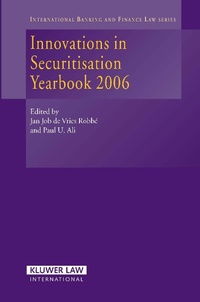
Innovations in Securitisation Yearbook 2006
Published on 8. September 2006
374 pages
978-90-411-5772-0 (ISBN)
Description

Despite fears that regulators around the world would act to curtail securitisation severely in the aftermath of the collapse of Enron, WorldCom, and Parmalat, the securitisation industry has witnessed what can only be described as relentless innovation. Securisation remains one of the most important means for financial institutions to diversify their funding, transfer credit risk and manage solvency requirements. This volume, the second in a series focusing on the latest innovations in the global securitisation industry, provides advisers with detailed guidance on key structural and legal issues of innovative securitisations, as well as describing the most recent developments in the accounting and risk-capital treatment of securitisation transactions. The contributors represent a wide range of expert participants in the design, execution, and regulation of securitisation transactions.
Among the critical features of contemporary securitisation covered are the following:
project finance CLOs;
securitisation of equity risk;
securitisation of commodity risk through commodity trigger swaps;
the convergence of structured credit and securitisation markets;
innovation in RMBS: negative equity transactions;
innovation in CMBS: A/B structure
new markets in Europe, Japan, and Islamic countries;
catastrophe risk securitisation;
effect of recent US bankruptcy legislation on synthetics;
microfinance loan securitisation in emerging markets;
public sector securitisation;
securitisable intellectual property;
application of accounting standards in a rapidly changing environment, and
updated analysis of Basel II.
The practical perspective of the contributions, combined with the extensive use of case studies of key transactions, should make this volume an invaluable resource for lawyers as well as legal and business academics interested in the very latest developments in the global securitisation markets.
Among the critical features of contemporary securitisation covered are the following:
project finance CLOs;
securitisation of equity risk;
securitisation of commodity risk through commodity trigger swaps;
the convergence of structured credit and securitisation markets;
innovation in RMBS: negative equity transactions;
innovation in CMBS: A/B structure
new markets in Europe, Japan, and Islamic countries;
catastrophe risk securitisation;
effect of recent US bankruptcy legislation on synthetics;
microfinance loan securitisation in emerging markets;
public sector securitisation;
securitisable intellectual property;
application of accounting standards in a rapidly changing environment, and
updated analysis of Basel II.
The practical perspective of the contributions, combined with the extensive use of case studies of key transactions, should make this volume an invaluable resource for lawyers as well as legal and business academics interested in the very latest developments in the global securitisation markets.
More details
Other editions
Additional editions
Book
09/2006
Kluwer Law International
€298.60
Shipment within 10-20 days
Content
- Cover
- Half Title Page
- Editorial Board
- Title Page
- Copyright Page
- Table of Contents
- Foreword
- Preface
- Contributors
- Chapter 1 Securitisation of Project Finance Loans
- 1. INTRODUCTION
- 2. WHAT IS PFI?
- 3. CONSIDERATIONS FOR INVESTORS IN A SYNTHETIC CDO REFERENCING PFI LOANS
- 4. ELIGIBILITY CRITERIA
- 5. SYNTHETIC STRUCTURES
- 5.1. Two Transactions: A Basic Comparison
- 5.2. Transaction Structure
- 5.3. Reference Portfolio
- 5.4. Replenishment
- 5.5. Credit Default Swap
- 5.6. Terms of the Credit-Linked Notes
- 5.7. Re-characterization
- 5.8. Regulatory Capital Considerations
- 6. CONCLUDING REMARKS
- Chapter 2 PFI/PPP Loans are Well-Suited to Portfolio (CDO) Securitisation
- 1. INTRODUCTION
- 2. RECENT DEVELOPMENTS IN FINANCING PROJECT FINANCE CLOs
- 2.1. Structuring Project Finance CLOs: To be True-Sale or not to be True-Sale? This is the Question
- 3. STANDARD & POOR'S PROJECT FINANCE CLOs RATING CRITERIA
- 3.1. Different Credit Profiles
- 3.2. Different Loan Structures
- 3.3. Different Behavioural Characteristics
- 3.4. Credit Assessment of a Pool's Assets
- 3.5. Default Model Characteristics
- 3.5.1. Inputs of the CDO Evaluator
- 3.5.2. Example of a Synthetic Structure
- 3.6. Cash Flow Analysis Characteristics
- 3.6.1. Default Timing
- 3.6.2. Recovery Timing
- 3.6.3. Loss Severity
- 3.6.4. Replenishing the Pool
- Chapter 3 Securitisation of Catastrophic Risks
- 1. INTRODUCTION
- 2. BACKGROUND TO CATASTROPHIC RISK SECURITISATION
- 3. CATASTROPHE BONDS
- 4. INSURANCE
- 5. CONCLUSION
- Chapter 4 Equity Default Swaps and the Securitisation of Risk
- 1. INTRODUCTION
- 2. THE DEVELOPMENT OF EQUITY DEFAULT SWAPS
- 2.1. The Basic Terms of Equity Default Swaps
- 2.2. The Economics of Equity Default Swaps
- 2.3. The Uses of Equity Default Swaps
- 2.4. Documenting Equity Default Swaps
- 3. THE SECURITISATION OF EQUITY DEFAULT SWAPS
- 3.1. The Synthetic Collateralized Debt Obligation
- 3.2. The Inclusion of Equity Default Swaps in CSO Portfolios (ECOs and Hybrid CSOs)
- 3.3. The Response of the Rating Agencies
- 3.3.1. Moody's
- 3.3.2. Standard & Poor's
- 3.3.3. Conclusion
- 3.4. Specific Documentation Issues
- 4. THE EXPANDING MARKET FOR SECURITISATIONS OF EQUITY DEFAULT SWAPS
- 4.1. Managed ECO Issues
- 4.2. The Wider Consumer Base
- 5. CLOSING REMARKS AND CONCLUSION
- Chapter 5 That's One Small Step for Man . . . Securitising Commodity Risk through Apollo
- 1. INTRODUCTION
- 2. COMMODITY MARKETS
- 3. DOCUMENTATION
- 3.1. Commodity Options and Commodity Trigger Swaps ('CTS')
- 4. SECURITISATION OF COMMODITY TRIGGER SWAPS
- 5. APOLLO TRANSACTION
- 5.1. Credit Rating
- 5.2. Cash Flow
- 5.3. Reference Portfolio
- 5.4. Documentation
- 5.5. Flexible Product
- 6. CONCLUDING REMARKS
- Chapter 6 Developments in Derivatives and Synthetic Securitization following the US Bankruptcy Reforms of 2005
- 1. INTRODUCTION
- 2. A WORD ON NETTING - WHAT THE TERMS MEAN AND WHY BANKRUPTCY LAWS MATTER
- 3. THE HISTORICAL DEVELOPMENT OF LEGISLATIVE INSOLVENCY SAFE HARBOURS FOR SWAP CONTRACTS
- 3.1. Lessons from Long-Term Capital Management and the Spectre of Systemic Failure
- 3.2. The Aftermath of LTCM
- 4. TITLE IX OF THE US BANKRUPTCY ABUSE PREVENTION AND CONSUMER PROTECTION ACT OF 2005
- 4.1. Harmonized Insolvency Legislation
- 4.2. Expanded Covered Product Categories and Definitions
- 4.3. Expanded Group of Covered Participants
- 4.4. Cross-Product Netting
- 4.5. Safe Harbour From the Automatic Stay in Bankruptcy
- 4.6. Timing of Damages Calculation
- 4.7. Distinct Treatment for Insolvent Banks
- 5. ISSUES RELATING TO SECURITISATION AND STRUCTURED FINANCE
- 5.1. True Sales
- 5.2. Interests in Mortgage-Backed Securities Underlying Repurchase Agreements
- 5.2.1. Financing MBS Securities with Repurchase Agreements
- 5.2.2. Financing Whole Loans with Repurchase Agreements
- 5.3. CDS on ABS - Pay as You Go
- 5.4. The New Status Quo
- 5.5. What About Systemic Risk?
- Chapter 7 Eurohypothec and Eurotrust: Future Instruments of a Pan-European Mortgage Market
- 1. INTRODUCTION
- 1.1. Common Law Countries
- 1.2. Common Law Jurisdictions
- 2. THE EUROHYPOTHEC MODEL: THE BASIC GUIDELINES 2005
- 2.1. Legal Nature
- 2.2. Constitution
- 2.3. Transfer
- 2.4. Extinction
- 2.5. Enforcement
- 2.6. Insolvency
- 2.7. Necessity of an Effective Land Register System
- 2.8. Implementation
- 3. FIDUCIARY RELATIONS AND THE MORTGAGE MARKET
- 3.1. Why They are Relevant
- 3.1.1. Syndicated Financings
- 3.1.2. Securitisations
- 3.1.3. Risk Management Operations at Banks
- 3.1.4. Transfer Backing-Assets (Loans Secured by Mortgages) to be Used in Covering Pools to Issue Covered Bonds European-Wide
- 3.2. The role of the Trust in an English Securitisation Process
- 3.3. The Spanish Case
- 3.4. The French Case
- 3.5. The German Case
- 3.5.1. Insolvency Remoteness of the Registered Land Charge Held in a Fiduciary Capacity
- 3.5.2. Legal Provisions Governing the Funding Register
- 3.5.3. Possible Uses to Which the Funding Register May be Put
- 3.5.3.1. Syndicated Loan
- 3.5.3.2. Sale of Individual Loans and Portfolios
- 3.5.3.3. Securitisation
- 3.5.3.4. Use of Third-Party Loans to Fund Pfandbrief
- 3.5.4. Trust for Foreign Assets
- 3.5.5. Old Cases
- 3.5.6. Further need for Regulation
- 3.5.7. Conclusion
- 3.6. Solution: Eurotrust
- 4. EUROHYPOTHEC AND EUROTRUST
- 5. SUMMARY
- Chapter 8 Sovereign Securitisation in Europe
- 1. INTRODUCTION
- 2. WHY GO ABS?
- 3. BUSY YEARS IN EUROPEAN PUBLIC SECTOR SECURITISATION
- 3.1. Belgium's Delinquent Tax Receivables Transaction
- 3.2. German Transactions
- 3.3. Explorer Developments
- 4. RATING ENHANCING (LEGAL) FEATURES
- 5. PUBLIC SECTOR SECURITISATION: GOING FORWARD
- Chapter 9 CDS of ABS: Structured Credit and Securitisation at the Cutting Edge
- 1. INTRODUCTION
- 1.1. CDO Squared
- 1.2. The Credit Derivatives Market
- 2. CDS ON ABS
- 2.1. Investors
- 2.2. Collateral Managers
- 2.3. Originators and Issuers
- 2.4. Nascent Market
- 2.5. Effect on Securitisations
- 2.6. Adapting CDS for CDOs
- 2.7. Drafting Process
- 3. THREE TEMPLATES
- 3.1. CDS on ABS
- 3.2. PAUG
- 4. CDS ON ABS VERSUS CORPORATE CDS
- 4.1. Environment
- 4.2. Reference Obligation
- 4.3. Physical Settlement
- 4.4. Sourcing ABS
- 4.5. Changes in Notional Amount
- 5. THE FIRST TEMPLATE: CDS ON ABS
- 5.1. Credit Events
- 5.2. Bankruptcy
- 5.3. Failure to Pay
- 5.4. PIK-ing
- 5.5. Loss Event
- 5.6. Ratings Downgrade
- 5.7. Conditions for Settlement
- 5.8. Settlement
- 5.9. Cash Settlement
- 5.10. Physical Settlement
- 5.11. New Developments
- 6. THE SECOND AND THIRD TEMPLATES: PAUG
- 6.1. PAUG
- 6.2. Form I v Form II
- 6.3. Main Differences
- 6.4. Credit Events
- 6.5. Failure to Pay Principal
- 6.6. Writedown
- 6.7. Distressed Ratings Downgrade
- 6.8. Floating Amount Events
- 6.9. Interest Shortfall
- 6.10. Implied Writedown
- 6.11. PAUG Settlement
- 6.12. Fixed Amount Events
- 6.13. Fixed Payments in Form II
- 6.14. Two-way Settlement
- 6.15. Settlement
- 6.16. Physical Settlement
- 6.17. Multiple settlements
- 6.18. Form II Settlement
- 6.19. Special Features - Step-up Provisions
- 6.20. Calculation Agent
- 6.21. Rating Agencies' Approach
- 7. IMPACT ON SECURITISATION - PAUG SECURITISATION
- 8. CONCLUSION
- Chapter 10 Microfinance Loan Obligations - Structured Finance for Microfinance Investments
- 1. INTRODUCTION TO MICROFINANCE
- 1.1. Capital Markets and Socially Responsible Investors
- 1.2. Microfinance Funds and Investment Vehicles
- 1.3. Microfinance Institutions
- 1.4. Micro- and Small Enterprises
- 1.5. Current Trends in Microfinance
- 2. STRUCTURED MICROFINANCE INVESTMENTS
- 2.1. Setting the Stage
- 2.2. The MFLO Platform
- 2.3. Elements of the MFLO platform
- 2.3.1. Special Purpose Vehicle
- 2.3.2. Pool of Term Loans
- 2.3.3. Loan Servicing
- 2.3.4. Joint Commitment
- 2.3.5. Multiple of Closings
- 2.3.6. Structured Asset-Backed Notes (CLOs)
- 2.3.7. Credit Enhancement
- 2.3.8. Advisory Committee
- 2.4. First Facilitated Transaction
- 2.4.1. Asset-backed Notes
- 3. OUTLOOK
- Chapter 11 Securitisation in Japan
- 1. A 'HISTORY' OF SECURITISATION IN JAPAN
- 2. DISCUSSION OF COMMON STRUCTURES
- 2.1. Double Cayman Island Entity Structures
- 2.2. Kabushiki Kaisha Structure
- 3. TMKS AND THE ASSET LIQUIDATION LAW
- 4. JAPAN LAW TRUSTS
- 5. LEGAL AND REGULATORY FRAMEWORK - SPECIFIED CLAIMS LAW, PERFECTION LAW, SERVICER LAW, ETC
- 5.1. Perfection of Transfers
- 5.1.1. Article 467 of the Civil Code
- 5.1.2. Specified Claims Law
- 5.2. Perfection Law
- 5.3. Servicing
- 5.4. Money Lending
- 5.5. Asset Liquidation Law
- 6. CREDIT RISK AND OTHER STRUCTURED PRODUCTS
- 6.1. Credit Products
- 6.2. CDO structure
- 6.3. Other Structured Products
- 7. THE FUTURE
- 7.1. Changes in Law
- 7.1.1. Bankruptcy Law Reform
- 7.1.2. Amendments to the Trust Business Law
- 7.1.3. New Japanese Company Law
- 7.1.4. Relaxation of 'Two-Year Rule'
- 7.1.5. Amendment to the Perfection Law
- 7.2. Asset Classes
- 7.2.1. Intellectual Property
- 7.2.2. Future Flow
- 7.2.3. Synthetics
- 7.2.4. Whole Business Securitisations
- 7.2.5. Other Asset Classes
- Chapter 12 Fund-Raising for High-Technology Companies: The Intellectual Property Securitisation Option
- 1. INTRODUCTION
- 2. SECURITISATION AND HIGH-TECHNOLOGY COMPANIES
- 3. STRUCTURE OF AN INTELLECTUAL PROPERTY SECURITISATION
- 4. SPECIAL CHARACTERISTICS OF INTELLECTUAL PROPERTY RIGHTS
- 5. LEGAL RISKS IN INTELLECTUAL PROPERTY SECURITISATIONS
- 5.1. Validity and Ownership of the Intellectual Property Rights
- 5.2. Infringement of Intellectual Property Rights
- 5.3. Duration and Durability
- 6. CONCLUSION
- Chapter 13 Negative Equity Mortgages
- 1. INTRODUCTION
- 2. BACKGROUND
- 3. STRUCTURE
- 3.1. Warehousing Phase
- 3.2. Securitisation Phase
- 3.3. Commercial Factors
- 3.4. Cash flow
- 3.4.1. Interest
- 3.4.1.1. Senior Certificate Holder Versus Junior Certificate-holders
- 3.4.1.2. Subordinated Certificate Holder Versus Residual Certificate-holder
- 3.4.2. Principal
- 3.4.3. Loss
- 3.5 Taxation Considerations
- 4. FUTURE APPLICATIONS
- Chapter 14 Commercial Mortgage Backed Securities in Europe
- 1. INTRODUCTION
- 2. WHAT IS CMBS?
- 2.1. CMBS Transaction Types
- 2.1.1. Single Borrower, Single Property
- 2.1.2. Single Borrower, Multi-Property
- 2.1.3. Multi-Borrower, Multi-Property
- 2.1.4. Government-related
- 2.2. CMBS Notes
- 3. CMBS PARTIES
- 3.1. Issuer
- 3.2. Seller/Originator
- 3.3. Sponsor, Borrower and Property Manager
- 3.4. Servicing
- 3.5. Trustee
- 3.6. (Cross Currency) Interest Rate Swap
- 3.7. Liquidity Facility
- 4. DRIVING FORCES IN THE EUROPEAN CMBS MARKET
- 4.1. RATIONALE FOR CMBS: PROPERTY LENDERS AND BORROWERS
- 4.2. Rationale for CMBS: Investors
- 5. THE EUROPEAN CMBS MARKET IN FUGURES (2005HI)
- 5.1. CMBS Issuance
- 5.2. Country of Collateral
- 5.3. Property Types
- 5.4. CMBS Credit Spreads
- 5.5. Issuer Types
- 6. EUROPEAN CMBS - PROPERTY, LEASES AND TENANTS
- 6.1. Property Pool
- 6.2. Leases
- 6.3. Tenants
- 7. EUROPEAN CMBS - STRUCTURAL ISSUES
- 7.1. Legal Environment
- 7.1.1. Transfer of Loans
- 7.1.2. (Pan) European Enforcement and Security
- 7.2. Loan Terms and Conditions
- 7.2.1. (P)repayments
- 7.2.2. A/B Loan Structures
- 7.2.3. Other Trends
- 7.3. Structural Aspects
- 7.3.1. Note Repayments
- 7.3.2. Excess Margin, Reserve Account and Principal Deficiency Ledger
- 7.3.3. Liquidity Facility
- 7.3.4. Currency and Interest Rate Swap
- 7.3.5. Servicing and Special Servicing
- 8. INVESTOR INFORMATION AND MODELLING
- 9. A EUROPEAN CMBS TRANSACTION: SELF STORAGE SECURITISATION B.V.
- 9.1. Sponsor/Borrower/Property Manager
- 9.2. Properties/Lease/Tenants
- 9.3. Structure
- 9.4. Conclusion
- 10. SUMMARY AND EXPECTATIONS FOR THE EUROPEAN CMBS MARKET
- Chapter 15 A/B Structures in CMBS Transactions: An Overview From an Italian Perspective
- 1. INTRODUCTION
- 2. SECURITISATION AND SALE OF THE A/B LOANS
- 3. SUBORDINATION AND INTERCREDITOR ARRANGEMENTS
- 3.1. Structural Subordination in the Granting of Security
- 3.2. Intercreditor Arrangements and Payments Priorities
- 3.3. 'Turnover' clauses
- 4. SERVICING AND CONTROL RIGHTS OF THE B LENDER
- 5. CURE RIGHTS OF THE B LENDER
- Chapter 16 Accounting for Securitisations: A World of Continuing Change
- 1. INTRODUCTION
- 1.1 IAS Update (At publication date)
- 2. SECURITISATION: A UK PERSPECTIVE
- 3. SECURITISATION: AN AUSTRALIAN PERSPECTIVE
- 4. IMPLICATIONS OF THE ADOPTION OF IFRS IN AUSTRALIA
- 4.1. Application of UIG 112
- 4.2. Application of AASB 139
- 4.2.1. General Rules - Sales with 'Strings Attached'
- 4.2.1.1. Should the Derecognizing Principles be Applied to Part or all of a Financial asset?
- 4.2.1.2. Have the Rights to the Cash Flows Expired?
- 4.2.1.3. Has the Entity Transferred Substantially all Risks and Rewards?
- 4.2.1.4. Has the Entity Retained Substantially all Risks and Rewards?
- 4.2.1.5. Has the Entity Retained Control of the Asset?
- 4.2.1.6. Continue to Recognize the Asset to the Extent of the Entity's Continuing Involvement
- 4.2.1.7. Recognition of Gains and Losses on Transfer
- 4.2.2. Securitisations
- 4.2.2.1. Consolidation of SPEs
- 4.2.2.2. Has the Entity Transferred its Rights to Receive the Cash Flows from the Assets?
- 4.2.2.3. Has the Entity Assumed an Obligation to Pay the Cash Flows from the Assets that Meet the Pass-through Criteria?
- 4.2.2.4. Risks and Rewards
- 4.2.2.5. Control
- 4.2.2.6. Continuing Involvement
- 4.3. Accounting Analysis of Certain Financing Structures Using SPEs
- 4.3.1. Collateralized Debt Obligations (CDOs)
- 4.3.1.1. Overview of Structure
- 4.3.1.2. Accounting Analysis - Applying the Flow Chart
- 4.3.1.3. Consolidation of the SPE?
- 4.3.1.4. Has the Entity Transferred its Rights to Receive Cash Flows from the Assets?
- 4.3.1.5. Have the Pass-Through Conditions Been Met?
- 4.3.1.6. Has the Entity Transferred Substantially all the Risks and Rewards?
- 4.3.2. Residential Mortgage-Backed Securitisations
- 4.3.2.1. Overview of Structure
- 4.3.2.2. Accounting Analysis - Applying the Flow Chart
- 4.3.2.3. Consolidation of the SPE?
- 4.3.2.4. Has the Entity transferred its Rights to Receive Cash Flows from the Assets?
- 4.3.2.5. Have the Pass-Through Criteria Been Met?
- 4.3.2.6. Has the Entity Transferred Substantially all the Risks and Rewards?
- 4.3.3. Trade Receivables
- 4.3.3.1. Overview of Structure
- 4.3.3.2. Accounting Analysis - Consolidation of the SPE?
- 4.3.3.3. Has the Entity Transferred its Rights to the Cash Flows?
- 4.3.3.4. Have the Pass-Through Conditions Been Met?
- 4.3.3.5. Has the Entity Transferred Substantially all the Risks and Rewards?
- 4.3.3.6. Has the Entity Transferred Control of the Asset?
- 4.3.4. Credit Linked Notes
- 4.3.4.1. Overview of Structure
- 4.3.4.2. Accounting Analysis - Consolidation of the SPE?
- 4.3.4.3. Has the Entity Transferred its Rights to Receive Cash Flows from the Asset?
- 4.3.4.4. Have the Pass-Through Criteria Been Met?
- 5. SECURITISATION: A US PERSPECTIVE
- 5.1. US Accounting Overview
- 5.2. Sale Criteria
- 5.2.1. Legal Isolation
- 5.2.2. Right to Pledge or Exchange
- 5.2.3. Effective Control Criteria
- 5.3. Current Developments Impacting the Sale Criteria
- 5.4. Consolidation
- 5.5. Qualifying Special Purpose Entities (QSPEs)
- 5.5.1. Demonstrably Distinct Nature of a QSPE
- 5.5.2. Activities of a QSPE
- 5.5.3. Assets a QSPE May Hold
- 5.5.4. Selling of Non-cash Financial Assets Held by a QSPE
- 5.5.5. Current Developments Impacting QSPEs
- 5.6. Variable Interest Entity
- 5.7. Determining Consolidation of VIE Based on Variability
- 5.8. Sale or Secured Borrowing?
- 5.9. Initial Accounting/Gain-on-Sale Calculation
- 5.10. Impact of Proposed Changes
- 6. CONCLUSION
- Chapter 17 The Asset Securitisation Framework in Basel II
- 1. THE NEW CAPITAL FRAMEWORK FOR ASSET SECURITISATION
- 2. OPERATIONAL REQUIREMENTS FOR THE RECOGNITION OF RISK TRANSFER
- 2.1. Operational Requirements for Traditional Securitisations
- 2.2. Operational Requirements For Synthetic Securitisations
- 2.3. Operational Requirements and Treatment of Clean-Up Calls
- 2.4. Operational Requirements for External Ratings Assignments
- 2.5. Operational Requirements for the Internal Assessment Approach (IAA)
- 3. MINIMUM CAPITAL REQUIREMENTS IN PILLAR ONE
- 3.1. Off-Balance Sheet Items - Some Specifics
- 3.2. Standardized Approach - Some Specifics
- 3.3. Internal Ratings Based Approach - Some Specifics
- 3.3.1. Supervisory Formula
- 3.3.2. The Internal Assessment Approach and the Treatment of Liquidity Facilities
- 4. REQUIREMENTS IN PILLAR TWO
- 5. REQUIREMENTS IN PILLAR THREE
- 6. ADDITIONAL VIEWS ON THE SECURITISATION FRAMEWORK
- 6.1. An Example of Residential Mortgages
- 6.2. Example - Synthetic Securitisation
- 7. APPENDIX I
- 8. APPENDIX 2
- Back Cover
