

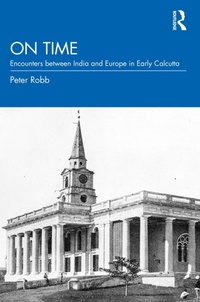
On Time
Encounters between India and Europe in Early Calcutta
Published on 31. March 2026
190 pages
978-1-040-87669-5 (ISBN)
Description

This book explores the intersection of public and private temporal systems. Examining Calcutta between 1780-1830, it reveals how time functioned as both a regulatory mechanism of emerging colonial governance and a deeply personal construct that continued to reflect pre-colonial norms and practices.
The author navigates the complex temporal landscape of early colonial Calcutta, where European clock-based standardization encountered and coexisted with indigenous temporal frameworks. The analysis illuminates how time manifested across diverse contexts-from distance perception and collective memory to religious festivals, scientific endeavours, financial transactions, and labour relations. It assesses extensions of law, imperfections of policy, and both European and Indian reactions.
Drawing upon a rich tapestry of sources, including the collection of Richard Blechynden's diaries and papers, this study offers unprecedented insight into the daily temporal experiences of both Europeans and Indians in a period when (as is argued) they foreshadowed major changes to come. It will be a significant reading for scholars and researchers of colonialism, South Asian history, India-England relations, temporal studies and modern Indian history.
The author navigates the complex temporal landscape of early colonial Calcutta, where European clock-based standardization encountered and coexisted with indigenous temporal frameworks. The analysis illuminates how time manifested across diverse contexts-from distance perception and collective memory to religious festivals, scientific endeavours, financial transactions, and labour relations. It assesses extensions of law, imperfections of policy, and both European and Indian reactions.
Drawing upon a rich tapestry of sources, including the collection of Richard Blechynden's diaries and papers, this study offers unprecedented insight into the daily temporal experiences of both Europeans and Indians in a period when (as is argued) they foreshadowed major changes to come. It will be a significant reading for scholars and researchers of colonialism, South Asian history, India-England relations, temporal studies and modern Indian history.
More details
Language
English
Place of publication
London
United Kingdom
Publishing group
Taylor & Francis Ltd
Target group
College/higher education
Product notice
Reflowable
File size
1,16 MB
ISBN-13
978-1-040-87669-5 (9781040876695)
Copyright in bibliographic data and cover images is held by Nielsen Book Services Limited or by the publishers or by their respective licensors: all rights reserved.
Schweitzer Classification
Other editions
Additional editions
Book
approx. 03/2026
1st Edition
Routledge
€213.10
Not yet published
Person
Peter Robb, Professor Emeritus at SOAS University of London, a Fellow of the Royal Historical Society and a Fellow and former President of the Royal Asiatic Society.
Content
1. Times and places 2. Recording time: Blechynden, Ananda Ranga Pillai; diaries as sources 3. Marking time: celebration and ceremony 4. Making time: readings and measurement 5. Borrowing time: debts and contracts 6. Using time: workers and wages 7. Regulating time: laws and norms 8. Time in context 9. Responding to time
