

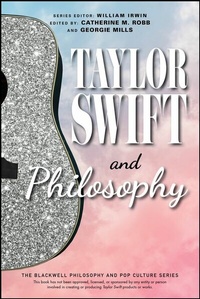
Taylor Swift and Philosophy
Description

Explore the philosophical wisdom of Taylor Swift and her music
Taylor Swift is a "Mastermind" when it comes to relationships, songwriting, and performing sold-out stadium tours. But did you know that Taylor is also a philosophical mastermind?
Taylor Swift and Philosophy is the first book to explore the philosophical topics that arise from Taylor Swift's life and music. Edited and authored by Swifties who also happen to be philosophers and scholars, this fun and engaging book is written with general readers in mind-you don't have to be a devoted fan or a specialist in philosophy to explore the themes, concepts, and questions expressed in Taylor's songs.
- Is Taylor Swift a philosopher?
- What can her songs tell us about ethics and society?
- What is the nature of friendship?
- Should you forgive someone for breaking your heart?
Presenting top-tier research and new perspectives on important contemporary issues, twenty-seven chapters discuss the philosophical contexts of Taylor's work, such as the ethics of reputational damage, the impacts of first impressions, the moral obligation to speak out against injustice, and much more.
Taylor Swift and Philosophy is a must-read for Swifties who want to deepen their appreciation and understanding of Taylor's work, as well as for philosophy students and scholars with an interest in popular culture and media studies.
More details
Other editions
Additional editions
Persons
CATHERINE M. ROBB is an Assistant Professor of Philosophy at Tilburg University, Netherlands. Her research interests include ethics, metaphysics, aesthetics, and applied philosophy, with a focus on the nature and value of ability, skill and talent, and related ethical implications.
GEORGIE MILLS is a Research Fellow at Delft University of Technology, Netherlands. She is primarily a philosopher of science, emotion, and medicine with a range of interests in the philosophy of pop culture. She has published work on Punk, Post-Punk, Britney Spears, and Ted Lasso.
Content
Contributors viii
Introducing ... Taylor Swift's Philosophy Era xiv
Catherine M. Robb and Georgie Mills
"Who Is Taylor Swift Anyway? Ew" 1
1 Is Taylor Swift a Philosopher? 3
Catherine M. Robb
2 "You Should Find Another Guiding Light": Is Taylor Swift Admirable? 12
Kate C.S. Schmidt
3 Eyes Open: Taylor Swift and the Philosophy of Easter Eggs 19
Eline Kuipers
4 Taylor Swift and the Ethics of Body Image 28
Gah-Kai Leung
5 So Mother for That: Taylor Swift and Childless Mothering 36
Lucy Britt and Brian Britt
"Look What You Made Me Do": Reputation, Forgiveness, and Blame 47
6 Can I Forgive You for Breaking My Heart? 49
Sophia Pettigrove and Glen Pettigrove
7 How to Forgive an Innocent: Taylor, Kanye, and the Ethics of Forgiveness 58
Sarah Köglsperger
8 "This Is Why We Can't Have Nice Things": Goodwill as a Finite Resource 66
Georgie Mills
9 Taylor Swift's Philosophy of Reputation 72
Catherine M. Robb and Roos Slegers
10 "It's Me, Hi! I'm the Problem It's Me": Taylor Swift and Self- Blame 81
Agnès Baehni
"The Girl in the Dress Wrote You a Song" 89
11 Begin Again (Taylor's Version): On Taylor Swift's Repetition and Difference 91
King-Ho Leung
12 Is Taylor Swift's Music Timeless?: A Metaphysical Proof 99
Patrick Dawson
13 "I Remember It All Too Well": Memory, Nostalgia, and the Archival Art of Songwriting 107
Rebecca Keddie
14 Taylor's Version: Rerecording, Narrative, and Self- Interpretation 116
Jana Alvara Carstens
"With My Calamitous Love and Insurmountable Grief" 127
15 Taylor Swift on the Values and Vulnerability of Love 129
Macy Salzberger
16 "Every Scrap of You Would Be Taken from Me": Taylor Swift on Grief 137
Jonathan Birch
17 "What a Shame She Went Mad": Anger, Affective Injustice, and Taylor Swift's "mad woman" 147
Erica Bigelow
18 I'm Fine with My Spite: The Philosophy of Female Anger in the Work of Taylor Swift 154
Amanda Cercas Curry and Alba Curry
"I Should've Known": Taylor Swift's Philosophy of Knowledge 163
19 "Summer Love" or "Just a Summer Thing?": Feminist Standpoint Epistemology and the folklore Love Triangle 165
Lottie Pike and Tom Beevers
20 The Trouble with Knowing You Were Trouble 174
Eric Scarffe and Katherine Valde
21 "I Knew Everything When I Was Young": Examining the Wisdom of Youth 182
Urja Lakhani
22 How Do We Know What Taylor Swift Is Feeling? 189
Neil Mussett
"Back to December": Fate, Memory, and Imagination 199
23 A Real Lasting Legacy: Memory, Imagination, and Taylor Swift 201
Christopher Buford
24 Stained Glass Windows in My Mind: Modality in the Imagery of Taylor Swift 208
Shoshannah Diehl
25 "Take Me to the Lakes": Transcendentalism and Ecology in Taylor Swift's folklore 216
Joshua Fagan
26 Wildest Dreams: Stoic Fate and Acceptance (Taylor's Version) 225
David Hahn
27 Mythic Motifs in The Tortured Poets Department: "The Story Isn't Mine Anymore" 231
Georgie Mills
Index of Terms and Names 238
Index of Taylor Swift's Songs and Albums 241
Contributors
Agnès Baehni is a PhD candidate in philosophy at the University of Geneva. She divides her time between moral philosophy and listening to Taylor Swift's music, and often does both at the same time. She is currently writing a doctoral thesis on the topic of the moral relationship to the self.
Tom Beevers is eagerly awaiting an invite on tour as Swift's traveling philosophical adviser. In the meantime, he whiles away his hours as an Assistant Professor in Philosophy at Northeastern University London. He writes on philosophy of language and epistemology, and also enjoys running and cooking (does Taylor need a chef?).
Erica Bigelow is a PhD candidate in philosophy at the University of Washington. Her dissertation asks about our ethical obligations to others' emotions, particularly against the backdrop of vast structural injustice. Erica is also a precollege philosophy facilitator with PLATO. She attended Taylor Swift's infamous Gillette Stadium "rain show" in 2011, and hasn't missed a tour since.
Jonathan Birch is Professor of Philosophy at the London School of Economics and Political Science, where he is best known for his work on animal consciousness and the origins of altruism. He once confused his students by giving "a bad Taylor Swift album" as an example of something that is conceivable but not metaphysically possible.
Brian Britt is Professor of Religion and Cultural Theory in the Department of Religion and Culture at Virginia Tech, where he also serves as Director of the ASPECT PhD program. He writes and teaches about biblical tradition, modern religious thought, literature, and popular culture. The present collaboration with Lucy Britt is the latest in a series of projects informed by his children, including essays on TikTok and the Teletubbies.
Lucy Britt is an Assistant Professor of Politics at Bates College, where she teaches and researches the politics of race and ethnicity, the politics of memory, and African American political theory. She also teaches feminist political theory and writes about feminism and popular culture, from Taylor Swift to trauma-dumping on The Bachelor. She is excited that the discourse surrounding Taylor Swift has become an opportunity to engage in critical feminist, queer, and intersectional interventions in "Swiftiedom."
Christopher Buford is Professor of Instruction at The University of Akron. His research interests include external world skepticism, personal identity, and advance directives. When not working on philosophy, he enjoys listening to metal, jazz, and EDM. More Swiftie-adjacent than Swiftie, he does admit that the algorithms have started working Taylor's songs into his playlists.
Jana Alvara Carstens obtained her PhD in philosophy at the University of Pretoria. She once arrogantly proclaimed that she doesn't listen to Taylor Swift. Not long after making this statement, she borrowed a friend's car and a 1989 CD was in the stereo. She didn't turn down the volume. Instead, she realized she was a snob like the guy from "We Are Never Ever Getting Back Together." She wanted to contribute to this book to atone for publicly bashing Swift. Perhaps she's also a little bit afraid of karma.
Alba Curry is a Lecturer in Philosophy at the University of Leeds, UK. Currently her work defends the positive value of anger in ancient Chinese and Greek ethics, individually and comparatively, and its value to contemporary philosophies of emotions, feminism, and artificial intelligence. Despite having been one of those who said, "Who is Taylor Swift anyway?," she became a fan because she loves to investigate phenomena she doesn't immediately like (much like how she started her research on anger).
Amanda Cercas Curry is a postdoctoral researcher at MilaNLP at Bocconi University, Italy. Her research interests are broad and as a computer scientist working on AI, she loves to spend time working with philosophers. She believes that multidisciplinary approaches involving diverse teams and feminist design methods are key in solving today's ethical and technical challenges. As a woman in STEM, she often feels she has had to prove there is more to her than meets the eye, and has found great solace in Taylor Swift's takes on life (she even slept at an airport for her).
Patrick Dawson was, to confess, a bit of a Taylor Swift hater in his younger days. Then he got an education, traveled the world, and took up his current fellowship at University College Dublin. Now, Patrick tries to prove that the past doesn't exist. All that's real is the present, Swift-appreciating Patrick of today. He's also dabbled in debate and stand-up comedy. Given these interests in the present, and the spoken word, you'd think Speak Now would be his favorite album. But Patrick's more of a folklore guy, reflecting his other loves: nature, cardigans, and that "single thread of gold" from him to his daughter, Idun.
Shoshannah Diehl is an English instructor at Marshall University, where she uses her Swiftie abilities to teach textual analysis to the next generation. Her scholarship interests include linguistics, philosophy, sci-fi and fantasy literature, and deciphering the difference between Quill Lyrics, Fountain Pen Lyrics, and Glitter Gel Pen Lyrics. She spends her spare time writing fiction and cultivating the persona of an argumentative, antithetical dream girl.
Joshua Fagan is a graduate student at the University of St Andrews, Scotland. Like Taylor Swift, he fantasizes about disappearing into the greenery of the Lake District and never returning. When not debating whether folklore is better than evermore, he specializes in nineteenth-century British and American literature, with a particular focus on the intersection of literature and science in response to the upheaval and malaise created by industrialization.
David Hahn is an adjunct at SUNY Geneseo. He has been called Treacherous, Trouble, and an Anti-Hero; but rarely because of his Dress. If you have a Getaway Car, he knows places in Buffalo NY where he can see you standing in Snow on the Beach.
Rebecca Keddie works as an archivist, and recently graduated with an MA in archives and record management. Her master's dissertation looked at how place can function as archive and was inspired by her obsession with Taylor Swift's song "Cornelia Street." Post-graduation, she's put her degree to good use by continuing to relate it back to Taylor Swift, as with just about everything else in her life.
Sarah Köglsperger is a PhD candidate in philosophy at the University of Fribourg. When she was young and reckless, studying philosophy at LMU Munich, she was immediately enchanted with Taylor Swift's music. Currently, Sarah is working on the influence of personal relationships on blame and forgiveness. She enjoys listening to Taylor Swift's songs, as they vividly capture the intricate nature of relationships and the moral challenges they may pose. Now midnights become her afternoons, as she writes her dissertation while her cat is purring in her lap 'cause it loves her.
Eline Kuipers is a PhD candidate in philosophy of mind at Ruhr University Bochum, Germany, as well as a long-time Swiftie. For her dissertation, she gives her blood, sweat, and tears to investigate how we plan, control, and execute our actions. In her free time, she loves to make sparkling friendship bracelets, cuddle with her red cat and bearded dragon, have the time of her life in theme parks with her partner in crime, annoy her friends with marvelous Easter egg interpretations, and proudly sing Taylor Swift songs as if she was the loudest woman the town has ever seen.
Urja Lakhani recently completed her graduate education in philosophy from Birkbeck, University of London. Her research is focused on political epistemology and feminist philosophy. Currently working as a policy analyst, Urja also serves on the editorial board of The Philosopher, the UK's longest-running public philosophy journal. Urja has been a lifelong Swiftie. Her childhood in India was accompanied by the sounds of Taylor Swift's earlier albums. Despite never owning a guitar, she found herself shedding tears over teenage heartaches to the tunes of "Teardrops on My Guitar." Later, she moved to New York, where the bright lights never blinded her. Now, she resides in London with her own London boy.
Gah-Kai Leung is a PhD candidate in the Department of Politics and International Studies, University of Warwick, UK. Like Taylor Swift's back catalogue, his philosophical interests are wide and eclectic, including social and political philosophy, applied ethics, the philosophy of social science, and the philosophy of art. His current karaoke song of choice is "Anti-Hero" and someday he hopes to be just as talented at lip syncing as Emma Stone, only with Swift songs rather than tracks by DJ Khaled.
King-Ho Leung is Lecturer (Assistant Professor) in Theology, Philosophy, and the Arts at King's College London, UK. The lingering questions that keep him up-and sometimes wonderstruck-include the relation between philosophy and religion, what it means to exist spiritually or authentically, and whether Taylor Swift will ever return to writing pop-country...
