

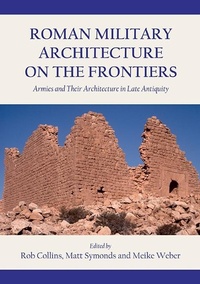
Roman Military Architecture on the Frontiers
Armies and Their Architecture in Late Antiquity
Published on 30. November 2015
208 pages
978-1-78297-993-7 (ISBN)
Description

The Roman army was one of the most astounding organizations in the ancient world, and much of the success of the Roman empire can be attributed to its soldiers. Archaeological remains and ancient texts provide detailed testimonies that have allowed scholars to understand and reconstruct the army's organization and activities. This interest has traditionally worked in tandem with the study of Roman frontiers. Historically, the early imperial period, and in particular the emergence of the frontiers, has been the focus of research. During those investigations, however, the remains of the later Roman army were also frequently encountered, if not always understood. Recent decades have brought a burgeoning interest in not only the later Roman army, but also late antiquity more widely.
It is the aim of this volume to demonstrate that while scholars grappling with the late Roman army may want for a rich corpus of inscriptions and easily identifiable military installations, research is revealing a dynamic, less-predictable force that was adapting to a changing world, in terms of both external threats and its own internal structures. The dynamism and ingenuity of the late Roman army provides a breath of fresh air after the suffocating uniformity of its forbears. The late Roman army was a vital and influential element in the late antique empire. Having evolved through the 3rd century and been formally reorganized under Diocletian and Constantine, the limitanei guarded the frontiers, while the comitatenses provided mobile armies that were fielded against external enemies and internal threats. The transformation of the early imperial army to the late antique army is documented in the rich array of texts from the period, supplemented by a perhaps surprisingly rich archaeological record.
It is the aim of this volume to demonstrate that while scholars grappling with the late Roman army may want for a rich corpus of inscriptions and easily identifiable military installations, research is revealing a dynamic, less-predictable force that was adapting to a changing world, in terms of both external threats and its own internal structures. The dynamism and ingenuity of the late Roman army provides a breath of fresh air after the suffocating uniformity of its forbears. The late Roman army was a vital and influential element in the late antique empire. Having evolved through the 3rd century and been formally reorganized under Diocletian and Constantine, the limitanei guarded the frontiers, while the comitatenses provided mobile armies that were fielded against external enemies and internal threats. The transformation of the early imperial army to the late antique army is documented in the rich array of texts from the period, supplemented by a perhaps surprisingly rich archaeological record.
More details
Other editions
Additional editions
Rob Collins | Matt Symonds | Meike Weber
Roman Military Architecture on the Frontiers
Armies and Their Architecture in Late Antiquity
Book
09/2015
Oxbow Books
€75.71
Shipment within 3-4 weeks
Content
- Intro
- List of Figures and Tables
- List of Contributors
- Acknowledgements
- List of Abbreviations
- 1. Late Roman military architecture: An introduction
- 2. Making sense of the frontier armies in late antiquity: An historian's perspective
- 3. Economic reduction or military reorganization? Granary demolition and conversionin later 4th-century northern Britannia
- 4. Late Roman military buildings at Binchester (Co. Durham)
- 5. Fourth-century fortlets in Britain: sophisticated systems or desperate measures?
- 6. The late Roman coastal fort of Oudenburg (Belgium): Spatial and functional transformationswithin the fort walls
- 7. The legionary fortress of Vindobona (Vienna, Austria): Change in function and designin the late Roman period
- 8. The dwindling legion: Architectural and administrational changes in Novae (Moesia inferior)on the threshold of late antiquity
- 9. Severan Castra, Tetrarchic Quadriburgia, Justinian Coenobia, and Ghassanid Diyarat:Patterns of transformation of limes Arabicus forts during late antiquity
- 10. Castra or centenaria? Interpreting the later forts of the North African frontier
- 11. In defence of the late empire
