

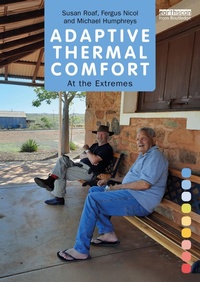
Adaptive Thermal Comfort
At the Extremes
1st Edition
Published on 19. March 2026
320 pages
978-1-317-29092-6 (ISBN)
Description

Building Design is at a crossroads in our heating world. Today many modern buildings fail to keep their occupants comfortable during more extreme weather. A revolution in design thinking is essential as we prepare for the even worse climates of the future with new ways of staying affordably and thermally safe and healthy indoors. This book is a compendium of information on thermal comfort in buildings. It provides a clear overview of the complexity of the challenges faced in reducing energy use in buildings and emissions from them in humanities' multitude of different cultures and climates. Buildings are a major and growing driver of climate change not least because of the global trend towards an overdependence on mechanical systems to provide comfort indoors. European and American industries have used international standards and regulations to persuade legislators around the world that 'Western' conditions for comfort are universally correct and are essential for the buildings of those committed to being part of global markets. That focus on mechanical efficiency has resulted in decades of buildings that are increasingly poorly adapted to local climates and lifestyles and are unable to protect occupants when electricity grids fail. Buildings in the future will have to run for as long as possible on local natural energy and this book outlines how that modal shift forwards to hybrid or mixed-mode buildings might happen and how low-cost and low-impact comfort can be achieved through good basic design that can also provide high amenity value and thermal delight in and around buildings.
The theory of Adaptive Thermal Comfort states that people adapt to those temperatures they normally occupy, and if they become uncomfortable due to a change in conditions they tend to change themselves, or their surroundings to return to comfort if they are able and can afford to. The book explains how comfort is ultimately the result of a conversation between people and their environments. This is the third of three volumes that builds on the practical and theoretical foundations of the subject laid out in the first two volumes. It builds on the authors global perspectives and experiences to lend shape to an emerging roadmap for re-imagining the design and construction of adaptable and resilient buildings, and a re-shaping of the expectations and behavioural lifestyle changes needed to prepare humanity to survive and thrive comfortably in the very different weather and climates ahead.
The theory of Adaptive Thermal Comfort states that people adapt to those temperatures they normally occupy, and if they become uncomfortable due to a change in conditions they tend to change themselves, or their surroundings to return to comfort if they are able and can afford to. The book explains how comfort is ultimately the result of a conversation between people and their environments. This is the third of three volumes that builds on the practical and theoretical foundations of the subject laid out in the first two volumes. It builds on the authors global perspectives and experiences to lend shape to an emerging roadmap for re-imagining the design and construction of adaptable and resilient buildings, and a re-shaping of the expectations and behavioural lifestyle changes needed to prepare humanity to survive and thrive comfortably in the very different weather and climates ahead.
Reviews / Votes
"Even as the climate warms, so too does the debate about thermal comfort in buildings. 'At the Extremes' is appropriately hard-hitting and insightful-a true guide for hotter times ahead".Jonathon Porritt, writer and campaigner, President of The Conservation Volunteers and Population Matters
"We can't air-condition our way out of the climate crisis-this book is an essential manifesto for designing a resilient future, showing how our bodies, buildings, and cultures must adapt to a heating world."
Prashant Kapoor, Chief Industry Specialist, Green Buildings and Cities, Climate Business Department, IFC
"This is a truly stupendous piece of work covering all dimensions of the question of thermal comfort in buildings -historical time, location, built space and the challenge of Climate Change. A must read for designers and researchers for an urgently needed 'reset' for theory and practice."
Ashok Lall, Principal of Ashok B Lall Architects, Delhi, India
"How wonderful to read a book on science that is written so clearly: for in a time of adjustment we need plain speaking... As Sue Roaf says: 'the first step to escaping from an echo chamber is to realise that you are in one.' May this book assist you to thrust the window of your enclosed space wide open and brave this world which created you - if you can find one that opens!"
Phil Harris, Troppo Architects
"Many congratulations on this new book. It's brimming with ideas related to radically cutting carbon in the face of the drastic rates of climate change we are now caught in."
Aubrey Meyer, The Global Commons Institute, UK
"Adaptive Thermal Comfort: At the Extremes is a provocative reading of how comfort has been defined, captured, codified, exported and enforced in our built environment-with highly uncomfortable results for our heating world. We are honored that our projects have been identified as exemplars for localized, adaptable and culturally attuned comfort. This book is a necessary critique of how we got here and offers actionable suggestions for designers, professionals and policy-makers moving forward."
Richard Hassell, WOHA, Singapore
More details
Edition
1. Auflage
Language
English
Place of publication
London
United Kingdom
Publishing group
Taylor & Francis Ltd
Target group
College/higher education
Professional and scholarly
Illustrations
21 Tables, color; 147 Line drawings, color; 86 Halftones, color; 233 Illustrations, color
File size
44,84 MB
ISBN-13
978-1-317-29092-6 (9781317290926)
Copyright in bibliographic data and cover images is held by Nielsen Book Services Limited or by the publishers or by their respective licensors: all rights reserved.
Schweitzer Classification
Other editions
Additional editions
Book
approx. 03/2026
1st Edition
Routledge
€66.00
Not yet published
Book
approx. 03/2026
1st Edition
Routledge
€161.50
Not yet published
Persons
Susan Roaf is Emeritus Professor of Architectural Engineering at Heriot Watt University. Raised in Malaysia and the Australian bush, and educated in Britain, she has lived and worked as an architect, anthropologist and archaeologist in Iran, Iraq, Pakistan, California and Antarctica, experiences that colour her unique understanding of buildings and comfort in different climates and cultures and inspired her work on adapting buildings and cities to a heating world. She pioneered UK building integrated solar technologies and eco-design, and with Nicol and Humphreys has promoted adaptive thermal comfort globally. Her expertise in ancient technologies informed some of her 23 books and other publications, all aimed at understanding building performance in the past, present and future.
Fergus Nicol is an award winning leader in the field of adaptive thermal comfort, having started as a physicist at the Building Research Establishment in the 1960s. He moved on to work with the UK Medical Research Council, and into teaching, before leaving both to start the radical book shop Bookmarks. Returning to research in 1992, he is now an Emeritus Professor in a number of universities, and a top cited scholar across his many publications. He led influential pan-European and Pakistan studies on comfort and he leads the NCEUB, Network for Comfort and Energy use in Buildings. He co-founded and ran the Windsor Conferences on comfort and is internationally respected for his support of fellow researchers and students.
Michael Humphreys is known for his pioneering work on the adaptive approach to comfort. He was Head of Human Factors at the Building Research Establishment, and has been a Research Professor at Oxford Brookes University. His scientific interests are the methodology of field studies of environmental comfort, the structure and statistical modelling of human adaptive behaviour, and the interactions between the several aspects of the indoor environment.
Fergus Nicol is an award winning leader in the field of adaptive thermal comfort, having started as a physicist at the Building Research Establishment in the 1960s. He moved on to work with the UK Medical Research Council, and into teaching, before leaving both to start the radical book shop Bookmarks. Returning to research in 1992, he is now an Emeritus Professor in a number of universities, and a top cited scholar across his many publications. He led influential pan-European and Pakistan studies on comfort and he leads the NCEUB, Network for Comfort and Energy use in Buildings. He co-founded and ran the Windsor Conferences on comfort and is internationally respected for his support of fellow researchers and students.
Michael Humphreys is known for his pioneering work on the adaptive approach to comfort. He was Head of Human Factors at the Building Research Establishment, and has been a Research Professor at Oxford Brookes University. His scientific interests are the methodology of field studies of environmental comfort, the structure and statistical modelling of human adaptive behaviour, and the interactions between the several aspects of the indoor environment.
Content
DEDICATION
PREFACE
ACKNOWLEDGEMENTS
COMFORT IN BUILDINGS
Chapter 1. Designing for Comfort at the Extremes
Chapter 2. Dangerous Curves: The Over-Heating Buildings Problem
PEOPLE AND COMFORT
Chapter 3. How Bodies Adapt
Chapter 4. How People Adapt
BUILDINGS AND COMFORT
Chapter 5. How People Adapt in Buildings
Chapter 6. Comfort Clouds
COMFORT AND CULTURES
Chapter 7. Comfort, Cultures and Customs
Chapter 8. Comfort Colonialism
THERMAL HEARTBEATS OF BUILDINGS
Chapter 9. Thermal Heartbeats of Buildings
Chapter 10. Killer Buildings: Heatwaves
Chapter 11. Killer Buildings: Hypothermia
ECOLOGY AND COMFORT
Chapter 12. The Ecology of Comfort
Chapter 13. Heat Flows and Ecological Engineering
Chapter 14. Harvesting Comfort from Landscapes
Chapter 15. Mining Comfort from the Earth
Chapter 16. Thermal Mass
Chapter 17. Harvesting Comfort from Sky Cycles
Chapter 18. Air and Comfort
Chapter 19. Thermal Landscaping of Buildings
DESIGNING FOR A HOTTER CLIMATE
Chapter 20. Reconnecting Designers to Climates
Chapter 21. Firmness, Commodity and Delight
Chapter 22. Designing Thermally Well-Behaved Buildings
Chapter 23. Thermal Delight in Design
COMFORT AND WELLBEING
Chapter 24. Comfort and Well-being
Chapter 25. Mental Well-Being, Health and Comfort
Chapter 26. Emotions and Well-Being
Chapter 27. Spiritual Comfort and Beliefs
Chapter 28. Adaptable Buildings = Adaptive Comfort
APPENDICES
PREFACE
ACKNOWLEDGEMENTS
COMFORT IN BUILDINGS
Chapter 1. Designing for Comfort at the Extremes
Chapter 2. Dangerous Curves: The Over-Heating Buildings Problem
PEOPLE AND COMFORT
Chapter 3. How Bodies Adapt
Chapter 4. How People Adapt
BUILDINGS AND COMFORT
Chapter 5. How People Adapt in Buildings
Chapter 6. Comfort Clouds
COMFORT AND CULTURES
Chapter 7. Comfort, Cultures and Customs
Chapter 8. Comfort Colonialism
THERMAL HEARTBEATS OF BUILDINGS
Chapter 9. Thermal Heartbeats of Buildings
Chapter 10. Killer Buildings: Heatwaves
Chapter 11. Killer Buildings: Hypothermia
ECOLOGY AND COMFORT
Chapter 12. The Ecology of Comfort
Chapter 13. Heat Flows and Ecological Engineering
Chapter 14. Harvesting Comfort from Landscapes
Chapter 15. Mining Comfort from the Earth
Chapter 16. Thermal Mass
Chapter 17. Harvesting Comfort from Sky Cycles
Chapter 18. Air and Comfort
Chapter 19. Thermal Landscaping of Buildings
DESIGNING FOR A HOTTER CLIMATE
Chapter 20. Reconnecting Designers to Climates
Chapter 21. Firmness, Commodity and Delight
Chapter 22. Designing Thermally Well-Behaved Buildings
Chapter 23. Thermal Delight in Design
COMFORT AND WELLBEING
Chapter 24. Comfort and Well-being
Chapter 25. Mental Well-Being, Health and Comfort
Chapter 26. Emotions and Well-Being
Chapter 27. Spiritual Comfort and Beliefs
Chapter 28. Adaptable Buildings = Adaptive Comfort
APPENDICES
