

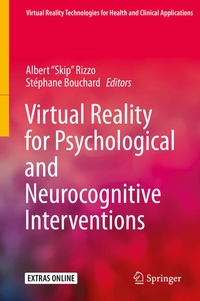
Virtual Reality for Psychological and Neurocognitive Interventions
Description

This exciting collection tours virtual reality in both its current therapeutic forms and its potential to transform a wide range of medical and mental health-related fields. Extensive findings track the contributions of VR devices, systems, and methods to accurate assessment, evidence-based and client-centered treatment methods, and-as described in a stimulating discussion of virtual patient technologies-innovative clinical training. Immersive digital technologies are shown enhancing opportunities for patients to react to situations, therapists to process patients' physiological responses, and scientists to have greater control over test conditions and access to results. Expert coverage details leading-edge applications of VR across a broad spectrum of psychological and neurocognitive conditions, including:
-
Treating anxiety disorders and PTSD.
-
Treating developmental and learning disorders, including Autism Spectrum Disorder,
-
Assessment of and rehabilitation from stroke and traumatic brain injuries.
-
Assessment and treatment of substance abuse.
-
Assessment of deviant sexual interests.
-
Treating obsessive-compulsive and related disorders.
-
Augmenting learning skills for blind persons.
Readable and relevant, Virtual Reality for Psychological and Neurocognitive Interventions is an essential idea book for neuropsychologists, rehabilitation specialists (including physical, speech, vocational, and occupational therapists), and neurologists. Researchers across the behavioral and social sciences will find it a roadmap toward new and emerging areas of study.
More details
Other editions
Additional editions
Persons
Sté phane Bouchard holds the Canada Research Chair in Clinical cyberpsychology and teaches psychotherapy and cyberpsychology at the Université du Québec en Outaouais in Canada As a scientist-practitioner, his current research projects involve developing virtual environments to treat complex anxiety disorders and pathological gambling, leading randomized control trials on the efficacy of in virtuo exposure for mental health disorders, and conducting experimental studies to understand to why virtual reality is an effective treatment tool. Another prolific area of expertise is telepsychotherapy, where he conducts randomized control trials and processes studies on the efficacy of delivering cognitive-behavior therapy in videoconference. His research lab holds Psyche , the only six-sided total immersion virtual reality system dedicated to mental health research. He has received for more than 12 million dollars in research funding, has published more than 150 scientific articles and book chapters, delivered hundreds of scientific communications around the world and is actively collaborating with researchers from around the globe. He is also the president of Cliniques and Development In Virtuo, as company that distributes virtual environments to mental health professionals.
Content
Chapter 1: Applications of Virtual Reality in Clinical Psychology and Clinical Cognitive Neuroscience - An Introduction.- Chapter 2: Virtual Reality: Whence, How and What For.- Chapter 3: Virtual Reality and Anxiety Disorders Treatment: Evolution and Future Perspectives.- Chapter 4: Virtual Reality Applications to Treat Posttraumatic Stress Disorder.- Chapter 5: Using VR for Obsessive-Compulsive and Related Disorders.- Chapter 6: Virtual Environments for Substance Abuse Assessment and Treatment.- Chapter 7: Virtual Reality in the Assessment and Treatment of Weight-Related Disorders.- Chapter 8: Virtual Reality Distraction Helps Control Acute Pain and Has Potential to Reduce PTSD Symptom Severity during Medical Procedures. Chapter 9: Using Virtual Reality with Child Sexual Offenders: Assessing Deviant Sexual Interests.- Chapter 10: Using Innovative Technologies as Therapeutic and Educational Tools for Children with Autism Spectrum Disorder.- Chapter 11. A Review of Virtual Classroom Environments for Neuropsychological Assessment.- Chapter 12. Developmental and Learning Disabilities.- Chapter 13. Virtual Reality and Psychotic Disorders.- Chapter 14. Assessment and Rehabilitation Using Virtual Reality after Stroke: A Literature Review.- Chapter 15: Assessment and Rehabilitation after Traumatic Brain Injury using Virtual Reality: A Systematic Review and Discussion Concerning Human-Computer Interactions.- Chapter 16: Developing Virtual Environments for Learning and Enhancing Skills for the Blind: Incorporating User-Centered and Neuroscience Based Approaches.- Chapter 17: Virtual Human Standardized Patients for Clinical Training.
