

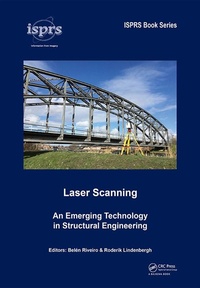
Laser Scanning
An Emerging Technology in Structural Engineering
1st Edition
Published on 18. October 2019
284 pages
978-1-351-01885-2 (ISBN)
Description

This book provides an overview on the evolution of laser scanning technology and its noticeable impact in the structural engineering domain. It provides an up-to-date synthesis of the state-of-the-art of the technology for the reverse engineering of built constructions, including terrestrial, mobile, and different portable solutions, for laser scanning. Data processing of large point clouds has experienced an important advance in the last years, and thus, an intense activity in the development of automated data processing algorithms has been noticed. Thus, this book aims to provide an overview of state-of-the-art algorithms, different best practices and most recent processing tools in connection to particular applications.
Readers will find this a comprehensive book, that updates the practice of laser scanning for researchers and professionals not only from the geomatic domain, but also other fields such as structural and construction engineering. A set of successful applications to structural engineering are illustrated, including also synergies with other technologies, that can inspire professionals to adopt laser scanning in their day-to-day activity.
This cutting-edge edited volume will be a valuable resource for students, researchers and professional engineers with an interest in laser scanning and its applications in the structural engineering domain.
Readers will find this a comprehensive book, that updates the practice of laser scanning for researchers and professionals not only from the geomatic domain, but also other fields such as structural and construction engineering. A set of successful applications to structural engineering are illustrated, including also synergies with other technologies, that can inspire professionals to adopt laser scanning in their day-to-day activity.
This cutting-edge edited volume will be a valuable resource for students, researchers and professional engineers with an interest in laser scanning and its applications in the structural engineering domain.
More details
Series
Edition
1. Auflage
Language
English
Place of publication
London
United Kingdom
Publishing group
Taylor & Francis Ltd
Target group
College/higher education
Professional and scholarly
ISBN-13
978-1-351-01885-2 (9781351018852)
Copyright in bibliographic data and cover images is held by Nielsen Book Services Limited or by the publishers or by their respective licensors: all rights reserved.
Schweitzer Classification
Other editions
Additional editions
Book
06/2021
1st Edition
CRC Press
€97.90
Shipment within 10-20 days
Book
10/2019
1st Edition
CRC Press
€207.60
Shipment within 10-20 days
Persons
Dr. Belen Riveiro was born in Pontevedra (Spain) in 1983. Since 2012 she is an Associate Professor at the Department of Materials Engineering, Applied Mechanics and Construction at the University of Vigo (Spain). She holds a MSc in Construction Engineering (2015), MESc in Forestry Engineering (2006) and a PhD in Environmental Engineering (2011). She has been an Associate Professor in Geomatics at Newcastle University (UK) in 2011, and was a postdoctoral research fellow at the University of Minho (2012 and 2014), the University of Cambridge (2015) and at Delft University of Technology (2016). Her research is focused on the application of remote sensing technologies in structural engineering for the automated modelling, inspection and material characterization using inverse analysis procedures. At a larger scale, she uses LiDAR for the modelling of terrestrial transport infrastructure and urban spaces. She has been principal Investigator in several research and innovation projects (at national and international level) and coordinator of an European action focused on the resilience of transport infrastructure to extreme events (within the H2020 Framework Program). She has published more than 80 research papers in SCI-JCR journals (h-index 22), and more than 60 communications to international conferences. She is co-author of 9 patents and has supervised 6 PhD theses. She is the Secretary of the ISPRS WGII/10 3D Mapping for Environmental & Infrastructure Monitoring for the period 2016-2020. In 2017 she was awarded by the Spanish Royal Academy of Engineering with a medal of the Juan Lopez de Penalver Prize within the Awards for Young Researchers.
Dr. Roderik Lindenbergh is associate professor in laser scanning at the Dept. of Geoscience and Remote Sensing of Delft University of Technology. He studied mathematics at the University of Amsterdam and studied 6 months at RWTH Aachen for his MSc project on computational group theory. After 8 months at QM&W College, London, he worked on his PhD in geometry and topology at Utrecht University, where he obtained his PhD on limits of Voronoi diagrams in 2002. From then he has been working at the current Dept. of Geoscience and Remote Sensing of TU Delft. His main research interests are properties, processing methodology and applications of laser scan point clouds and digital terrain analysis using satellite data. He was elected best lecturer 2017 of the Faculty of Civil Engineering and Geosciences. He was Chair of Laser Scanning 2017, a workshop organized at the Geospatial Week in Wuhan, China. He is associate editor of the ISPRS journal on Photogrammetry and Remote Sensing and he is the 2016-2020 Chair of ISPRS WG II/10 on 3D mapping for environmental and infrastructural monitoring.
Dr. Roderik Lindenbergh is associate professor in laser scanning at the Dept. of Geoscience and Remote Sensing of Delft University of Technology. He studied mathematics at the University of Amsterdam and studied 6 months at RWTH Aachen for his MSc project on computational group theory. After 8 months at QM&W College, London, he worked on his PhD in geometry and topology at Utrecht University, where he obtained his PhD on limits of Voronoi diagrams in 2002. From then he has been working at the current Dept. of Geoscience and Remote Sensing of TU Delft. His main research interests are properties, processing methodology and applications of laser scan point clouds and digital terrain analysis using satellite data. He was elected best lecturer 2017 of the Faculty of Civil Engineering and Geosciences. He was Chair of Laser Scanning 2017, a workshop organized at the Geospatial Week in Wuhan, China. He is associate editor of the ISPRS journal on Photogrammetry and Remote Sensing and he is the 2016-2020 Chair of ISPRS WG II/10 on 3D mapping for environmental and infrastructural monitoring.
Content
Multispectral terrestrial lidar: state of the art and challenges, Multiplatform mobile laser scanning, Introduction to mobile mapping with portable systems, Indoor modeling with Laser Scanning, Geometric point cloud quality, Semantic Segmentation of Dense Point Clouds, Object identification / change detection and deformation monitoring, A Smart Point Cloud Infrastructure for intelligent environments, Integration of TLS and Sonar for the modelling of semi-immersed structures, Integral diagnosis and structural analysis of historical constructions by terrestrial laser scanning, Laser scanning for bridge inspection,Laser scanning data for inverse problems in structural engineering, Construction site monitoring based on laser scanning data, Integrated Modelling and Management Information System (MMIS) for SCAN to BIM projects.
