

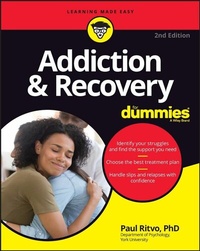
Addiction & Recovery For Dummies
Description

Addiction and Recovery For Dummies gives you the tools you need to identify and face addiction in yourself or a loved one, while working towards a healthy and realistic approach to recovery. This book offers a compassionate, unbiased, and non-judgmental guide to evaluating and overcoming addiction. You'll learn to identify the range of addiction levels, the various types (including substance and non-substance), and the possible causes of addiction. An expert author guides you through the range of addiction treatment philosophies and approaches, including twelve-step programs, other in- and outpatient programs, and teen treatments. We'll also look at common recovery roadblocks, so you're prepared to overcome whatever hurdles your recovery process brings. Medications, therapeutic communities, self-help groups, long-term recovery strategies--it's all in here.
* Learn the signs of addiction and identify the most appropriate treatments
* Gain advice on offering help to friends or family members struggling with addiction
* Discover available recovery supports, including groups and medications
* Understand the media and cultural factors that encourage addiction, and how to avoid them
Updated with the latest treatment options, Addiction & Recovery For Dummies is a valuable resource for those on a recovery journey, and a support guide for the 45 million people who are directly impacted by addiction.
More details
Other editions
Additional editions
Person
Content
Chapter 1
Addiction: What Is It?
IN THIS CHAPTER
Looking at use, abuse, and addiction
Understanding your personal risk of addiction
Reviewing treatment options
Stepping onto the road to recovery
Congratulations on picking up this book and leafing through it. Even if you just read these few words (and no further), remember that you are on a path. Just by choosing to pick up this book means you are seeking to find a nonaddictive path for yourself or for someone you love. It could be a path that will lead to a rediscovery of your inner strength and inner peace.
Yes, you have probably had highs that feel so good it's hard to describe them. But they are not sustainable in the way you elicited them. You have to find a nonaddictive path to getting high and find a gratifying way of living. You may think you have already found one and that all you have to do is tone things down a bit. But it's hard to "tone down" a poisoning - poisons destroy in both small doses and in large doses. Addiction is the poison of everyday life in the 21st century. Why is that true?
Addiction robs you of freedom and control. You may think you choose to use and can choose to use less - but just try to stop. See if it's possible. See whether you have control over the addictive substance or behavior you're afflicted with. If you find you do, great. Abstain for a while. Be sure you have the control you think you have. If you don't have control, if abstaining is unthinkable or impossible, read on.
In this chapter, I tell you about the different forms of addictions, emphasizing substance addictions and behavioral addictions. I tell you about how the medical community views addiction and how your personal view, when it's all said and done, is what you'll likely follow. I also provide a brief overview of what the rest of this book provides.
I designed this book to help you understand where you are, right now, in your control over addictions. This understanding can help you find your path to freedom and well-being, and resume true control of your life.
Defining Substance Use, Abuse, and Addiction
You may hear a number of addiction-related terms and it can be confusing as to what exactly they mean. The less confusion around these terms, the better. The clearer your understanding, the more you know about how to get and make use of the help available.
Understanding what addiction is
In 1964, the World Health Organization (WHO) suggested replacing the term addiction with the word dependence for describing the feeling that, mentally and physically, you must use a substance. Your brain and body yearn for it!
In this book, addiction refers to a combined mental-physical dependence where you're irresistibly compelled to use a substance or behave a certain way. Using the substance or engaging in that behavior is so compelling that even knowing you may face considerable harm does not stop you from doing it.
You're addicted when you no longer direct yourself out of harm's way. You're addicted when you use substances or engage in behaviors that put you in harm's way.
Simply put, addiction causes a fundamental change in your brain. A change that scientists and clinicians are trying hard to understand. But even though this change is mysterious and powerful, when it occurs, certain urges become irresistible. You become so compelled that nothing else matters. It doesn't matter how smart you are, how accomplished, or how physically strong. It's well proven that addiction can happen to virtually anyone.
Mental dependence
Mental dependence refers to associations that develop in your mind between events (called triggers) and emotional and physical urges to use the substance or do the behavior. The triggers are memory traces that are, in turn, set off by other stimuli. They exert a powerful influence on behavior. Moreover, they're not just in your mind - through a series of chain reactions, they induce biochemical changes throughout the body.
What is the difference between mental and physical dependence when both cause fundamental chemical changes? The main difference is that the chemical changes brought on by mental dependence are due to mental associations. Simply put, just thinking about getting high changes your chemistry and affects your whole body biochemically so that physical excitement is felt and is compelling.
Physical dependence
Physical dependence, on the other hand, doesn't require any thinking at all. It's simply related to the physical addictive effects on multiple brain chemicals called neurotransmitters. The brain adjusts and tries to tolerate the drug. Then you don't feel "normal" or "good" unless you take the substance. Physical dependence describes your brain's physical adaptation.
As explained in Chapter 10, you can detoxify your brain (get rid of poisonous chemicals). You can clear out a physical dependence relatively quickly (several days). However, your mental dependence can last a lifetime. Much of this book is about reducing mental dependence. My goal is to help you direct yourself away from the disaster and cause the mental imprint to fade. If you are successful, the imprint fades so completely that you may wonder why you didn't start a new and better life sooner.
For more of the differences between mental and physical dependence, see Chapter 5.
The difference between abuse and dependence
The difference between abuse and dependence is a matter of time and degree. Essentially, dependence is associated with tolerance (you need more and more substance to feel the same high) and withdrawal symptoms (you experience substance-specific withdrawal symptoms when you stop using), and abuse is associated with a single or continued substance use despite harmful health, social, and financial consequences. The medical criteria for substance dependence and substance abuse are summarized in the following sections.
Medical criteria for substance dependence
From the medical perspective, dependence is defined as experiencing at least three of the following criteria within a 12-month period:
- You experience tolerance to the substance, which is defined as a need for markedly increased amounts to achieve the desired effect, or there's a markedly diminished effect with continued use of the same amount.
- You experience withdrawal, as evidenced by a withdrawal syndrome for the substance or when medications, prescribed to relieve withdrawal symptoms, are discontinued.
- You've taken the substance in larger amounts or over a longer duration than initially intended.
- You've made unsuccessful attempts to cut down or control substance use.
- A great deal of time in activities is spent obtaining the substance (preoccupation with how and when you will get your next fix).
- You neglect or abandon important social, occupational, or recreational activities because of use.
- Your substance use continues despite knowledge that there are persistent or recurrent problems related to your use.
Medical criteria for substance abuse
The medical definition of abuse is experiencing one or more of the following criteria within a 12-month period:
- Your recurrent use of the substance results in a failure to fulfill major role obligations at work, home, or school.
- You use the substance in situations where it's physically hazardous (for instance, while driving a car).
- You have recurrent substance-related legal problems.
- You continue to use the substance despite persistent or recurrent social or interpersonal problems caused or worsened by use (for instance, arguments with your spouse about the consequences of your use).
Nonsubstance or behavioral addictions
Nonsubstance or behavioral addictions are behaviors you engage in that meet many of the same criteria as substance addictions. The behaviors dominate your life: You feel compelled to do them. Examples are pathological gambling and sex addiction.
When the medical criteria outlined in the preceding two sections are applied to behavioral addictions, the definitions become less clear. You can readily see how a behavioral addiction meets criteria for abuse (such as pathological gambling), but the dependence criteria don't apply as readily with addictions like workaholism, overeating, and excessive sex. Still, tolerance builds up with behavioral addictions. You need to do more and more of the activity or engage in more and more risk in relation to the activity to get the same high. (For more on behavioral addictions, see Chapter 3.)
Your personal definition of addiction
Regardless of all criteria, you know if you have a substance or behavioral addiction. You know it because the actions involved in getting the substance or doing the behavior dominate your life. You may not want to reveal what you know to anyone else, but it's difficult or impossible to hide it from yourself.
Sometimes the line between heavy use and abuse or dependence gets fuzzy. The case examples of Joe and Mark in the following sections may help...
