

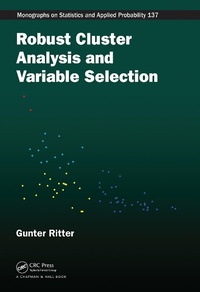
Robust Cluster Analysis and Variable Selection
1st Edition
Published on 2. September 2014
392 pages
978-1-4398-5797-7 (ISBN)
Description

Clustering remains a vibrant area of research in statistics. Although there are many books on this topic, there are relatively few that are well founded in the theoretical aspects. This book presents an overview of the theory and applications of probabilistic clustering and variable selection, synthesizing the key research results of the last 50 years. It includes all the important theoretical details, and covers the probabilistic models and inference, robustness issues, optimization algorithms, validation techniques and variable selection methods. The book illustrates the different methods with simulated data and applies them to real-world data sets that can be easily downloaded from the web.
Reviews / Votes
"I congratulate the author on his hard work, which provides a well-founded mathematical/probabilistic treatment for some valuable clustering techniques...I highly recommend this book and find it very enjoyable to read for those with enough background and who wish to gain a more in-depth knowledge of cluster analysis. For this audience, it is a stimulating read covering several novel and useful ideas and providing a starting point for developing more advanced theory and applications...In summary, I found the book appealing and I appreciate the effort made by the author in providing a rigorous approach to (robust) cluster analysis."-Journal of the American Statistical Association, May 2016
"This book is quite theoretical, with parts of the text being highly technical. However, it also provides the practitioner with useful procedures and algorithms applicable without having to understand the probabilistic fundamentals."
-Mathematical Reviews, August 2015
"Professor Ritter has contributed an original and highly valuable volume on probabilistic clustering. This book provides a selection of methods that the author has found most useful in the analysis of real and simulated data. It places a special focus on problems caused by outliers and irrelevant variables, yet, above all, with an admirable and in-depth attention to the roots of methods in mathematical theorems and fundamental statistical principles. An absolute must for those who really care about the mathematical-statistical foundations of probabilistic cluster analysis and who want to get to the bottom of them."
-Iven Van Mechelen, Past President of the International Federation of Classification Societies
"This book provides a marvelous, deep, comprehensive, and knowledgeable presentation of basic and advanced methods and algorithms for data clustering related to model-based approaches (mixture model and fixed-classification approach). Its special and innovative features consist in the presentation of outlier models and corresponding trimming variants of classical maximum likelihood clustering methods and in a complete derivation of the large-sample theory of the resulting estimates, with and without outliers (this did not exist in book form before). In addition to presenting suitable (EM and k-parameters) clustering algorithms, the author proposes new ideas to cope with a possibly large number of 'local' clustering solutions, e.g., by selecting 'favorite' classifications, together with methods for cluster evaluation and variable selection. Real-case examples, e.g., from gene analysis, illustrate the proposed methods.
Given its broad methodological range, the presentation of new concepts and methods in clustering, the consideration of outlier-infected situations, and the complete and exact derivation of results, this book can be considered a standard work for all classificationists and data analysts. For practitioners, it contains a wealth of models and algorithms to choose from and many tricky practical advices for computing and interpretation. For researchers, this will be an indispensable source of information concerning the statistical and mathematical foundations and results in the context of model-based clustering."
-Hans-Hermann Bock, RWTH Aachen University, Germany
More details
Series
Edition
1. Auflage
Language
English
Place of publication
London
United Kingdom
Publishing group
Taylor & Francis Ltd
Target group
Professional and scholarly
ISBN-13
978-1-4398-5797-7 (9781439857977)
Copyright in bibliographic data and cover images is held by Nielsen Book Services Limited or by the publishers or by their respective licensors: all rights reserved.
Schweitzer Classification
Other editions
Additional editions
Gunter Ritter
Robust Cluster Analysis and Variable Selection
Book
10/2024
1st Edition
Chapman & Hall/CRC
€75.70
Shipment within 10-20 days
Gunter Ritter
Robust Cluster Analysis and Variable Selection
Book
09/2014
1st Edition
Chapman & Hall/CRC
€198.08
Shipment within 15-20 days
Person
Dr. Gunter Ritter is an emeritus professor in the Department of Mathematics and Computer Science at the University of Passau. He is the author and coauthor of numerous research papers in scientific journals in the areas of measure theory, probability theory, queuing theory, statistics, pattern and image recognition, and Fourier analysis. He is a member of the International Federation of Classification Societies and its German branch GfKl as well as the German Mathematical Society.
Content
Introduction. Mixture and Classification Models and Their Likelihood Estimators. Robustification by Trimming. Algorithms. Favorite Solutions and Cluster Validation. Variable Selection in Clustering. Applications. Appendices. Bibliography. Index.
