

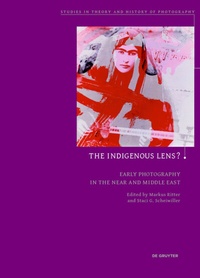
The Indigenous Lens?
Description

The historiography of early photography has scarcely examined Islamic countries in the Near and Middle East, although the new technique was adopted very quickly there by the 1840s. Which regional, local, and global aspects can be made evident? What role did autochthonous image and art traditions have, and which specific functions did photography meet since its introduction? This collective volume deals with examples from Iran, the Ottoman Empire, and the Arab lands and with the question of local specifics, or an "indigenous lens." The contributions broach the issues of regional histories of photography, local photographers, specific themes and practices, and historical collections in these countries. They offer, for the first time in book form, a cross-section through a developing field of the history of photography.
Reviews / Votes
"Zahlreiche Illustrationen machen den Band zu einem wertvollen und lesens- wie anschauenswerten Dokument der Forschung zur frühen Fotografie in südwestasiatischen Gebieten bis hin zu Regionen des Balkans. Der von Ritter und Schweiwiller herausgegebene Band ist eine hochwillkommene Ergänzung der Bemühungen zur Erforschung der visuellen Kulturen der behandelten Regionen."
Rüdiger Lohlker in: Wiener Zeitschrift für die Kunde des Morgenlandes 108 (2018), 511-512
More details
Other editions
Additional editions
Persons
Markus Ritter, University of Vienna; Staci Gem Scheiwiller, California State University Stanislaus, Turlock.
Content
- Intro
- Contents
- FOREWORD
- NOTE ON TRANSLITERATION
- Introduction: Early Photography in the Near and Middle East and the Notion of an "Indigenous Lens"
- Histories
- The Search for an Ottoman Vernacular Photography
- Photography during the Qajar Era, 1842-1925
- Biographies
- Geographies Traced and Histories Told: Photographic Documentation of Land and People by ?Abdollah Mirza Qajar, 1880s-1890s
- Early Photography of the Holy Sites of Islam in the Arabian Peninsula
- Relocating Sevruguin: Contextualizing the Political Climate of the Iranian Photographer Antoin Sevruguin (c. 1851-1933)
- Practices
- The Ottoman in Ottoman Photography: Producing Identity through its Negation
- Written Images: Poems On Early Iranian Portrait Studio Photography (1864-1930) and Constitutional Revolution Postcards (1905-1911)
- The Gate of the Bosporus: Early Photographs of Istanbul and the Dolmabahçe Palace
- The Heroic Lens: Portrait Photography of Ottoman Insurgents in the Nineteenth-Century Balkans-Types and Uses
- lass Plates and Kodak Cameras: Arab Amateur Photography in the "Era of Film"
- Archives
- The Photography Studio of the Naseri Harem in Nineteenth-Century Iran
- The Photograph Alb ums of the Royal Golestan Palace: A Window into the Soci al Hi story of Iran during the Qajar Era
- How a Former Museum of Modern Art Curator Assembled an International History of Photography Collection for Iran in the 1970s
- Works Cited
- LIST OF CONTRIBUTORS
