

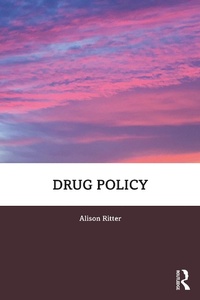
Drug Policy
1st Edition
Published on 29. November 2021
188 pages
978-1-000-48857-9 (ISBN)
Description

Taking a multidisciplinary perspective (including public health, sociology, criminology, and political science amongst others) and using examples from across the globe, this book provides a detailed understanding of the complex and highly contested nature of drug policy, drug policy making, and the theoretical perspectives that inform the study of drug policy. It draws on four different theoretical perspectives: evidence-informed policy, policy process theories, democratic theory, and post-structural policy analysis.
The use and trade in illegal drugs is a global phenomenon. It is viewed by governments as a significant social, legal, and health problem that shows no signs of abating. The key questions explored throughout this book are what governments and other bodies of social regulation should do about illicit drugs, including drug policies aimed at improving health and reducing harm, drug laws and regulation, and the role of research and values in policy development. Seeing policy formation as dynamic iterative interactions between actors, ideas, institutions, and networks of policy advocates, the book explores how policy problems are constructed and policy solutions selected, and how these processes intersect with research evidence and values. This then animates the call to democratise drug policy and bring about inclusive meaningful participation in policy development in order to provide the opportunity for better, more effective, and value-aligned drug policies.
This book will be of great interest to students and scholars of drug policy from a number of disciplines, including public health, sociology, criminology, and political science.
The use and trade in illegal drugs is a global phenomenon. It is viewed by governments as a significant social, legal, and health problem that shows no signs of abating. The key questions explored throughout this book are what governments and other bodies of social regulation should do about illicit drugs, including drug policies aimed at improving health and reducing harm, drug laws and regulation, and the role of research and values in policy development. Seeing policy formation as dynamic iterative interactions between actors, ideas, institutions, and networks of policy advocates, the book explores how policy problems are constructed and policy solutions selected, and how these processes intersect with research evidence and values. This then animates the call to democratise drug policy and bring about inclusive meaningful participation in policy development in order to provide the opportunity for better, more effective, and value-aligned drug policies.
This book will be of great interest to students and scholars of drug policy from a number of disciplines, including public health, sociology, criminology, and political science.
Reviews / Votes
"This is a must-read book for anyone interested in drugs and drug policy. Written in an accessible and engaging style for an international audience, it maps out the key theories, concepts and policy issues using examples from around the world to explain and illustrate. Ritter skilfully takes us on a journey that presents the complexity of drug policy in a way that is accessible, inclusive, impartial and informed. The result is a book that encourages us all to reflect, reassess and aspire to do better."Professor Joanne Neale, Professor of Addictions Qualitative Research. King's College London, UK
"This book explores policy formation and implementation, at levels ranging from the global to the local, and from diverse perspectives, including the role of research, of values and interests, and of citizen participation. Describing and using diverse analytical frames for policy processes and participation, the book draws on the author's detailed knowledge of changing drug policies and is both an excellent review of thinking and research about drug policy, and a useful introduction to policy studies in general."
Professor Robin Room, Distinguished Professor, Centre for Alcohol Policy Research, La Trobe University, Australia; Professor, Centre for Social Research on Alcohol and Drugs, Department of Public Health Sciences, Stockholm University, Sweden
"This book is a comprehensive and genuinely multi-disciplinary guide to a dynamic and highly contested field, written by a world leading expert. It is clear and accessible, but also characterised by sustained and thoughtful engagement with the complexities and challenges of governing drugs. It is this balance, along with Ritter's unsurpassed knowledge of the field, that makes Drug Policy an indispensable and generative text for students, researchers, and practitioners."
Professor Helen Keane, School of Sociology, Research School of Social Sciences, The Australian National University
"Everyone has an opinion about drug policy and there are lots of books expressing those opinions, mostly loud and fat. This slim volume manages to be a calm guide to a contested domain. With great intellectual range and depth, it is comprehensive in terms of elements of the drug problem covered, dispassionate in its examination of different policy positions and constructive in assessing how researchers might influence policy makers."
Peter Reuter. Distinguished University Professor, School of Public Policy and Department of Criminology, University of Maryland, USA
More details
Edition
1. Auflage
Language
English
Place of publication
London
United Kingdom
Publishing group
Taylor & Francis Ltd
Target group
College/higher education
ISBN-13
978-1-000-48857-9 (9781000488579)
Copyright in bibliographic data and cover images is held by Nielsen Book Services Limited or by the publishers or by their respective licensors: all rights reserved.
Schweitzer Classification
Other editions
Additional editions
Person
Alison Ritter, AO is Professor and Director of the Drug Policy Modelling Program at UNSW Sydney. She leads multi-disciplinary drug policy research, is Editor of the International Journal of Drug Policy, and works extensively with governments on drug policy problems.
Content
Acknowledgements A Note On Terminology 1. Drug Policy, An Introduction 2. Drug Policies To Improve Health And Reduce Harm 3. Drug Policies As Laws And Regulations, And Their Policing 4. Improving Drug Policy Choices: The Role Of Research Evidence 5. Analysing Drug Policy Formation 6. Analysing The Discursive Effects Of Drug Policy 7. Influencing Drug Policy: Making Change Happen 8. Democratising Drug Policy
