

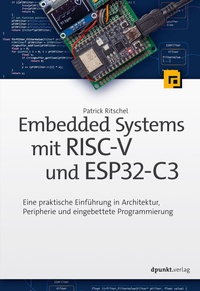
Embedded Systems mit RISC-V und ESP32-C3
Eine praktische Einführung in Architektur, Peripherie und eingebettete Programmierung
Published on 4. May 2023
346 pages
978-3-96910-998-4 (ISBN)
Available for download
Description

Dein Einstieg in Embedded Systems mit RISC-V
- Mit Schritt-für-Schritt-Anleitungen und zahlreiche Abbildungen werden Sie an das Thema herangeführt
- Hands-On-Projekte vermitteln Ihnen grundlegende Konzepte und Funktionsweisen
- Erhalten Sie einen kostengünstigen Start in die Welt der eingebetteten Systeme
Neu und groß im Kommen - RISC-V ist eine auf freier Technologie basierende Befehlssatzarchitektur. In Anwendung im ESP32-C3-DevKitM-1 werden hier grundlegende Konzepte und Funktionsweisen von Mikrocontrollern theoretisch vermittelt.
Mehrere Hands-On-Projekte dienen außerdem dazu, Leser*innen einen ersten Einblick zu geben und Sie für das selbstständige Programmieren mit Mikrocontrollern vorzubereiten und das Gelernte Schritt für Schritt zu vertiefen.
Das Werk ist in drei Teile gegliedert, welche aufeinander aufbauen. Teil I geht hierbei auf den Aufbau eines RISC-V-Mikroprozessors und die hardwarenahe Programmierung ein. Hierbei werden den Leser:innen wichtige Grundlagen mit auf den Weg gegeben. Der zweite Teil setzt den Fokus auf das Erlernen von elektrotechnischen Grundlagen und wie Peripheriemodule angesteuert werden. Im letzten Teil wird ein Pulsoximeter als Beispiel genommen, wie verschiedene Internetprotokolle funktionieren.
More details
Other editions
Additional editions
Patrick Ritschel
Embedded Systems mit RISC-V und ESP32-C3
Eine praktische Einführung in Architektur, Peripherie und eingebettete Programmierung
Book
05/2023
dpunkt
€44.90
Article exhausted; check different version
Patrick Ritschel
Embedded Systems mit RISC-V und ESP32-C3
Eine praktische Einführung in Architektur, Peripherie und eingebettete Programmierung
Book
05/2023
1st Edition
dpunkt
€39.90
Available immediately
Person
Prof.(FH) Dipl-Ing. Patrick Ritschel studierte Informatik an der TU Wien. Anschließend leitete er die Entwicklung von Smart Cards bei der Winter AG. Seit 2003 unterrichtet er embedded Systems, Programmierung und Algorithmik in C, C++ und Java, sowie Mobile Computing an der Fachhochschule Vorarlberg. Er gründete die clownfish IT GmbH, die eingebettete Anwendungen im B2B-Bereich anbietet. In seiner Freizeit zieht es ihn mit seiner Familie auf die Theaterbühne, um zu spielen, zu singen und auch Theaterstücke zu schreiben.
Content
- Cover
- Über den Autor
- Titel
- Impressum
- Vorwort
- Inhaltsverzeichnis
- I Mikrocontrollergrundlagen
- 1 Einleitung
- 1.1 Ziel des Buchs
- 1.2 Struktur des Buches
- 1.3 Zielpublikum
- 1.4 Gebrauchsanweisung
- 1.4.1 Konventionen
- 2 Hallo, Welt!
- 2.1 Wahl der Programmiersprache
- 2.2 Benötigte Komponenten für die Applikationsentwicklung
- 2.2.1 Development Board
- 2.2.2 Software für die Entwicklung
- 2.3 Die erste Applikation
- 3 Der Mikroprozessor
- 3.1 Prozessorarchitektur
- 3.1.1 Eine kleine Aufgabe
- 3.1.2 Die Registerbank
- 3.1.3 Die Arithmetic Logic Unit (ALU)
- 3.1.4 Datenspeicher
- 3.1.5 Befehlsspeicher
- 3.1.6 Steuerwerk
- 3.1.7 Weitere Einheiten
- 3.1.8 Der Prozessor
- 3.1.9 Pipeline
- 3.2 Instruction Set Architecture
- 3.2.1 RISC-V
- 3.2.2 sum_up_n in Assembler
- 3.2.3 sum_up_n-Maschinensprache
- 3.3 Performance
- 3.3.1 Control and Status Registers
- 3.3.2 Funktionsaufruf
- 3.3.3 Optimierung des Codes
- 3.3.4 Änderung des Verfahrens
- 4 Der Mikrocontroller
- 4.1 Aufbau eines Mikrocontrollers
- 4.1.1 Test des Zufallszahlengenerators
- 4.1.2 Das Bussystem
- 4.1.3 ESP32-C3 Memory Map
- 4.2 Speicher
- 4.2.1 Speichertechnologien
- 4.2.2 Speicherzugriffe in Software
- 4.2.3 Cache
- 4.2.4 Linker
- 4.3 Peripheriemodule
- 4.3.1 Peripheriezugriff
- 4.3.2 Durchführung des Zufallszahlentests
- 4.3.3 Informationen der Hersteller
- 4.3.4 Speicherlayout der Peripherie
- 4.3.5 Bits als Schalter
- 4.4 Bitmaskierung
- 4.4.1 Klassische Aussagenlogik
- 4.4.2 Bitweise Operatoren in C
- 4.4.3 Bitmaskierung
- 4.5 Zusammenfassung
- II Peripheriemodule
- 5 Digitale Ein-/Ausgabe
- 5.1 Peripherie
- 5.2 Projekt Pulsoximeter
- 5.3 Elektrotechnische Grundlagen
- 5.3.1 Strom und Spannung
- 5.3.2 Widerstand und Ohm'sches Gesetz
- 5.3.3 Halbleiter und Diode
- 5.3.4 Schaltungsaufbau »LED an Batterie«
- 5.4 LED schalten
- 5.4.1 Transistor
- 5.4.2 Logische Funktionen mit CMOS
- 5.4.3 GPIO-Modul
- 5.4.4 Schaltungsaufbau ESP32-C3 mit LEDs
- 5.4.5 Pin-Multiplexing
- 5.4.6 Set-/Reset-Register
- 5.4.7 Bitfeld und Union in C
- 5.4.8 Gesamtes Modul kapseln
- 5.4.9 API des Herstellers
- 5.4.10 Oszilloskop als Hilfsmittel
- 5.4.11 Kondensator
- 5.4.12 Leistung, Arbeit, Batterielebensdauer
- 5.5 Taster anschließen
- 5.5.1 GPIO Eingangssignalpfad
- 6 Interrupts und Exceptions
- 6.1 Exceptions und Interrupts
- 6.1.1 RISC-V-Ausnahmebehandlung
- 6.1.2 Aktivierung des Interrupts
- 6.1.3 Exception Handler
- 6.2 Schichtenarchitektur und Callback
- 6.2.1 Schichtenarchitektur
- 6.2.2 Callbacks
- 6.3 Interrupt bei Tastendruck
- 6.4 Sourcecodeverwaltung
- 6.4.1 Module in Unterverzeichnissen
- 6.4.2 Komponentenmodell des ESP-IDF
- 6.4.3 Versionsverwaltung
- 7 Externe Komponenten digital anschließen
- 7.1 Display ansteuern
- 7.2 Konfiguration im ESP-IDF
- 7.3 I2C-Protokoll
- 7.3.1 SMBus
- 7.4 SPI-Schnittstelle
- 7.4.1 Bit-Banging
- 7.4.2 DMA: Direct Memory Access
- 7.4.3 Dateispeicherung auf SD-Karten
- 7.5 WS2812B
- 7.6 Weitere Kommunikationsschnittstellen
- 7.6.1 Serielle Schnittstelle, RS-232
- 7.6.2 I2S
- 7.6.3 CAN
- 7.6.4 Funkschnittstellen
- 8 Analoge Werte verarbeiten
- 8.1 Die Welt ist analog
- 8.1.1 Abtastung (Sampling)
- 8.1.2 Analog-Digital-Wandlung
- 8.1.3 Messen am Spannungsteiler
- 8.2 Werte filtern
- 8.2.1 Filterimplementierung
- 8.3 Den Herzschlag erkennen
- 8.3.1 Diskrete Fourier-Transformation
- 8.4 Die Zeit messen
- 8.4.1 Taktgeber
- 8.5 Das Timer-Modul
- 8.5.1 Timer des ESP32-C3
- 8.5.2 Systemzeit und Kalenderzeit
- 8.5.3 Zeitsynchronisierung
- 8.5.4 Pulsweitenmodulation (PWM)
- 8.5.5 Weitere Komponenten
- 8.6 Zusammenfassung
- III Embedded System
- 9 Embedded Betriebssystem
- 9.1 Embedded Applikationsmodell
- 9.2 Multitasking
- 9.3 Echtzeitbetriebssystem
- 9.3.1 FreeRTOS
- 9.4 Nebenläufigkeit
- 9.4.1 Semaphor
- 9.4.2 Kritische Region
- 9.4.3 Deadlock
- 9.4.4 Producer/Consumer
- 9.4.5 Message-Queue
- 9.4.6 Mutex und Signalisierung
- 9.4.7 Prioritätenbasiertes Scheduling
- 9.5 Systemkontext
- 9.6 Gerätetreiber
- 9.6.1 POSIX-Standard
- 10 Internet der Dinge
- 10.1 Internet
- 10.1.1 Wi-Fi-Konfiguration
- 10.1.2 Berkeley Sockets
- 10.1.3 UDP
- 10.1.4 TCP
- 10.1.5 Datenformate
- 10.1.6 Header
- 10.2 Cloud-Zugriff
- 10.2.1 REST und CoAP
- 10.2.2 MQTT-Protokoll
- 10.2.3 Webserver
- 10.3 Bluetooth
- 10.3.1 NimBLE Stack
- 10.3.2 Generic Access Profile (GAP)
- 10.3.3 GATT-Profil und ATT-Protokoll
- 10.4 Power-Management
- 10.4.1 Sleep Modes
- 10.4.2 Power-Management-Algorithmus
- 11 Schlusswort
- IV Anhang
- A Webseite zum Buch
- A.1 Material zum ESP32-C3 und ESP-IDF
- A.2 Beispiele des Buchs
- A.3 Übungsbeispiele
- A.4 Errata
- Literaturverzeichnis
- Index
