

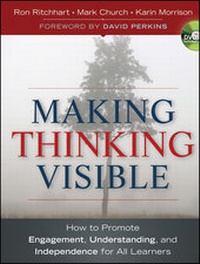
Making Thinking Visible
Description

More details
Other editions
Additional editions
Persons
Content
Chapter 2
Putting Thinking at the Center of the Educational Enterprise
How does one learn to teach? More to the point, how does one learn to teach well? We have to say the more time we spend in education, the more vexing we find this question. Not because there aren't ready answers out there, but because the answers often seem to be too ready, too simplistic, and self-perpetuating in nature. It is easy to think of the job of teaching as delivering the prescribed curriculum to students. Indeed, when we train to be teachers we often focus on the methods of delivering content. There are even courses at the university level referred to as "methods" courses. In our early years of teaching we often struggle with getting the curriculum across and agonize over failed lessons aimed at doing just that. This view of teaching is ubiquitous, generally shared by parents and students as well as teachers themselves. We see it playing out in our language when we talk about teacher "training," which usually means training in new methods. We see it in policymakers' efforts to improve education, which generally focus on changing the curriculum with the assumption that teachers will then deliver that curriculum and schools will improve as a result. We see it in the calls for enhanced content knowledge for teachers, an important thing to be sure, but oftentimes promoted as sufficient for effective teaching in and of itself.
We believe this view of teaching, as little more than the delivery of content, is not only an overly simplistic view of teaching but also a dangerous one in that it puts the focus on the teacher and not the learner, casting the learner in a passive role and assuming that learning is merely taking in what has been delivered. As a result of this view of teaching and learning, assessments focus on the degree of absorption by the student of what the teaching has delivered. Thus, we create a distorted view of teaching that is self-reinforcing and divorced from what we know about supporting effective learning. We judge teaching effectiveness based on student absorption of material, and teaching becomes defined as the delivery of that material. The educational system becomes distorted, being more concerned with producing effective test takers than successful learners (Gallagher, 2010). Consequently, the answer to the question "How does one learn to teach?" becomes, "By mastering the content and developing some delivery strategies." Oh, and you might want to learn some good classroom management techniques to deal with students' rebellion against their imposed passivity.
In contrast, when we place the learner at the hub of the educational enterprise, our focus as teachers shifts in a most fundamental way that has the potential to profoundly affect the way we define teaching. With the learner at the center of the educational enterprise, rather than at the end, our role as teachers shifts from the delivery of information to fostering students' engagement with ideas. Instead of covering the curriculum and judging our success by how much content we get through, we must learn to identify the key ideas and concepts with which we want our students to engage, struggle, question, explore, and ultimately build understanding. Our goal must be to make the big ideas of the curriculum accessible and engaging while honoring their complexity, beauty, and power in the process. When there is something important and worthwhile to think about and a reason to think deeply, our students experience the kind of learning that has a lasting impact and powerful influence not only in the short term but also in the long haul. They not only learn; they learn how to learn.
In Chapter One, we shared how this deeper understanding of the educational enterprise was pivotal in Mark Church's evolution as a teacher. He is not the only one for whom this is true of course. The literature on teacher change suggests that this shift from a focus on teaching to that of learning is a central aspect of many teachers' professional growth and integral to the process of learning to be an effective practitioner (Hatch, 2006; Intrator, 2002, 2006; McDonald, 1992; Palmer, 1998). Rather than seeing learning as the passive taking in of information, we must honor the fact that learning occurs as a result of our thinking and active sense making. Consequently, as teachers interested in both students' learning and understanding, we have two chief goals: (1) creating opportunities for thinking and (2) making students' thinking visible. Although these goals are not the same, they are synergistic and interdependent. When we create opportunities for thinking, we establish both the context and the need for making students' thinking visible.
In his book Smart Schools, our colleague David Perkins (1992) makes a case for the importance of developing opportunities for thinking: "Learning is a consequence of thinking. Retention, understanding, and the active use of knowledge can be brought about only by learning experiences in which learners think about and think with what they are learning.. Far from thinking coming after knowledge, knowledge comes on the coattails of thinking. As we think about and with the content that we are learning, we truly learn it" (p. 8). Thus, thinking is at the center of the learning enterprise and not a mere add-on, something to do if there is time. We as teachers must acknowledge that when we reduce the amount of thinking we ask of our students, we reduce the amount of learning as well. However, even when we create opportunities for thinking, we must realize that students' thinking may still be invisible to us. To make sure thinking isn't left to chance and to provide us with the information we need in order to respond to students' learning needs, we must also make their thinking visible.
How Does Visibility Serve Both Learning and Teaching?
When we make thinking visible, we get not only a window into what students understand but also how they are understanding it. Uncovering students' thinking gives us evidence of students' insights as well as their misconceptions. We need to make thinking visible because it provides us with the information we as teachers need to plan opportunities that will take students' learning to the next level and enable continued engagement with the ideas being explored. It is only when we understand what our students' are thinking, feeling, and attending to that we can use that knowledge to further engage and support them in the process of understanding. Thus, making students' thinking visible becomes an ongoing component of effective teaching.
The Harvard Smithsonian Center for Astrophysics has famously documented how teachers' inattention to students' thinking leads to superficial learning and ingrained misconceptions about science even for students who succeed at the highest level. In their Minds of Our Own video, an honors chemistry teacher admits that "I don't like asking 'why' questions on tests. I spend so much time covering the concepts then I ask the question, 'Why?' and I get back so many different answers. It's sometimes very depressing to see some of the answers that you get back when you ask 'Why?' questions. They are valuable, but as a teacher it is sometimes very frustrating to see some of the reasons students think a certain scientific phenomenon takes place." This teacher, far from being cavalier or uncaring, is expressing the bind that he finds himself in when teaching for the test. He knows his students don't really understand what is being taught, but in the delivery paradigm of education he focuses on covering the material for the test and keeps their thinking invisible so as to allow for the semblance of learning, an illusion that equates scores on a test with evidence of learning. However widespread and ubiquitous this practice is-and make no mistake, teachers all over the world have been forced into accepting this compromise-this illusion, some might say delusion, about what real learning is serves no one well, least of all students who wind up being ill prepared for future learning (Schwartz, Sadler, Sonnert, & Tai, 2009). It also robs the teacher of the ability to confront students' misconceptions and design experiences to advance their understanding.
In contrast, our colleague Tina Grotzer, who directs the Complex Causality Project at Harvard Project Zero, has designed a series of modules on scientific concepts that directly confronts students' misconceptions and seeks to reveal their thinking so as to restructure it. For instance, in a unit on density, students watch as the teacher drops two candles of equal diameter, one short and one long, into two containers of liquid. The shorter candle floats while the larger candle sinks. Students are asked to write what they observed and explain why the event they witnessed happened. In doing so, students are encouraged to develop and put forth theories of explanation drawing on their scientific knowledge. Thus, at the outset students' thinking is surfaced through their words and drawings. The teacher then removes the candles from the two containers and switches them. This time the larger candle floats and the smaller one sinks; an unexpected outcome for most students. Again, students are asked to write about what they observed and to develop an explanation. Students then share their reactions and discuss how the simple experiment changed where they focused their...
