

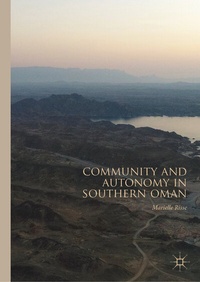
Community and Autonomy in Southern Oman
Description

This book explores how there is latitude for people to make their own choices and how the chances to assert independence change over time in a Muslim, Arab, tribal culture. The book first gives a brief overview of day-to-day life in the Dhofar region of southern Oman, then focuses on how the traits of self-control and self-respect are linked in the everyday actions of several groups of tribes who speak Gibali (Jibbali, also known as Shari/S?eret), a non-written, Modern South Arabian language. Although no work can express the totality of a culture, this text describes how Gibalis are constantly shifting between preserving autonomy and signaling membership in family, tribal, and national communities. The work reflects observations and conclusions from over ten years of research into the history and culture of the Dhofar region along with longstanding, deep involvement with both men and women in the Gibali community.
More details
Other editions
Additional editions

Person
Marielle Risse, Ph.D., has lived and worked in Oman for over 12 years, teaching literature, culture and education at the university level. She has presented at the conferences of the British Society for Middle Eastern Studies, Middle Eastern Studies Association, Royal Geographical Society, British Foundation for the Study of Arabia, American Comparative Literature Association, and the Modern Language Association. Her work has been published in the Proceedings of the Seminar for Arabian Studies , Pedagogy , Journeys , Ariel , Interdisciplinary Humanities , The Chronicle of Higher Education, and The Washington Post.
Content
Dedication.-Acknowledgements.-Preface.-Chapter 1: Language, Culture, Methodology and Literature Review.-Chapter 2: Situating Gibalis: Governance, History, Religion and Tribes.-Chapter 3: Community/Autonomy in Daily Life: People and Places.-Chapter 4: Community/Autonomy in Daily Life: Practices and Perceptions.-Chapter 5: Community/Autonomy: Honor and Self-Respect.-Chapter 6: "Why Would I Hurt a Woman?": The Absence of Honor Killing in Gibali Culture.-Chapter 7: Generosity and Gifts in Gibali Culture.-Coda.
