

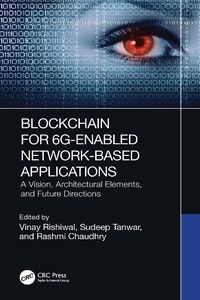
Blockchain for 6G-Enabled Network-Based Applications
A Vision, Architectural Elements, and Future Directions
1st Edition
Published on 4. August 2022
282 pages
978-1-000-62544-8 (ISBN)
Description

This book provides a comprehensive overview of blockchain for 6G-enabled network-based applications. Following the key services of blockchain technology, this book will be instrumental to ideate and understand the necessities, challenges, and various case studies of different 6G-based applications. The emphasis is on understanding the contributions of blockchain technology in 6G-enabled applications, and its aim is to give insights into evolution, research directions, challenges, and the ways to empower 6G applications through blockchain.
The book consistently emphasizes the missing connection between blockchain and 6G-enabled network applications. The entire ecosystem between these two futuristic technologies is explained in a comprehensive manner.
The book constitutes a one-stop guide to students, researchers, and industry professionals.
The book progresses from a general introduction toward more technical aspects while remaining easy to understand throughout.
Comprehensive elaboration of material is supplemented with examples and diagrams, followed by easily understandable approaches with regard to technical information given thereon.
Blockchain and its applications in 6G-enabled applications can drive many powerful solutions to real-world technical, scientific, and social problems. This book presents the most recent and exciting advances in blockchain for 6G-enabled network applications. Overall, this book is a complete outlet and is designed exclusively for professionals, scientists, technologists, developers, designers, and researchers in network technologies around blockchain integration with IoT, blockchain technology, information technology, and 6G-enabled industrial applications. Secondary readers include professionals involved in policy making and administration, security of public data and law, network policy developers, blockchain technology experts, regulators, and decision makers in government administrations.
The book consistently emphasizes the missing connection between blockchain and 6G-enabled network applications. The entire ecosystem between these two futuristic technologies is explained in a comprehensive manner.
The book constitutes a one-stop guide to students, researchers, and industry professionals.
The book progresses from a general introduction toward more technical aspects while remaining easy to understand throughout.
Comprehensive elaboration of material is supplemented with examples and diagrams, followed by easily understandable approaches with regard to technical information given thereon.
Blockchain and its applications in 6G-enabled applications can drive many powerful solutions to real-world technical, scientific, and social problems. This book presents the most recent and exciting advances in blockchain for 6G-enabled network applications. Overall, this book is a complete outlet and is designed exclusively for professionals, scientists, technologists, developers, designers, and researchers in network technologies around blockchain integration with IoT, blockchain technology, information technology, and 6G-enabled industrial applications. Secondary readers include professionals involved in policy making and administration, security of public data and law, network policy developers, blockchain technology experts, regulators, and decision makers in government administrations.
More details
Edition
1. Auflage
Language
English
Place of publication
London
United Kingdom
Publishing group
Taylor & Francis Ltd
Target group
College/higher education
Professional and scholarly
Illustrations
20 Tables, black and white; 42 Line drawings, black and white; 27 Halftones, black and white; 69 Illustrations, black and white
ISBN-13
978-1-000-62544-8 (9781000625448)
Copyright in bibliographic data and cover images is held by Nielsen Book Services Limited or by the publishers or by their respective licensors: all rights reserved.
Schweitzer Classification
Other editions
Additional editions
Vinay Rishiwal | Sudeep Tanwar | Rashmi Chaudhry
Blockchain for 6G-Enabled Network-Based Applications
A Vision, Architectural Elements, and Future Directions
Book
10/2024
1st Edition
CRC Press
€78.80
Shipment within 10-20 days
Vinay Rishiwal | Sudeep Tanwar | Rashmi Chaudhry
Blockchain for 6G-Enabled Network-Based Applications
A Vision, Architectural Elements, and Future Directions
Book
08/2022
1st Edition
CRC Press
€148.80
Shipment within 10-20 days
Persons
Dr. Vinay Rishiwal, PhD is working as a Professor in the Department of Computer Science and Information Technology, Faculty of Engineering and Technology, MJP Rohilkhand University, Bareilly, Uttar Pradesh, India. He obtained B.Tech degree in Computer Science and Engineering in the year 2000 from MJP Rohilkhand University (SRMSCET), India and received his PhD in Computer Science and Engineering from Gautam Buddha Technical University, Lucknow, India, in the year 2011. He has 20 years of experience into academics. He is a senior member of IEEE and worked as Convener Student Activities Committee, IEEE Uttar Pradesh Section. He has published more than 90 research papers in various journals and conferences of International repute. He is a General/Conference chair of four International Conferences namely ICACCA, IoT-SIU, MARC 2020 and ICAREMIT. He has received many awards as best paper and best orator in various conferences. Dr. Rishiwal has visited many countries for academic purposes and worked upon many projects of MHRD and UGC. His current research interest includes Wireless Sensor Networks, IoT, Cloud Computing, Social networks and Blockchain Technology. He was invited as Guest Editor/Editorial Board Members of many International Journals, invited for keynote Speaker in many International Conferences held in India and abroad.
Dr. Sudeep Tanwar is full Professor in the Computer Science and Engineering Department at Institute of Technology, Nirma University, Ahmedabad, Gujarat, India. He is visiting Professor in Jan Wyzykowski University in Polkowice, Poland and University of Pitesti in Pitesti, Romania. He received B.Tech in 2002 from Kurukshetra University, India, M.Tech (Honor's) in 2009 from Guru Gobind Singh Indraprastha University, Delhi, India and Ph.D. in 2016 with specialization in Wireless Sensor Network. He has authored or coauthored more than 200 technical research papers published in leading journals and conferences from the IEEE, Elsevier, Springer, Wiley, etc. Some of his research findings are published in top cited journals such as IEEE TNSE, IEEE Transactions on TVT, IEEE Transactions on Industrial Informatics, IEEE Access, Computer Communication, Applied Soft Computing, Journal of Network and Computer Application, Pervasive and Mobile Computing, International Journal of Communication System, Telecommunication System, Computer and Electrical Engineering and IEEE Systems Journal. He has also published 10 edited/authored books with International/National Publishers like IET, Springer. He has guided many students leading to M.E./M.Tech and guiding students leading to Ph.D. He is Associate Editor of IJCS, Wiley and Security and Privacy Journal, Wiley. His current interest includes Wireless Sensor Networks, Fog Computing, Smart Grid, IoT, and Blockchain Technology. He was invited as Guest Editors/Editorial Board Members of many International Journals, invited for keynote Speaker in many International Conferences held in Asia and invited as Program Chair, Publications Chair, Publicity Chair, and Session Chair in many International Conferences held in North America, Europe, Asia and Africa. He has been awarded best research paper awards from IEEE GLOBECOM 2018, IEEE ICC 2019, and Springer ICRIC-2019. He has Google scholar citations more than 1200 with H-index 18 and i-10 Index 38.
Dr. Rashmi Chaudhry is an Assistant Professor in the Computer Science and Engineering department at Dr. Shyama Prasad Mukherjee International Institute of Information Technology Naya Raipur, Sector 24, Naya Raipur, Chhattisgarh. Prior to joining IIITNR, she was a faculty member in TIET, Patiala, Punjab, India. She received her Ph.D. from ABV-IIITM, Gwalior and M.Tech from IIT (Indian School of Mines), Dhanbad, India. She has been a visiting research scholar at Anglia Ruskin University, Chelmsford, U.K. in 2015 under UKIERI project between India and U.K. She has published research papers in leading journals and conferences of IEEE, Elsevier and Springer. Her current interest includes Wireless Sensor Networks, IoT, Fog Computing, Machine Learning and Intelligent Transportation Systems.
Dr. Sudeep Tanwar is full Professor in the Computer Science and Engineering Department at Institute of Technology, Nirma University, Ahmedabad, Gujarat, India. He is visiting Professor in Jan Wyzykowski University in Polkowice, Poland and University of Pitesti in Pitesti, Romania. He received B.Tech in 2002 from Kurukshetra University, India, M.Tech (Honor's) in 2009 from Guru Gobind Singh Indraprastha University, Delhi, India and Ph.D. in 2016 with specialization in Wireless Sensor Network. He has authored or coauthored more than 200 technical research papers published in leading journals and conferences from the IEEE, Elsevier, Springer, Wiley, etc. Some of his research findings are published in top cited journals such as IEEE TNSE, IEEE Transactions on TVT, IEEE Transactions on Industrial Informatics, IEEE Access, Computer Communication, Applied Soft Computing, Journal of Network and Computer Application, Pervasive and Mobile Computing, International Journal of Communication System, Telecommunication System, Computer and Electrical Engineering and IEEE Systems Journal. He has also published 10 edited/authored books with International/National Publishers like IET, Springer. He has guided many students leading to M.E./M.Tech and guiding students leading to Ph.D. He is Associate Editor of IJCS, Wiley and Security and Privacy Journal, Wiley. His current interest includes Wireless Sensor Networks, Fog Computing, Smart Grid, IoT, and Blockchain Technology. He was invited as Guest Editors/Editorial Board Members of many International Journals, invited for keynote Speaker in many International Conferences held in Asia and invited as Program Chair, Publications Chair, Publicity Chair, and Session Chair in many International Conferences held in North America, Europe, Asia and Africa. He has been awarded best research paper awards from IEEE GLOBECOM 2018, IEEE ICC 2019, and Springer ICRIC-2019. He has Google scholar citations more than 1200 with H-index 18 and i-10 Index 38.
Dr. Rashmi Chaudhry is an Assistant Professor in the Computer Science and Engineering department at Dr. Shyama Prasad Mukherjee International Institute of Information Technology Naya Raipur, Sector 24, Naya Raipur, Chhattisgarh. Prior to joining IIITNR, she was a faculty member in TIET, Patiala, Punjab, India. She received her Ph.D. from ABV-IIITM, Gwalior and M.Tech from IIT (Indian School of Mines), Dhanbad, India. She has been a visiting research scholar at Anglia Ruskin University, Chelmsford, U.K. in 2015 under UKIERI project between India and U.K. She has published research papers in leading journals and conferences of IEEE, Elsevier and Springer. Her current interest includes Wireless Sensor Networks, IoT, Fog Computing, Machine Learning and Intelligent Transportation Systems.
Content
Preface. About the Editors. List of Contributors. 1 Evolution and Innovation of Blockchain Paradigms for the 6G Ecosystem. 2 Empowering 6G Networks through Blockchain Architecture. 3 Blockchain Technology and 6G: Trends, Challenges, and Research Directions. 4 Blockchain and Artificial Intelligence-Based Radio Access Network Slicing for 6G Networks. 5 Key Generation: Encryption and Decryption Using Triangular Cubical Approach for Blockchain in the 6G Network and Cloud Environment. 6 Blockchain-Based Efficient Resource Allocation and Minimum Energy Utilization in Cloud Computing Using SMO. 7 Role of Blockchain Technology in Intelligent Transportation Systems. 8 Blockchain and 6G Communication with Evolving Applications: Forecasts and Challenges. 9 Emergence of Blockchain Applications with the 6G-Enabled IoT-Based Smart City. 10 Blockchain: Insights Related to Application and Challenges in the Energy Sector. Index.
