

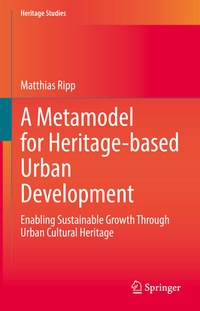
A Metamodel for Heritage-based Urban Development
Description

This book proposes a Metamodel for heritage-based urban development, based on urban morphology, governance theory, and the metamodeling concept of John P. Van Gigch. Building on international policies such as the 2011 Recommendation for Historic Urban Landscapes and the results of the 2016 Urban Habitat III Conference, cultural heritage is now regarded as a potential resource for sustainable urban development. While more and more evidence of the potential benefits of cultural heritage for sustainable development has been published, this book is the first to develop and design a Metamodel that can be universally applied in a wide variety of settings.
The Metamodel was developed using grounded theory and design research methodology and is based on three successful case-models from European contexts. The book includes three application scenarios that elaborate how the metamodel can be used to design, evaluate, and improve processes where cultural heritage is a starting point forsustainable urban development.Reviews / Votes
"Metamodel for Heritage- Based Urban Development, is a valuable contribution to urban heritage studies as it offers a new methodology for understanding the complexity of the topic. . The systemic approach presented in this book responds to this need as it brings together theories, personal experiences . . The approach presented here is equally useful for students of heritage studies focusing on process. The research methodology is inspiring for researchers in the heritage field." (Yonca Erkan, Built Heritage, Vol. 7 (1), 2023)
More details
Other editions
Additional editions
Person
Dr. Matthias Ripp, a senior heritage manager with a background of historical geography, is coordinating the "Old Town of Regensburg with Stadtamhof" site. He is active in numerous networks such as Heritage Europe and ICOMOS. He coordinated the EU HerO (Heritage as Opportunity) project and chairs the UNESCO world heritage working group on historic city centres of the German Association of Cities. Since November 2011 he has also been regional coordinator for the North West European and North-American region of the Organisation of World Heritage Heritage Cities (OWHC), is teaching at different Universities and works as a trainer, facilitator and consultant.
