

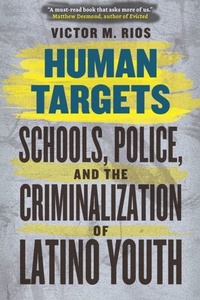
Human Targets
Schools, Police, and the Criminalization of Latino Youth
1st Edition
Published on 31. May 2024
221 pages
978-0-226-09104-4 (ISBN)
Description

At fifteen, Victor Rios found himself a human target-flat on his ass amid a hail of shotgun fire, desperate for money and a place on the street. Faced with the choice of escalating a drug turf war or eking out a living elsewhere, he turned to a teacher, who mentored him and helped him find a job at an auto shop. That job would alter the course of his whole life-putting him on the road to college and eventually a PhD. Now, Rios is a rising star, hailed for his work studying the lives of African American and Latino youth.
In Human Targets, Rios takes us to the streets of California, where we encounter young men who find themselves in much the same situation as fifteen-year-old Victor. We follow young gang members into schools, homes, community organizations, and detention facilities, watch them interact with police, grow up to become fathers, get jobs, get rap sheets-and in some cases get killed. What is it that sets apart young people like Rios who succeed and survive from the ones who don't? Rios makes a powerful case that the traditional good kid/bad kid, street kid/decent kid dichotomy is much too simplistic, arguing instead that authorities and institutions help create these identities-and that they can play an instrumental role in providing young people with the resources for shifting between roles. In Rios's account, to be a poor Latino youth is to be a human target-victimized and considered an enemy by others, viewed as a threat to law enforcement and schools, and burdened by stigma, disrepute, and punishment. That has to change.
This is not another sensationalistic account of gang bangers. Instead, the book is a powerful look at how authority figures succeed-and fail-at seeing the multi-faceted identities of at-risk youths, youths who succeed-and fail-at demonstrating to the system that they are ready to change their lives. In our post-Ferguson era, Human Targets is essential reading.
In Human Targets, Rios takes us to the streets of California, where we encounter young men who find themselves in much the same situation as fifteen-year-old Victor. We follow young gang members into schools, homes, community organizations, and detention facilities, watch them interact with police, grow up to become fathers, get jobs, get rap sheets-and in some cases get killed. What is it that sets apart young people like Rios who succeed and survive from the ones who don't? Rios makes a powerful case that the traditional good kid/bad kid, street kid/decent kid dichotomy is much too simplistic, arguing instead that authorities and institutions help create these identities-and that they can play an instrumental role in providing young people with the resources for shifting between roles. In Rios's account, to be a poor Latino youth is to be a human target-victimized and considered an enemy by others, viewed as a threat to law enforcement and schools, and burdened by stigma, disrepute, and punishment. That has to change.
This is not another sensationalistic account of gang bangers. Instead, the book is a powerful look at how authority figures succeed-and fail-at seeing the multi-faceted identities of at-risk youths, youths who succeed-and fail-at demonstrating to the system that they are ready to change their lives. In our post-Ferguson era, Human Targets is essential reading.
All prices
More details
Other editions
Additional editions

Book
03/2017
University of Chicago Press
€55.80
Article exhausted; check different version
Book
03/2017
University of Chicago Press
€23.56
Shipment within 10-20 days
Person
Victor M. Rios is professor of sociology at the University of California, Santa Barbara. He is the author of
Punished: Policing the Lives of Black and Latino Boys and
Street Life: Poverty, Gangs, and a Ph.D.
Content
- Intro
- Contents
- Foreword by James Diego Vigil
- Introduction. Crossing Institutional Settings
- Chapter One. The Probation School
- Chapter Two. The Liquor Store and the Police
- Chapter Three. Cultural Misframing
- Chapter Four. Multiple Manhoods
- Chapter Five. The Mano Suave and Mano Dura of Stop and Frisk
- Chapter Six. Immigrant Targets
- Conclusion. From Culture of Control to Culture of Care: Policy and Program Implications
- Methodological Appendix
- Acknowledgments
- Notes
- References
- Index
