

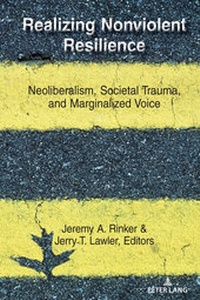
Realizing Nonviolent Resilience
Description

Current neoliberal social and economic realities have had enormous impacts on the abilities of oppressed groups and marginalized communities to realize resistance and innate resiliencies. How does the ubiquity of neoliberal economic forces exacerbate traumatized populations' helplessness, and, thereby, influence their inability to grapple with their oppressors and engage in fruitful change solutions? This edited volume asks how nonviolent conflict practitioners might intervene to 'treat' traumatized, and often marginalized, populations suspended in the predicament of 'acting in' and 'acting out' their collective traumas. Treating trauma is an integral aspect of successful peacebuilding work. This work aims to explore the role of trauma in peacebuilding and illuminate the ways that neoliberal marginalization impacts trauma-informed peace work.
More details
Other editions
Additional editions
Persons
Jeremy A. Rinker received his PhD from George Mason University/School for Conflict Analysis & Resolution and his MA in religious studies from University of Hawaii. He is an assistant professor at the University of North Carolina Greensboro's Department of Peace and Conflict Studies. Rinker is founding Editor of the Journal of Transdisciplinary Peace Praxis.
Jerry T. Lawler, PhD is a psychologist at the Greater Baltimore Counseling Center and Safe Harbor Behavioral Health, Baltimore. He recieved his MA in psychology from San Jose State University and his PhD in clinical psychology from California School of Professional Psychology (now Alliant University). He has been in private practice in Baltimore since 2001.
Content
Jeremy A. Rinker/Jerry T. Lawler: Introduction - Acknowledgments - Michael Minch: Neoliberalism as a Violence System - Jeremy A. Rinker/Jerry T. Lawler: Toward Best Practices in Trauma-Informed Peacebuilding: Systematizing Interventions in Protracted - Holly Sienkiewicz/Maura Nsonwu/Elizabeth Biddle/Natacha Nikokeza, - Paige Moore/Mary Anne Busch: "It is like we have died, but we are still breathing": The Trauma of Housing Resettled Refugees Within a Neoliberal Model - Cindy Brooks Dollar: Trauma, Yoga, and Trauma Recovery: From the Clinical to the Sociological - Shelly Clay-Robison: The Arts Are Not for Sale: Addressing Cultural Trauma and Prioritizing People over Profit in Yogyakarta, Indonesia - Autumn R. Cockrell-Abdullah: Interrupting the Cycle of Violence: Art, Marginalization and Collective National Trauma in Iraqi Kurdistan -Margarita Tadevosyan: Peacebuilding Work in Restricted Political Environments: Local NGO-Government Relations in the South Caucasus - Matthew Bereza: Local Responses to Neoliberalism and Historical Trauma in El Salvador - Karina V. Korostelina: An Identity-Based Approach to Community Resilience - Joe Cole: Ecovillages, Sustainability, and Social and Environmental Healing - Jeremy A. Rinker/Jerry T. Lawler: Afterword and Future Directions - Contributors' Biographies -Index.
