

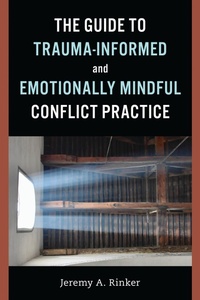
The Guide to Trauma-Informed and Emotionally Mindful Conflict Practice
1st Edition
Published on 15. October 2024
1 pages
979-8-7651-9352-5 (ISBN)
Description

Restoring social harmony requires both emotion and the difficult embrace of past felt traumas.
Jeremy A. Rinker provides a clarion call for practitioners to bravely explore human emotions and past trauma. He interrogates current conflict intervention practice-moving past interest-based negotiation and needs-based conflict resolution-and provides a guide for more emotionally mindful and trauma-informed conflict intervention work.
The Guide to Trauma-Informed and Emotionally Mindful Conflict Practice addresses the underattended aspects of emotions and foregrounds historical harms in the work of resolving social conflict. It critically investigates trauma and human emotions as an underexplored resource in addressing local and entrenched community violence and integrates the theory and practice of trauma-informed approaches using cultural framing, storytelling, resilience, and emotional human connection to chart new ways toward peace. This refocusing of peace work is critical for not only conflict resolution but also for overcoming the ossification of polarized social identity formations.
Jeremy A. Rinker provides a clarion call for practitioners to bravely explore human emotions and past trauma. He interrogates current conflict intervention practice-moving past interest-based negotiation and needs-based conflict resolution-and provides a guide for more emotionally mindful and trauma-informed conflict intervention work.
The Guide to Trauma-Informed and Emotionally Mindful Conflict Practice addresses the underattended aspects of emotions and foregrounds historical harms in the work of resolving social conflict. It critically investigates trauma and human emotions as an underexplored resource in addressing local and entrenched community violence and integrates the theory and practice of trauma-informed approaches using cultural framing, storytelling, resilience, and emotional human connection to chart new ways toward peace. This refocusing of peace work is critical for not only conflict resolution but also for overcoming the ossification of polarized social identity formations.
More details
Edition
1. Auflage
Language
English
Place of publication
United States
Publishing group
Bloomsbury Publishing Plc
Target group
College/higher education
Illustrations
6 BW Illustrations
ISBN-13
979-8-7651-9352-5 (9798765193525)
Copyright in bibliographic data and cover images is held by Nielsen Book Services Limited or by the publishers or by their respective licensors: all rights reserved.
Schweitzer Classification
Other editions
Additional editions
Book
11/2024
Association for Conflict Resolution
€98.80
Shipment within 3-4 weeks
Person
Jeremy A. Rinker is an associate professor at the University of North Carolina Greensboro's Department of Peace and Conflict Studies. He is the editor of the Journal of Transdisciplinary Peace Praxis.
Content
Introduction - Centering Trauma and Storytelling in Conflict Intervention Practice.
Chapter 1 -Trauma, Identity, and Sense of Victimhood: Conflict Dynamic Processes Conflict Resolution, and Conflict Transformation.
Chapter 2 - Developing a Trauma-informed Lens: Narrating and Listening to Narration
Chapter 3 - Challenging Hierarchies through Trauma Stories: What Does it Take to be an Effective Survivor?
Chapter 4 - How to Address Collective Injustice without Destroying the System: The Theory and Practice of Addressing Injustice and Systems Maintenance
Chapter 5 - Building a Toolbox for Trauma-informed Conflict Practice
Conclusion - Respecting Traumatic Story as Resistance and Resilience Practice for Change
Chapter 1 -Trauma, Identity, and Sense of Victimhood: Conflict Dynamic Processes Conflict Resolution, and Conflict Transformation.
Chapter 2 - Developing a Trauma-informed Lens: Narrating and Listening to Narration
Chapter 3 - Challenging Hierarchies through Trauma Stories: What Does it Take to be an Effective Survivor?
Chapter 4 - How to Address Collective Injustice without Destroying the System: The Theory and Practice of Addressing Injustice and Systems Maintenance
Chapter 5 - Building a Toolbox for Trauma-informed Conflict Practice
Conclusion - Respecting Traumatic Story as Resistance and Resilience Practice for Change
