

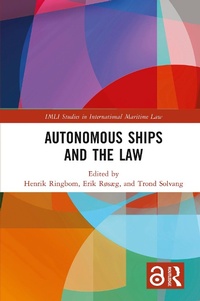
Autonomous Ships and the Law
1st Edition
Published on 2. December 2020
318 pages
978-1-000-33033-5 (ISBN)
Description

Interest in autonomous ships has grown exponentially over the past few years. Whereas a few years ago, the prospect of unmanned and autonomous vessels sailing on the seas was considered unrealistic, the debate now centers on when and in what format and pace the development will take place.
Law has a key role to play in this development and legal obstacles are often singled out as principal barriers to the rapid introduction of new technologies in shipping. Within a few years, autonomous ships have turned from a non-issue to one of the main regulatory topics being addressed by the International Maritime Organization. However, the regulatory discussion is still in its infancy, and while many new questions have been raised, few answers have been provided to them to date.
Increased automation of tasks that have traditionally been undertaken by ships' crews raises interesting legal questions across the whole spectrum of maritime law. The first of its kind, this book explores the issue of autonomous ships from a wide range of legal perspectives, including both private law and public law at international and national level, making available cutting-edge research which will be of significant interest to researchers in maritime law.
Chapter 3 of this book is freely available as a downloadable Open Access PDF at http://www.taylorfrancis.com under a Creative Commons Attribution-Non Commercial (CC-BY-NC) 4.0 license.
Law has a key role to play in this development and legal obstacles are often singled out as principal barriers to the rapid introduction of new technologies in shipping. Within a few years, autonomous ships have turned from a non-issue to one of the main regulatory topics being addressed by the International Maritime Organization. However, the regulatory discussion is still in its infancy, and while many new questions have been raised, few answers have been provided to them to date.
Increased automation of tasks that have traditionally been undertaken by ships' crews raises interesting legal questions across the whole spectrum of maritime law. The first of its kind, this book explores the issue of autonomous ships from a wide range of legal perspectives, including both private law and public law at international and national level, making available cutting-edge research which will be of significant interest to researchers in maritime law.
Chapter 3 of this book is freely available as a downloadable Open Access PDF at http://www.taylorfrancis.com under a Creative Commons Attribution-Non Commercial (CC-BY-NC) 4.0 license.
More details
Series
Edition
1. Auflage
Language
English
Place of publication
London
United Kingdom
Publishing group
Taylor & Francis Ltd
Target group
College/higher education
Product notice
Reflowable
Illustrations
6 Tables, black and white; 2 Line drawings, black and white; 2 Illustrations, black and white
File size
0,83 MB
ISBN-13
978-1-000-33033-5 (9781000330335)
Copyright in bibliographic data and cover images is held by Nielsen Book Services Limited or by the publishers or by their respective licensors: all rights reserved.
Schweitzer Classification
Other editions
Additional editions
Henrik Ringbom | Erik Rosaeg | Trond Solvang
Autonomous Ships and the Law
Book
01/2023
1st Edition
Routledge
€63.80
Shipment within 15-20 days
Henrik Ringbom | Erik Rosaeg | Trond Solvang
Autonomous Ships and the Law
Book
12/2020
1st Edition
Routledge
€232.20
Shipment within 15-20 days
Book
12/2020
Routledge
Unfortunately, price unknown
Available (delivery time upon request)
Persons
Henrik Ringbom is Professor II (part-time) at the Scandinavian Institute of Maritime Law in Oslo, Norway, and Head of Research at the Department of Law, Abo Akademi University in Turku/Abo, Finland.
Erik Rosaeg is Professor of Law at the Scandinavian Institute of Maritime Law,University of Oslo.
Trond Solvang is Professor of Law at the Scandinavian Institute of Maritime Law, University of Oslo.
Erik Rosaeg is Professor of Law at the Scandinavian Institute of Maritime Law,University of Oslo.
Trond Solvang is Professor of Law at the Scandinavian Institute of Maritime Law, University of Oslo.
Content
Part I: Introduction 1. Introduction 2. Terminology and Concepts Part II: Public international law issues 3. Autonomous Offender Ships and International Maritime Security Law 4. Developments, Challenges and Prospects at the IMO 5. Switching off Regulatory Requirements - Flag State Exemptions as a Tool to Facilitate Experiments with Highly Automated Vessels and their Operational Implementation Part III: Liability issues 6. Unmanned Ships and Fault as the Basis of Shipowner's Liability 7. Man, Machine and Culpa - or Finding a Path Towards Strict Liability 8. Diabolus ex machina-when an Autonomous Ship Does the Unexpected 9. Autonomous Ships and Product Liability under the EU Directive 10. Autonomous Technology in Shipping - an Increased Role for Negligence Product Liability? Part IV: Insurance issues 11. Hull Insurance of Autonomous Ships according to Nordic Law- What Are the Challenges? 12. P&I Perspectives 13. Insuring Autonomous Vessels - Scoping the Issues 14. Moving Forward by Looking Back: Insuring Autonomous Vessels under English Hull and Machinery Cover and Law Part V: Specific issues 15. Seaworthiness and Good Seamanship in the Age of Unmanned Vessels 16. Manning of Unmanned Ships 17. Pilotage of Autonomous and Remotely-Controlled Ships
