

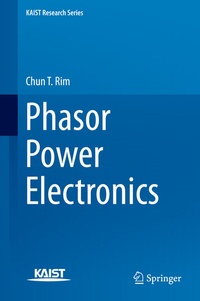
Phasor Power Electronics
Description

C hun T. Rim received the B.S. degree with Honor in electrical engineering from KIT in 1985, and the M.S. and Ph.D. degrees in electrical engineering from KAIST, Korea, in 1987 and 1990, respectively.
Since 2007, he has been an associate professor of Nuclear and Quantum Engineering at KAIST. He has been developing various wireless power technologies including inductive power transfer systems for On-Line Electrical Vehicles. From 1990 to 1995, he was a military officer at the Ministry of National Defense in Korea. From 1995 to 2003, he was a senior researcher at the Agency for Defense Development, Daejeon, and from 1997 to 1999, he was with Astrium in Portsmouth, U.K. From 2003 to 2007, he was a senior director at the Presidential Office, Seoul, Korea. He was involved in developing Korea's first airborne and spaceborne synthetic aperture radars. His research areas include wireless electric vehicles, wireless power systems for robots, mobiles, wearables and IoT, andgeneral unified modeling of power electronics. He has authored or coauthored 142 technical papers, written eight books, and holds 141 patents (awarded and pending). He won numerous awards including the Best Paper Award of IEEE Power Electronics Transactions in 2015 (wireless power) and three prizes by the Korean government. He was the chair of Wireless Power Committee of KIPE from 2010 to 2015 and the chair of EV Charger Committee of KIEE since 2011, respectively.
He is now an associate editor of IEEE Transactions on Power Electronics and the Journal of Emerging and Selected Topics in Power Electronics (J-ESTPE), a guest editor of the Special Issue on Wireless Power Transfer of the IEEE Transactions on Power Electronics , IEEE Transactions on Industrial Electronics , and J -ESTPE , and the general chair of the 2014 IEEE VTC-Workshop on Wireless power (WoW), 2015 IEEE WoW, and 2016 IEEE WoW.
More details
Other editions
Additional editions
Person
Chun T. Rim received the B.S. degree with Honor in electrical engineering from KIT in 1985, and the M.S. and Ph.D. degrees in electrical engineering from KAIST, Korea, in 1987 and 1990, respectively.
Since 2007, he has been an associate professor of Nuclear and Quantum Engineering at KAIST. He has been developing various wireless power technologies including inductive power transfer systems for On-Line Electrical Vehicles. From 1990 to 1995, he was a military officer at the Ministry of National Defense in Korea. From 1995 to 2003, he was a senior researcher at the Agency for Defense Development, Daejeon, and from 1997 to 1999, he was with Astrium in Portsmouth, U.K. From 2003 to 2007, he was a senior director at the Presidential Office, Seoul, Korea. He was involved in developing Korea's first airborne and spaceborne synthetic aperture radars. His research areas include wireless electric vehicles, wireless power systems for robots, mobiles, wearables and IoT, andgeneral unified modeling of power electronics. He has authored or coauthored 142 technical papers, written eight books, and holds 141 patents (awarded and pending). He won numerous awards including the Best Paper Award of IEEE Power Electronics Transactions in 2015 (wireless power) and three prizes by the Korean government. He was the chair of Wireless Power Committee of KIPE from 2010 to 2015 and the chair of EV Charger Committee of KIEE since 2011, respectively.
He is now an associate editor of IEEE Transactions on Power Electronics and the Journal of Emerging and Selected Topics in Power Electronics (J-ESTPE), a guest editor of the Special Issue on Wireless Power Transfer of the IEEE Transactions on Power Electronics, IEEE Transactions on Industrial Electronics, and J-ESTPE, and the general chair of the 2014 IEEE VTC-Workshop on Wireless power (WoW), 2015 IEEE WoW, and 2016 IEEE WoW.
Content
I Introduction to Power Electronics.- 1 The Philosophy of Power Electronics.- 2 Key Principles of Power Converters.- II Switching Converters as Electronic Transformers.- 1 State Space Average Model and Existence Function Model.- 2 Equational Models vs. Circuit Models.- 3 Switched Transformer Model and Averaged Transformer Model. 4 DC Analyses, AC Analyses, and Harmonic Analyses.- III Single Phase AC circuits and Resonant Converters.- 1 Basic Phasor Transformation.- 2 Application to Series Resonant Converters.- 3 Application to AC circuits and Phasor Detectors.- IV Multi-Phase AC circuits and Circuit DQ-Transformation.- 1 Circuit DQ-Transformation.- 2 Application to Current Source Inverter.- 3 Quantum Transformations.- V Unified General Phasor Transformation.- 1 Static Phasor Transformation.- 2 Laplace Phasor Transformation.- 3 Dynamics Characterization of Inductive Power Transfer Systems by Laplace Phasor Transform.- 4 General Phasor Transformers for Non-ideal Switching Converters.-VI Phasored Power Electronics and Beyond.- 1 Phasored Wireless Power Transfer.- 2 Phasored Filters.- 3 Complex Controllers and Phasored Signal Processing.- 4 Phasored Motors.- 5 Phasored Power Systems and Renewable Energies.- 6 Phasored Mechanics, Musical Instruments, and Quantum Mechanics.- VII Conclusions.- 1 Phasor Transformers in Power Electronics.- 2 The Futures of Power Electronics.
