

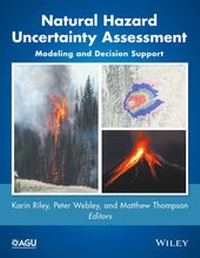
Natural Hazard Uncertainty Assessment
Description

Reviews / Votes
"This volume, edited by Karin Riley, Peter Webley,and Matthew Thompson, tackles the often-neglectedtopic of uncertainty in judging the effectiveness ofthe natural disaster models used when informingaction...While not for casual reading, this volume nonethelessprovides an approachable way to learn about the realitiesof natural disaster modelling. In addition, it highlightsthe importance of uncertainty, an inseparable part ofscience that is very often ignored." (Phenotype June 2017)More details
Other editions
Additional editions
Persons
Dr. Karin Riley is a Research Scientist in the Numerical Terradynamic Simulation Group in the University of Montana, Missoula, Montana. Her research interest focuses on the calculation of risk to terrestrial carbon stocks and expected emissions for the continental US, tree-level spatial model for the continental US, modeling of change in burn probabilities under climate change, and validation of FSim Large Fire Simulator's national burn probability and flame length outputs.
Dr. Peter Webley is the Research Assistant Professor at the Geophysical Institute in the University of Alaska Fairbanks. His research interests lie in volcanic ash cloud and plume detection through thermal and visible remote sensing as well as volcanic ash cloud modeling using Lagrangian transport and dispersion models. Given his background in thermal and radar based remote sensing, he also has an interest in real-time detection of ground based volcanic activity through remote sensing datasets and how to sue these for hazard assessment and risk mitigation. Through his research projects and collaborations, Dr Webley works closely on with both groups across UAF as well as further afield in the USGS, NASA, NSF, State University of New York - Buffalo, Michigan Technology University. Within the University of Alaska Fairbanks, Dr Webley is the UAF Faculty Senate Research Advisory Committee co-chair as well yearly he provides an instructional two-week module for the Alaska Summer Research Academy. Outside Alaska, Dr Webley is the America's and Caribbean chair for the World Organization of Volcano Observatories and on the Steering Committee of the Global Volcano model project.
Dr. Matthew Thompson is a Research Forester at the USFS Rocky Mountain Research Station in Missoula, MT. His research interest lies in application of principles from systems engineering, industrial engineering, risk analysis, operations research, economics, and decision-making under uncertainty to complex resource management with economic and environmental objectives.
Content
Contributors vii
1 Uncertainty in Natural Hazards, Modeling and Decision Support: An Introduction to This Volume 1 Karin Riley, Matthew Thompson, Peter Webley, and Kevin D Hyde
Part I: Uncertainty, Communication, and Decision Support 9
2 Natural Hazard Modeling and Uncertainty Analysis 11 Matthew Thompson and Jord J Warmink 3 Understanding Uncertainty as a Key Interdisciplinary Problem in Earth System Science 21 Florian Rauser and Gernot Geppert 4 Uncertainty and Probability in Wildfire Management Decision Support: An Example from the United States 31 Matthew Thompson, David Calkin, Joe H Scott, and Michael Hand
5 Role of Uncertainty in Decision Support for Volcanic Ash Cloud Modeling 43 Peter Webley
Part II: Geological Hazards 57
6 Building an Uncertainty Modeling Framework for Real?-Time VATD 59 Peter Webley, Abani Patra, Marcus Bursik, E Bruce Pitman, Jonathan Dehn, Tarung Singh, Puneet Singla, Matthew D Jones, Reza Madankan, E Ramona Stefanescu, and Solene Pouget
7 Uncertainties in Estimating Magma Source Parameters from InSAR Observation 89 Wenyu Gong, Zhong Lu, and Franz Meyer
8 Improving Model Simulations of Volcanic Emission Clouds and Assessing Model Uncertainties 105 Nina Iren Kristiansen, Delia Arnold, Christian Maurer, Julius Vira, Razvan Rädulescu, Damien Martin, ndreas Stohl, Kerstin Stebel, Mikhail Sofiev, Colin O'Dowd, and Gerhard Wotawa
9 Uncertainty Assessment of Pyroclastic Density Currents at Mount Vesuvius (Italy) Simulated Through the Energy Cone Model 125 Pablo Tierz, Laura Sandri, Antonio Costa, Roberto Sulpizio, Lucia Zaccarelli, Mauro Antonio Di Vito, and Warner Marzocchi
10 Earthquake Loss Estimation in the Gyeongju Area, Southeastern Korea, Using a Site Classification Map 147 Su Young Kang and Kwang?-Hee Kim
11 Implications of Different Digital Elevation Models and Preprocessing Techniques to Delineate Debris Flow Inundation Hazard Zones in El Salvador 167 Eric Ross Anderson, Robert E Griffin, and Daniel E Irwin
12 Evaluating the Performance of FLO2D for Simulating Past Lahar Events at the Most Active Mexican Volcanoes: Popocatépetl and Volcán de Colima 179 Lizeth Caballero, Lucia Capra, and Rosario Vázquez
Part III: Biophysical and Climatic Hazards 191
13 An Uncertainty Analysis of Wildfire Modeling 193 Karin Riley and Matthew Thompson
14 Fire and Smoke Remote Sensing and Modeling Uncertainties: Case Studies in Northern Sub?]Saharan Africa 215 Charles Ichoku, Luke T Ellison, Yun Yue, Jun Wang, and Johannes W Kaiser
15 Uncertainty and Complexity Tradeoffs When Integrating Fire Spread with Hydroecological Projections 231 Maureen C Kennedy and Donald McKenzie
16 Uncertainty Quantification and Propagation for Projections of Extremes in Monthly Area Burned Under Climate Change: A Case Study in the Coastal Plain of Georgia, USA 245 Adam J Terando, Brian Reich, Krishna Pacifici, Jennifer Costanza, Alexa McKerrow, and Jaime A Collazo
17 Simulating Vegetation Change, Carbon Cycling, and Fire Over the Western United States Using CMIP5 Climate Projections 257 D Bachelet, T Sheehan, K Ferschweiler, and J Abatzoglou
18 Sensitivity of Vegetation Fires to Climate, Vegetation, and Anthropogenic Drivers in the HESFIRE Model: Consequences for Fire Modeling and Projection Uncertainties 277 Yannick Le Page
19 Uncertainties in Predicting Debris Flow Hazards Following Wildfire 287 Kevin D Hyde, Karin Riley, and Cathelijne Stoof
20 Capturing Spatiotemporal Variation in Wildfires for Improving Postwildfire Debris?-Flow Hazard Assessments 301 Jessica R Haas, Matthew Thompson, Anne Tillery, and Joe H Scott
21 Uncertainty in Estimation of Debris?-Flow Triggering Rainfall: Evaluation and Impact on Identification of Threshold Relationships 319 E I Nikolopoulos, F Marra, and M Borga
22 Prospects in Landslide Prediction: Confronting the Challenges of Precipitation Uncertainty 329 Natasha Markuzon, Catherine Slesnick, Erin Leidy, John Regan, Xiang Gao, and Adam Schlosser
Index 337
CONTRIBUTORS
J. Abatzoglou
University of Idaho, Moscow, Idaho, USA
Eric Ross Anderson
Earth System Science Center, University of Alabama in Huntsville, Huntsville, Alabama, USA
Delia Arnold
Central Institute for Meteorology and Geodynamics (ZAMG), Vienna, Austria
D. Bachelet
Conservation Biology Institute, Corvallis, Oregon, and Oregon State University, USA
M. Borga
Department of Land, Environment, Agriculture and Forestry, University of Padova, Legnaro, Italy
Marcus Bursik
Department of Geology, University at Buffalo, SUNY, Buffalo, New York, USA
Lizeth Caballero
Facultad de Ciencias/Instituto de Geología, UNAM, Mexico City, Mexico
David Calkin
Rocky Mountain Research Station, US Forest Service, Missoula, Montana, USA
Lucia Capra
Centro de Geociencias, UNAM, Querétaro, Mexico
Jaime A. Collazo
Department of Applied Ecology, North Carolina State University, Raleigh, North Carolina, and US Geological Survey, North Carolina Cooperative Fish and Wildlife Research Unit, North Carolina State University, Raleigh, North Carolina, USA
Antonio Costa
Istituto Nazionale di Geofisica e Vulcanologia, INGV, Sezione di Bologna, Bologna, Italy
Jennifer Costanza
Department of Forestry and Environmental Resources, North Carolina State University, Raleigh, North Carolina, USA
Jonathan Dehn
Geophysical Institute, University of Alaska Fairbanks, Fairbanks, Alaska, and Volcanic Ash Detection, Avoidance and Preparedness for Transportation (V-ADAPT), Inc., Fairbanks, Alaska, USA
Mauro Antonio Di Vito
Istituto Nazionale di Geofisica e Vulcanologia, INGV, Osservatorio Vesuviano, Napoli, Italy
Luke T. Ellison
Climate and Radiation Laboratory, NASA Goddard Space Flight Center, Greenbelt, Maryland, and Science Systems and Applications Inc., Lanham, Maryland, USA
K. Ferschweiler
Conservation Biology Institute, Corvallis, Oregon, USA
Xiang Gao
Massachusetts Institute of Technology, Cambridge, Massachusetts, USA
Gernot Geppert
Universität Hamburg, Hamburg, Germany
Wenyu Gong
Geophysical Institute, University of Alaska Fairbanks, Fairbanks, Alaska, USA
Robert E. Griffin
Atmospheric Science Department, University of Alabama in Huntsville, Huntsville, Alabama, USA
Michael Hand
Rocky Mountain Research Station, US Forest Service, Missoula, Montana, USA
Jessica R. Haas
Rocky Mountain Research Station, US Forest Service, Missoula, Montana, USA
Kevin D. Hyde
University of Wyoming, Laramie, Wyoming, USA
Charles Ichoku
Climate and Radiation Laboratory, NASA Goddard Space Flight Center, Greenbelt, Maryland, USA
Daniel E. Irwin
NASA Marshall Space Flight Center, Huntsville, Alabama, USA
Matthew D. Jones
Center for Computational Research, University at Buffalo, SUNY, Buffalo, New York, USA
Johannes W. Kaiser
Max Planck Institute for Chemistry, Mainz, Germany
Su Young Kang
Department of Geological Sciences, Pusan National University, Busan, Korea
Maureen C. Kennedy
University of Washington, School of Interdisciplinary Arts and Sciences, Division of Sciences and Mathematics, Tacoma, Washington, USA
Kwang-Hee Kim
Department of Geological Sciences, Pusan National University, Busan, Korea
Nina Iren Kristiansen
Norwegian Institute for Air Research (NILU), Kjeller, Norway
Erin Leidy
Charles Stark Draper Laboratory, Cambridge, Massachusetts, and Massachusetts Institute of Technology, Cambridge, Massachusetts, USA
Yannick Le Page
Pacific Northwest National Laboratory, Joint Global Change Research Institute, University of Maryland, College Park, Maryland, USA
Zhong Lu
Southern Methodist University, Dallas, Texas, USA
Reza Madankan
Department of Mechanical and Aerospace Engineering, University at Buffalo, SUNY, Buffalo, New York, USA
Natasha Markuzon
Charles Stark Draper Laboratory, Cambridge, Massachusetts, USA
F. Marra
Department of Geography, Hebrew University of Jerusalem, Israel
Damien Martin
School of Physics and Centre for Climate and Air Pollution Studies, National University of Ireland Galway (NUIG), Galway, Ireland
Warner Marzocchi
Istituto Nazionale di Geofisica e Vulcanologia, INGV, Sezione di Roma1, Roma, Italy
Christian Maurer
Central Institute for Meteorology and Geodynamics (ZAMG), Vienna, Austria
Donald McKenzie
Pacific Wildland Fire Sciences Laboratory, Pacific Northwest Research Station, US Forest Service, Seattle, Washington, USA
Alexa McKerrow
Department of Applied Ecology, North Carolina State University, Raleigh, North Carolina, and Core Science Analytics, Synthesis & Libraries, US Geological Survey, Raleigh, North Carolina, USA
Franz Meyer
Geophysical Institute, University of Alaska Fairbanks, Fairbanks, Alaska, USA
E. I. Nikolopoulos
Department of Land, Environment, Agriculture and Forestry, University of Padova, Legnaro, Italy
Colin O'Dowd
School of Physics and Centre for Climate and Air Pollution Studies, National University of Ireland Galway (NUIG), Galway, Ireland
Krishna Pacifici
Department of Forestry and Environmental Resources, Program in Fisheries, Wildlife, and Conservation Biology, North Carolina State University, Raleigh, North Carolina, USA
Abani Patra
Department of Mechanical and Aerospace Engineering, University at Buffalo, SUNY, Buffalo, New York, USA
E. Bruce Pitman
Department of Mathematics, University at Buffalo, SUNY, Buffalo, New York, USA
Solene Pouget
Department of Geology, University at Buffalo, SUNY, Buffalo, New York, USA
Razvan Radulescu
School of Physics and Centre for Climate and Air Pollution Studies, National University of Ireland Galway (NUIG), Galway, Ireland
Florian Rauser
Max Planck Institute for Meteorology, Hamburg, Germany
John Regan
Charles Stark Draper Laboratory, Cambridge, Massachusetts, USA
Brian Reich
Department of Statistics, North Carolina State University, Raleigh, North Carolina, USA
Karin Riley
Rocky Mountain Research Station, US Forest Service, Missoula, Montana, and Numerical Terradynamic Simulation Group, College of Forestry and Conservation, University of Montana, Missoula, Montana, USA
Laura Sandri
Istituto Nazionale di Geofisica e Vulcanologia, INGV, Sezione di Bologna, Bologna, Italy
Adam Schlosser
Massachusetts Institute of Technology, Cambridge, Massachusetts, USA
Joe H. Scott
Pyrologix LLC, Missoula, Montana, USA
T. Sheehan
Conservation Biology Institute, Corvallis, Oregon, USA
Tarung Singh
Department of Mechanical and Aerospace Engineering, University at Buffalo, SUNY, Buffalo, New York, USA
Puneet Singla
Department of Mechanical and Aerospace Engineering, University at Buffalo, SUNY, Buffalo, New York, USA
Catherine Slesnick
Charles Stark Draper Laboratory, Cambridge, Massachusetts, USA
Mikhail Sofiev
Finnish Meteorological Institute (FMI), Helsinki, Finland
Kerstin Stebel
Norwegian Institute for Air Research (NILU), Kjeller, Norway
E. Ramona Stefanescu
Department of Mechanical and Aerospace Engineering, University at Buffalo, SUNY, Buffalo, New York, USA
Andreas Stohl
Norwegian Institute for Air Research (NILU), Kjeller, Norway
Cathelijne Stoof
Wageningen University, Wageningen, Netherlands
Robert Sulpizio
Dipartimento di Scienze della Terra e Geoambientali, Università di Bari, Bari, Italy, and Istituto per la Dinamica dei Processi Ambientali, Consiglio Nazionale delle Ricerche, IDPA-CNR, Milano, Italy
Adam J. Terando
US Geological Survey, Southeast Climate Science Center, Raleigh, North Carolina, and Department of Applied Ecology, North Carolina State University, Raleigh, North Carolina, USA
Matthew Thompson
Rocky Mountain Research Station, US Forest Service, Missoula, Montana, USA
Pablo Tierz
Istituto Nazionale di Geofisica e Vulcanologia, INGV, Sezione di Bologna, Bologna, Italy
Anne Tillery
US Geological Survey, Albuquerque, New Mexico, USA
Rosario Vázquez
Centro de Geociencias, UNAM, Querétaro, Mexico
Julius Vira
Finnish Meteorological Institute (FMI), Helsinki, Finland
Jun Wang
Department of Earth and Atmospheric Sciences, University of Nebraska, Lincoln, Nebraska, USA, and Now at Center for Global and Regional Environmental Research, and Department of Chemical and Biochemical Engineering, University of Iowa, Iowa City, Iowa, USA
Jord J. Warmink
Department of Water Engineering and Management, University of Twente, Enschede, Netherlands
Peter Webley
Geophysical Institute, University of Alaska Fairbanks, Fairbanks, Alaska, and Volcanic Ash Detection, Avoidance and Preparedness for Transportation (V-ADAPT), Inc., Fairbanks, Alaska, USA
Gerhard Wotawa
Central Institute for Meteorology and Geodynamics (ZAMG), Vienna, Austria
Yun...
