

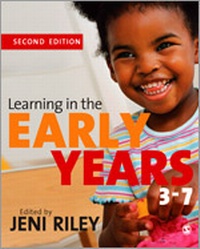
Learning in the Early Years 3-7
2nd Edition
Published on 26. June 2007
288 pages
978-1-4462-0451-1 (ISBN)
Description

'[T]his second edition book is a welcome contribution to the early years literature base, providing much needed information and a somewhat innovative response concerning how effectively to translate the Early Years Foundation Stage into practice' - Early Years
`This second edition of Learning in the Early Years has been fully updated to bring it in line with the Statutory Framework for the Early Years Foundation Stage...The presentation and style...is very readable and accessible and as such the book provides an excellent resource for students and experienced early years practitioners alike' - Early Years Update
Praise for the First Edition:
`It was a joy to read this book... This book provides a wealth of ideas for reflection, as well as guidance to promote knowledge and skills essential in early years teaching.'
Dario Pellegrini, Educational Psychologist
`I found it hard to put it down. I particularly liked the way it followed through into Key Stage 1' - Who Minds
`An important contribution to difficult work' - Elizabeth Quintero, The Steinhardt School of Education, New York University
This fully updated Second Edition of 'Learning in the Early Years 3-7' has been written to support early years practitioners understand and implement the new curriculum guidance document 'The Early Years Foundation Stage' (DfES, 2007). In this book, Jeni Riley clearly explains how to meet the requirements of the EYFS document and how this relates to the National Curriculum and the Primary National Strategy: Framework for teaching for literacy and mathematics. Offering informative and inspirational guidance on planning learning and teaching opportunities across the curriculum, this book will help you to promote social, intellectual, aesthetic, spiritual and physical development in your setting.
Topics covered include:
- appropriate and lively ways of working with young children
- developing subject knowledge
- supporting children for whom English is an additional language
- the role of adults when interacting with children to support learning
- the place of information and communications technology
- the transition between the Foundation Stage and Key Stage 1.
The book also draws on recent research on child development, on how babies think and on effective learning and teaching for children aged 3-7.
All early years students and practitioners will want to have this book to hand to guide them through the new guidance and to support them daily to implement successful practice.
Jeni Riley, Reader in Literacy in Primary Education, Institute of Education, University of London.
`This second edition of Learning in the Early Years has been fully updated to bring it in line with the Statutory Framework for the Early Years Foundation Stage...The presentation and style...is very readable and accessible and as such the book provides an excellent resource for students and experienced early years practitioners alike' - Early Years Update
Praise for the First Edition:
`It was a joy to read this book... This book provides a wealth of ideas for reflection, as well as guidance to promote knowledge and skills essential in early years teaching.'
Dario Pellegrini, Educational Psychologist
`I found it hard to put it down. I particularly liked the way it followed through into Key Stage 1' - Who Minds
`An important contribution to difficult work' - Elizabeth Quintero, The Steinhardt School of Education, New York University
This fully updated Second Edition of 'Learning in the Early Years 3-7' has been written to support early years practitioners understand and implement the new curriculum guidance document 'The Early Years Foundation Stage' (DfES, 2007). In this book, Jeni Riley clearly explains how to meet the requirements of the EYFS document and how this relates to the National Curriculum and the Primary National Strategy: Framework for teaching for literacy and mathematics. Offering informative and inspirational guidance on planning learning and teaching opportunities across the curriculum, this book will help you to promote social, intellectual, aesthetic, spiritual and physical development in your setting.
Topics covered include:
- appropriate and lively ways of working with young children
- developing subject knowledge
- supporting children for whom English is an additional language
- the role of adults when interacting with children to support learning
- the place of information and communications technology
- the transition between the Foundation Stage and Key Stage 1.
The book also draws on recent research on child development, on how babies think and on effective learning and teaching for children aged 3-7.
All early years students and practitioners will want to have this book to hand to guide them through the new guidance and to support them daily to implement successful practice.
Jeni Riley, Reader in Literacy in Primary Education, Institute of Education, University of London.
All prices
More details
Edition
Second Edition
Language
English
Place of publication
London
United Kingdom
Target group
College/higher education
ISBN-13
978-1-4462-0451-1 (9781446204511)
Copyright in bibliographic data and cover images is held by Nielsen Book Services Limited or by the publishers or by their respective licensors: all rights reserved.
Schweitzer Classification
Other editions
Additional editions
Jeni Riley
Learning in the Early Years 3-7
Book
07/2007
2nd Edition
SAGE Publications Inc
€221.35
Shipment within 10-20 days
Jeni Riley
Learning in the Early Years 3-7
Book
06/2007
2nd Edition
SAGE Publications Inc
€105.40
Shipment within 10-20 days
Person
Jeni Riley is Head of School of Early Childhood and Primary Education at the Institute of Education, University of London.
Content
The child, the context and early childhood education - Jeni Riley
Personal, social and emotional development: learning to be strong in a world of change - Liz Brooker and Lynne Broadbent
Communication, language and literacy: learning through speaking and listening, reading and writing - Jeni Riley and David Reedy
Mathematical development and education: problem-solving, reasoning and numeracy - Carol Aubrey, Mike Askew and Patti Barber
Knowledge and understanding of the world - Esme Glauert, Caroline Heal and John Cook
Physical development and physical education - Richard Bailey, Jonathan Doherty and Ian Pickup
Creative development: learning and the arts and design and technology - Roy Prentice, John Matthews, Helen Taylor and Gill Hope
Personal, social and emotional development: learning to be strong in a world of change - Liz Brooker and Lynne Broadbent
Communication, language and literacy: learning through speaking and listening, reading and writing - Jeni Riley and David Reedy
Mathematical development and education: problem-solving, reasoning and numeracy - Carol Aubrey, Mike Askew and Patti Barber
Knowledge and understanding of the world - Esme Glauert, Caroline Heal and John Cook
Physical development and physical education - Richard Bailey, Jonathan Doherty and Ian Pickup
Creative development: learning and the arts and design and technology - Roy Prentice, John Matthews, Helen Taylor and Gill Hope
