

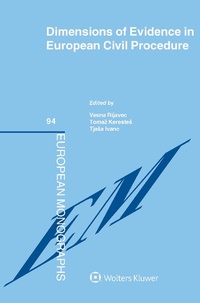
Dimensions of Evidence in European Civil Procedure
Published on 29. December 2015
450 pages
978-90-411-6665-4 (ISBN)
Description

Greater efficiency in civil dispute resolution is very much dependent on organized but fair fact-finding. Under European law, however, no clear-cut categorisation of means of evidence exists as yet, and significantly diverging interpretations persist of what is considered 'evidence' in the sense of the foundational Council Regulation (EC) No. 1206/2001 (EER). The EER fails to provide comprehensive rules for many other aspects of evidence taking, pointing instead to national legislation for solutions. As long as evidentiary rules remain different from country to country, there is an inherent risk of conflict of laws between different systems in the course of cooperation between courts in cross-border matters, leading to mistrust amongst judiciary and other participants in the proceedings.
Focusing on national rules, and using a comparative method which takes into consideration legal experiences from all legal circles in the EU, this book explains and analyses how the law of evidence works in Europe today. The authors draw on the vast base of relevant information collected in twenty-seven Member States by national reporters. Following the classical enumeration of types of evidence - production of documents, examination of witnesses, expert evidence, inspection by the judge, and examination of the parties - chapters encompass such issues and topics as the following.
- - judicial cooperation in cross-border cases;
- - general principles in evidence taking (the right to be heard, oral vs. written form, directness of evidence, burden of proof);
- - judges' case management powers regarding evidence;
- - means of evidence;
- - extent of influence of traditional principles and evidentiary rules on electronic evidence;
- - application of communication technology in cross-border proceedings;
- - legal costs;
- - language;
- - inadmissible evidence; and
- - instances in which a court can refuse a request for evidence.
The authors offer well-grounded recommendations on requested judge's entitlements, direct and convenient communication, cost issues, revised provisions concerning language obstacles, unification of presumptions, and much more.
Armed with the wide-ranging knowledge presented here, practitioners handling civil cases anywhere in Europe will derive great practical benefit from this book. As a masterful synthesis of how evidence is used in national courts in EU Member States, and of how that use is changing, the book will be greatly valued as a unique resource by legal scholars and academics. With featured recommendations it can contribute to the development of mutual trust among the national courts inside the EU as well as trust among policymakers and national courts.
Focusing on national rules, and using a comparative method which takes into consideration legal experiences from all legal circles in the EU, this book explains and analyses how the law of evidence works in Europe today. The authors draw on the vast base of relevant information collected in twenty-seven Member States by national reporters. Following the classical enumeration of types of evidence - production of documents, examination of witnesses, expert evidence, inspection by the judge, and examination of the parties - chapters encompass such issues and topics as the following.
- - judicial cooperation in cross-border cases;
- - general principles in evidence taking (the right to be heard, oral vs. written form, directness of evidence, burden of proof);
- - judges' case management powers regarding evidence;
- - means of evidence;
- - extent of influence of traditional principles and evidentiary rules on electronic evidence;
- - application of communication technology in cross-border proceedings;
- - legal costs;
- - language;
- - inadmissible evidence; and
- - instances in which a court can refuse a request for evidence.
The authors offer well-grounded recommendations on requested judge's entitlements, direct and convenient communication, cost issues, revised provisions concerning language obstacles, unification of presumptions, and much more.
Armed with the wide-ranging knowledge presented here, practitioners handling civil cases anywhere in Europe will derive great practical benefit from this book. As a masterful synthesis of how evidence is used in national courts in EU Member States, and of how that use is changing, the book will be greatly valued as a unique resource by legal scholars and academics. With featured recommendations it can contribute to the development of mutual trust among the national courts inside the EU as well as trust among policymakers and national courts.
More details
Other editions
Additional editions
Vesna Rijavec
DIMENSIONS OF EVIDENCE IN EURO
Book
11/2015
1st Edition
Kluwer Law International
€342.25
Shipment within 10-20 days
Content
- Intro
- Halftitle Page
- Series Page
- Title Page
- Copyright Page
- Editors
- Contributors
- Preface
- Introduction
- CHAPTER 1 Evidence Law in an International Context: The Principles of Transnational Civil Procedure
- §1.01 Introduction
- §1.02 Terminology
- §1.03 Evidence in the Storme Project
- §1.04 Evidence in the Principles and Rules of Transnational Civil Procedure
- §1.05 Conclusion
- Bibliography
- CHAPTER 2 Evidence in European Civil Procedure
- §2.01 Introduction
- §2.02 The Approach to the Resolution of Civil Disputes across Europe
- §2.03 The Role of the Parties
- §2.04 Party Control (The Principle of Free Disposition)
- §2.05 Pretrial Conduct (The Principle of Concentration)
- §2.06 The Adversarial Nature of the Trial at English Common Law
- §2.07 The Giving of Evidence before the Judge at Trial (The Principle of Immediacy or Directness)
- §2.08 Disclosure of Documents
- §2.09 Expert Evidence
- §2.10 Court Assessors
- §2.11 Court Examiners
- §2.12 Duty to Tell the Truth
- §2.13 Electronic Communication
- §2.14 Language
- §2.15 The Use Made by the Courts of the Evidence It Has Obtained or Which Has Been Put before It
- §2.16 Appeals
- §2.17 Costs
- §2.18 Length of Proceedings
- §2.19 Conclusion
- Bibliography
- CHAPTER 3 Fundamental Principles of Taking Evidence in Civil Procedure
- CHAPTER 3A The Right to Be Heard in the Taking of Evidence
- §3A.01 Introduction: Audi Alteram Partem Principle
- §3A.02 The Parties' Right to Propose Evidence
- §3A.03 The Court's Obligation to Take Proposed Evidence
- §3A.04 The Party's Access to Certain Means of Evidence
- [A] Classified Evidence
- [B] Blind and Partially Sighted Persons
- [C] Experts
- §3A.05 Sanctions for the Violation of Audi Alteram Partem Principle
- Bibliography
- CHAPTER 3B The Principles of Oral and Written Presentation
- §3B.01 Introduction
- §3B.02 Legal Provisions on Oral and Written Proceedings
- §3B.03 Definition of the Principle of Orality
- §3B.04 The Relation between the Principle of Oral and Written Form
- [A] The Claim
- [B] The Statement of Defence
- [C] The Hearing
- [D] Specific Types of Proceedings as Exceptions to the Principle of Orality
- [E] Proceedings at the Courts of Second and Third Instance
- [F] The Decision of the Court
- [G] Form of Procedural Acts
- §3B.05 Violation of the Principle of Orality
- §3B.06 Orality and Other Principles of Civil Procedure
- §3B.07 The European Perspective
- §3B.08 Conclusion
- Bibliography
- CHAPTER 3C Direct Evidence and the Review of the Trial Court's Findings of Fact by an Appellate Court: The Austrian Example
- §3C.01 Principle of Immediacy versus Review Purposes of the Appeal
- [A] Review Purposes
- [B] Forms of the Principle of Immediacy
- §3C.02 Ground for an Appeal: Inaccurate Findings of Fact
- §3C.03 Opposing of Errors of Fact Relied on by the Appellant
- §3C.04 Presenting Evidence again in the Appellate Court
- [A] Unobjectionable Evaluation of Evidence
- [B] Concerns about the Evaluation of Evidence
- [C] Repetition of the Taking of Evidence after Evidence Was Taken Indirectly at First Instance
- [1] Transcripts of the Taking of Evidence and Written Expert Reports
- [2] Change of Judges
- [3] Legal Assistance, Video Conference
- [4] Transfer of the Legal Proceedings
- [5] Preservation of Evidence
- [D] Repetition of the Taking of Evidence after Evidence WasTaken Directly at First Instance
- §3C.05 Conclusion
- Bibliography
- CHAPTER 3D Assessment of Evidence
- §3D.01 Introduction
- §3D.02 Modern Civil Procedural Law and the Origins of Rules of Evidence
- §3D.03 Three Systems of Assessment of Evidence: Modernised Legal Proof, Preponderance of Evidence and Free Assessment of Evidence
- §3D.04 The Modernised Legal Proof Doctrine with Limited Free Assessment of Evidence (France and, Partly, Italy)
- §3D.05 Common Law: Burden of Persuasion and Balance of Probabilities
- §3D.06 Free Assessment of Evidence in Germany, Austria and in Central and Northern Europe
- §3D.07 Other Notions Relevant for the Assessment of Evidence: Material Truth versus Formal Truth, the Certainty Standard and Different Perspectives on Burden of Proof
- Bibliography
- CHAPTER 3E The Judge's Case Management Powers regarding Evidence
- §3E.01 Introduction
- [A] The Distinction between the Principles of Party Presentation in Contrast to the Inquisitorial System
- [B] The Social Model of the Civil Procedure Rules
- [C] Growing Legal and Technical Complexity
- [D] From the Paroemia 'Da Mihi Factum - Dabo Tibi Ius' to a Working Partnership
- §3E.02 Europe between Two Systems
- [A] Case Management and the Principle of Party Presentation
- [B] The Eventual Maxim or Preclusion
- §3E.03 European Perspective
- Bibliography
- CHAPTER 4 Means of Proof
- CHAPTER 4A Witness Testimony
- §4A.01 Historical Background
- §4A.02 A Duty of Witness to Testify Refusal/Incapacity to Testify
- [A] Requirement of the Age and Mentally Capacity
- [B] Meaning of Oath
- [C] Privileged Witnesses (Refusal to Testify)
- §4A.03 Witness Summons
- §4A.04 Written Explanations by Witness Equate to Witness Testimony?
- §4A.05 The Role of the Court in Witness Interview Procedure
- [A] Pretrial Stage
- [B] Trial Stage
- [1] Cross-Examination Procedure in Common Law Countries
- §4A.06 Cross-Border Questions
- [A] Role of the Court in Cross-Border Cases for Ensuring Participation of Witnesses
- [B] Interview Procedure
- [1] Summons of Witnesses
- [2] Verification of Identity of Witness
- [3] Questions of Foreign Languages
- [4] Means of Communication between the Courts
- §4A.07 Conclusions
- Bibliography
- CHAPTER 4B Experts
- §4B.01 Introduction
- §4B.02 Decision to Appoint an Expert
- §4B.03 Which Expert?
- §4B.04 Expert Lists
- §4B.05 The Expert's Mission
- §4B.06 Written and/or Oral Expert Opinion
- §4B.07 Private Expert Reports
- §4B.08 Expert's Fees and Costs
- §4B.09 Evaluation of the Expert Opinion
- §4B.10 Conclusion and European Perspective
- Bibliography
- CHAPTER 5 Inadmissible Evidence: Illegally Obtained Evidence and the Limits of the Judicial Establishment of the Truth
- §5.01 Introduction
- §5.02 The Conflict between Establishing the Truth and the Boundaries Set by Substantive Law
- [A] The Role of Material Truth in Civil Procedure Law
- [B] A Unified Legal System?
- [C] The Court's Duty to Respect Constitutional Law
- [D] Inadmissibility as an Incentive to Respect the Law?
- [E] Admissibility as a Means to Accelerate Proceedings?
- §5.03 The Range of Possible Consequences of a Breach of Substantive Law
- §5.04 An Overview on the Treatment of Illegally Obtained Evidence in Europe
- §5.05 Case Study: Illegally Obtained Tape Recordings in Austrian Civil Procedure Law
- §5.06 Conclusion
- Bibliography
- CHAPTER 6 Other Issues
- CHAPTER 6A Legal Costs: An Obstacle for Effective Dispute Resolution in Europe?
- §6A.01 Cost Issues as Obstacles of Cross-Border Civil Litigation
- §6A.02 Analysis
- [A] How to Define Legal Costs?
- [B] Are Costs Related to Evidence Paid in Advance or Afterwards?
- [C] Compensation to Witnesses
- [D] General Rules of Cost Allocation
- [E] Experts
- [F] nterface between National Systems and the EER
- §6A.03 Balancing between Costs and Evidence
- §6A.04 Conclusions
- Bibliography
- CHAPTER 6B Language Obstacles in the Search for Effective and Fair Fact-Finding
- §6B.01 Introduction
- [A] Linguistic Diversity and the EU
- [B] Implications for Cross-Border Proceedings
- §6B.02 Official Court Languages
- [A] Agreements on Language of the Proceedings
- §6B.03 Interpretation and Translation in Evidence Taking
- [A] Translation of Documentary Evidence
- [B] Interpretation of Oral Procedural Acts
- §6B.04 Interpreters
- [A] Authority to Appoint Interpreters
- [B] Interpreters' Credentials
- §6B.05 Costs of Interpretation
- §6B.06 Conclusions
- Bibliography
- CHAPTER 6C Theoretical Background of Using Information Technology in Evidence Taking
- §6C.01 Introduction
- §6C.02 IT and Fundamental Principles of Civil Procedure
- [A] Traditional Preference for Oral Character of the Procedural Acts, Immediacy and Publicity
- [B] 'Improvements' of Access to Justice with the Use of ICT
- [C] Electronic Evidence and Civil Procedure
- [D] In Search for Definition of Electronic Evidence
- [E] Admissibility of Electronic Evidence
- [F] Meaning of the Document: Paper versus Electronic Form
- [G] Evidentiary Value of Electronic Documents and Question of Authenticity
- §6C.03 Conclusion: European Dimension of Using ICT in Evidence Taking Procedure
- Bibliography
- CHAPTER 6D Prevention from Destruction of Relevant Evidence in Cross-Border Cases
- §6D.01 Introduction
- §6D.02 The Issue of Evidence in the EU
- §6D.03 The Council Regulation (EC) No. 1206/2001 of 28 May 2001
- §6D.04 Member States and Their Position towards Safeguarding of Evidence
- §6D.06 Conclusions
- Bibliography
- CHAPTER 7 Common Core After All?
- §7.01 The European Insight
- [A] Ius Commune, Common Core, Europeanisation
- [B] Transnational Civil Procedure
- [C] European Procedural Law Convergence
- [D] European Evidence Law Convergence
- [E] The Role of the CJEU
- §7.02 Transnational Dimension
- §7.03 Is There Any Common Core?
- [A] In General
- [B] Free Assessment of the Evidence
- [C] Principle of Oral Proceedings versus Principle of Written Proceedings
- [D] Principle of Immediacy
- [E] Principle of Material Truth
- §7.04 Conclusions
- Bibliography
- CHAPTER 8 Assessment of Evidence Regulation
- §8.01 Introduction
- §8.02 Binding or Non-binding Character of the EER
- §8.03 Relationship between the EER and International Conventions
- §8.04 Scope of EER
- [A] Jurisdiction Ratione Materiae
- [B] The Use of EER in Judicial Proceedings
- §8.05 Exclusive Use in Particular Judicial Proceedings
- §8.06 Territorial Jurisdiction
- §8.07 Cross-Border Extension of Judicial Powers
- §8.08 Definition of Evidence
- §8.09 Categorisation of Means of Evidence
- §8.10 Content of the Request
- §8.11 Description of the Taking of Evidence to Be Performed
- §8.12 The Nature and Subject Matter of the Case and a Brief Statement of the Facts
- §8.13 Transmission of the Request
- §8.14 Execution of the Request
- §8.15 Active Legal Assistance (Taking of Evidence through the Requested Court)
- §8.16 Role of the Examiner
- §8.17 What Kind of Evidence Can Be Requested under the EER?
- §8.18 Methods and Procedures for Examining Witnesses and Parties as a Witness
- §8.19 Cross-Border Requests for Production of Documents
- §8.20 Disclosure by a Party to Litigation
- §8.21 Experts
- §8.22 Coercive Measures
- §8.23 Absent Witnesses
- §8.24 Execution of the Request in Accordance with a Special Procedure Provided for by the Law of the Member State of the Requesting Court
- §8.25 Passive Legal Assistance (Direct Taking of Evidence)
- §8.26 Use of Communication Technology
- §8.27 Videoconference
- §8.28 Costs
- §8.29 Language
- §8.30 Reasons for Refusal to Execute Recommendations
- §8.31 Inadmissible Evidence
- §8.32 Remedies against the Refusal
- §8.33 Conclusions
- Bibliography
- APPENDIX Cross-Border Taking of Evidence: European Case Studies
- Table of Legal Sources: EU
- Index
- Other
- Backcover
