

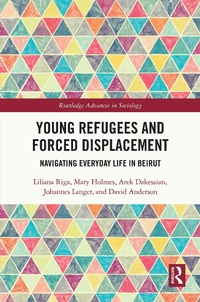
Young Refugees and Forced Displacement
Navigating Everyday Life in Beirut
1st Edition
Published on 29. December 2020
178 pages
978-1-000-33607-8 (ISBN)
Description

Young Refugees and Forced Displacement is about young Syrian and Iraqi refugees navigating the complex realities of forced displacement in Beirut. It is based on a British Academy funded two-year project with 51 displaced youths aged 8 to 17 and under the care of three local humanitarian organisations. Focus groups, interviews and innovative arts-based methods were used to learn about their everyday lives. At the end of the project, we coproduced with them a public mural, allowing unexpected epistemological and methodological reflections on researching refugees and the "right to opacity."
Families and friendships, humanitarian caregiving, racism, discrimination and everyday decencies and civilities make up the stuff of their ordinary, everyday encounters within refugeedom, defining both its sharper edges and its more inadvertent and quietly political ones. Thus, refugeedom, as we conceive it, includes "the humanitarian condition" but goes a little beyond it, to become also a human condition of political alterity. In navigating refugeedom, the young Syrians and Iraqis become sophisticated political and moral actors, using emotional reflexivity as they engage layered subjectivities to define the terms of their own forced displacement. This book will be of interest to policymakers, humanitarian organisations, social science scholars and students working on refugees, displacement, humanitarianism, intimacies and emotions, racism and discrimination. It may also be of interest to displaced youth.
Families and friendships, humanitarian caregiving, racism, discrimination and everyday decencies and civilities make up the stuff of their ordinary, everyday encounters within refugeedom, defining both its sharper edges and its more inadvertent and quietly political ones. Thus, refugeedom, as we conceive it, includes "the humanitarian condition" but goes a little beyond it, to become also a human condition of political alterity. In navigating refugeedom, the young Syrians and Iraqis become sophisticated political and moral actors, using emotional reflexivity as they engage layered subjectivities to define the terms of their own forced displacement. This book will be of interest to policymakers, humanitarian organisations, social science scholars and students working on refugees, displacement, humanitarianism, intimacies and emotions, racism and discrimination. It may also be of interest to displaced youth.
More details
Series
Edition
1. Auflage
Language
English
Place of publication
London
United Kingdom
Publishing group
Taylor & Francis Ltd
Target group
College/higher education
Illustrations
8 Halftones, black and white; 8 Illustrations, black and white
ISBN-13
978-1-000-33607-8 (9781000336078)
Copyright in bibliographic data and cover images is held by Nielsen Book Services Limited or by the publishers or by their respective licensors: all rights reserved.
Schweitzer Classification
Other editions
Additional editions
Liliana Riga | Mary Holmes | Arek Dakessian
Young Refugees and Forced Displacement
Navigating Everyday Life in Beirut
Book
08/2022
1st Edition
Routledge
€64.90
Shipment within 15-20 days
Liliana Riga | Mary Holmes | Arek Dakessian
Young Refugees and Forced Displacement
Navigating Everyday Life in Beirut
Book
12/2020
1st Edition
Routledge
€192.21
Shipment within 15-20 days
Persons
Liliana Riga is Senior Lecturer at the University of Edinburgh. She is a political and historical sociologist whose work explores immigration, refugees and civil society, racialised exclusions and political subjectivities. She is currently completing a book as a collection of essays, Refugeedom and Our Moral Selves.
Mary Holmes is Professor of Emotions and Society at the University of Edinburgh. Her research examines emotional reflexivity. She is one of the founding editors of the journal Emotions and Society and is currently writing a book, with Chris Beasley, on internet dating.
Arek Dakessian is a research fellow at Queen Margaret University. His research interests include cultural production, material culture, historical sociology and political alterity. Arek is also a founding member of LIVED, an Edinburgh-based charity.
Johannes Langer is a PhD student at the University of Edinburgh. His research explores questions of racism, immigration and the rise of rightist nationalism with a focus on regional difference and historical social change.
David Anderson was Research Assistant on the Belonging in Beirut project and is a PhD student at the University of Edinburgh. His PhD work addresses displacement, marginalisation and social space in the urban environment in Soacha, Colombia.
Mary Holmes is Professor of Emotions and Society at the University of Edinburgh. Her research examines emotional reflexivity. She is one of the founding editors of the journal Emotions and Society and is currently writing a book, with Chris Beasley, on internet dating.
Arek Dakessian is a research fellow at Queen Margaret University. His research interests include cultural production, material culture, historical sociology and political alterity. Arek is also a founding member of LIVED, an Edinburgh-based charity.
Johannes Langer is a PhD student at the University of Edinburgh. His research explores questions of racism, immigration and the rise of rightist nationalism with a focus on regional difference and historical social change.
David Anderson was Research Assistant on the Belonging in Beirut project and is a PhD student at the University of Edinburgh. His PhD work addresses displacement, marginalisation and social space in the urban environment in Soacha, Colombia.
Content
1. Navigating Beirut, Singing in the Dark
2. "I Don't Have Friends, I Just Have Cousins"
3. A Quiet Politics in Humanitarian Spaces
4. Becoming Young Political Subjects
5. A Right to Opacity?
Postscript
2. "I Don't Have Friends, I Just Have Cousins"
3. A Quiet Politics in Humanitarian Spaces
4. Becoming Young Political Subjects
5. A Right to Opacity?
Postscript
