

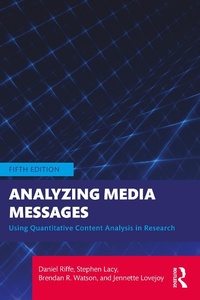
Analyzing Media Messages
Using Quantitative Content Analysis in Research
5th Edition
Published on 22. December 2023
242 pages
978-1-003-80620-2 (ISBN)
Description

The fifth edition of this comprehensive and engaging text guides readers through the essential tools and skills necessary to conduct quantitative content analysis research.
Readers will find a clear definition of quantitative content analysis and step-by-step instructions on designing a content analysis study, along with examples of content analysis studies and journal articles. This edition has been updated with the latest methods in sampling in the digital age, computerized content analysis, and the uses of social media in content analysis research. It maintains the concise, accessible approach of previous editions while including refreshed examples and discussions throughout.
This is an essential text for content analysis courses in communication and media studies programs at all levels, as well as a useful supplementary text in more general research methods courses.
Readers will find a clear definition of quantitative content analysis and step-by-step instructions on designing a content analysis study, along with examples of content analysis studies and journal articles. This edition has been updated with the latest methods in sampling in the digital age, computerized content analysis, and the uses of social media in content analysis research. It maintains the concise, accessible approach of previous editions while including refreshed examples and discussions throughout.
This is an essential text for content analysis courses in communication and media studies programs at all levels, as well as a useful supplementary text in more general research methods courses.
More details
Edition
5th edition
Language
English
Place of publication
London
United Kingdom
Publishing group
Taylor & Francis Ebooks
Target group
College/higher education
Illustrations
8 Tables, black and white; 24 Line drawings, black and white; 24 Illustrations, black and white
ISBN-13
978-1-003-80620-2 (9781003806202)
Copyright in bibliographic data and cover images is held by Nielsen Book Services Limited or by the publishers or by their respective licensors: all rights reserved.
Schweitzer Classification
Other editions
Additional editions
Daniel Riffe | Stephen Lacy | Brendan R. Watson
Analyzing Media Messages
Using Quantitative Content Analysis in Research
Book
12/2023
5th Edition
Routledge
€206.40
Shipment within 10-20 days
Daniel Riffe | Stephen Lacy | Brendan R. Watson
Analyzing Media Messages
Using Quantitative Content Analysis in Research
Book
12/2023
5th Edition
Routledge
€67.10
Shipment within 10-20 days
Persons
Daniel Riffe is Professor Emeritus in the School of Journalism and Media at the University of North Carolina at Chapel Hill, USA, and former editor of Journalism and Mass Communication Quarterly. His research examines mass communication and environmental risk, political communication and public opinion, international news coverage, and research methodology. Before joining UNC-Chapel Hill, he was Presidential Research Scholar in the Social and Behavioral Sciences at Ohio University.
Stephen Lacy is Professor Emeritus at Michigan State University, USA, where he studied content analysis and media managerial economics for more than 30 years in the School of Journalism and Department of Communication. He has co-written or co-edited five other books and served as co-editor of the Journal of Media Economics.
Brendan R. Watson is an independent scholar. His research examines the role of public affairs news/information in helping communities cope with social upheaval due to the increasing urbanization, globalization, and pluralism of postindustrial society. He also studies research methodology. He has taught graduate seminars in content analysis at Michigan State University and the University of Minnesota, where he was previously on the faculty. He holds a Ph.D. in Mass Communication from the University of North Carolina at Chapel Hill. He currently works for Level, a performance marketing agency.
Jennette Lovejoy is Professor and Chair of the Department of Communication and Media at the University of Portland, USA. She teaches critical media, journalism, and research methods. Her interdisciplinary research spans media, health, and content analysis methods. She has edited multiple books and published in leading communication and medical journals.
Stephen Lacy is Professor Emeritus at Michigan State University, USA, where he studied content analysis and media managerial economics for more than 30 years in the School of Journalism and Department of Communication. He has co-written or co-edited five other books and served as co-editor of the Journal of Media Economics.
Brendan R. Watson is an independent scholar. His research examines the role of public affairs news/information in helping communities cope with social upheaval due to the increasing urbanization, globalization, and pluralism of postindustrial society. He also studies research methodology. He has taught graduate seminars in content analysis at Michigan State University and the University of Minnesota, where he was previously on the faculty. He holds a Ph.D. in Mass Communication from the University of North Carolina at Chapel Hill. He currently works for Level, a performance marketing agency.
Jennette Lovejoy is Professor and Chair of the Department of Communication and Media at the University of Portland, USA. She teaches critical media, journalism, and research methods. Her interdisciplinary research spans media, health, and content analysis methods. She has edited multiple books and published in leading communication and medical journals.
Content
1. Introduction 2. Defining Content Analysis as a Social Science Tool 3. Designing a Content Analysis 4. Computers and Content Analysis 5. Measurement 6. Sampling 7. Reliability 8. Validity 9. Data Analysis Appendix A: Sample Protocol Appendix B: Reporting Standards for Content Analysis Articles
