

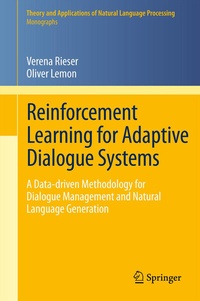
Reinforcement Learning for Adaptive Dialogue Systems
Description

The past decade has seen a revolution in the field of spoken dialogue systems. As in other areas of Computer Science and Artificial Intelligence, data-driven methods are now being used to drive new methodologies for system development and evaluation.
This book is a unique contribution to that ongoing change. A new methodology for developing spoken dialogue systems is described in detail. The journey starts and ends with human behaviour in interaction, and explores methods for learning from the data, for building simulation environments for training and testing systems, and for evaluating the results. The detailed material covers: Spoken and Multimodal dialogue systems, Wizard-of-Oz data collection, User Simulation methods, Reinforcement Learning, and Evaluation methodologies.
The book is a research guide for students and researchers with a background in Computer Science, AI, or Machine Learning. It navigates through a detailed case study in data-driven methods for development and evaluation of spoken dialogue systems. Common challenges associated with this approach are discussed and example solutions are provided. This work provides insights, lessons, and inspiration for future research and development - not only for spoken dialogue systems in particular, but for data-driven approaches to human-machine interaction in general.
More details
Other editions
Additional editions
Persons
Professor Oliver Lemon leads the Interaction Lab in the School of Mathematical and Computer Sciences (MACS) at Heriot-Watt University, Edinburgh. He previously worked at the School of Informatics, University of Edinburgh, and at Stanford University. His main expertise is in the area of machine learning methods for intelligent and adaptive multimodal interfaces, including work on Speech Recognition, Spoken Language Understanding, Dialogue Management, and Natural Language Generation. He applies this work in new interfaces for mobile search, virtual characters, Technology Enhanced Learning, and Human-Robot Interaction, in a variety of international research projects.
Dr Verena Rieser is a Lecturer in Computer Science at Heriot-Watt University, Edinburgh. She previously worked at Edinburgh University in the Schools of Informatics and GeoSciences, performing research in data-driven statistical methods for multimodal interfaces, as well as for modelling impacts of environmental change for sustainable development. She received her PhD (with distinction) from Saarland University in 2008, winning the Eduard-Martin prize.
Content
1.Introduction.- 2.Background.- 3.Reinforcement Learning for Information Seeking dialogue strategies.- 4.The bootstrapping approach to developing Reinforcement Learning-based strategies.- 5.Data Collection in aWizard-of-Oz experiment.- 6.Building a simulated learning environment from Wizard-of-Oz data.- 7.Comparing Reinforcement and Supervised Learning of dialogue policies with real users.- 8.Meta-evaluation.- 9.Adaptive Natural Language Generation.- 10.Conclusion.- References.- Example Dialogues.- A.1.Wizard-of-Oz Example Dialogues.- A.2.Example Dialogues from Simulated Interaction.- A.3.Example Dialogues from User Testing.- Learned State-Action Mappings.- Index.
