

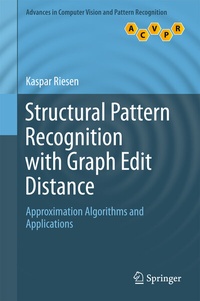
Structural Pattern Recognition with Graph Edit Distance
Description

This unique text/reference presents a thorough introduction to the field of structural pattern recognition, with a particular focus on graph edit distance (GED). The book also provides a detailed review of a diverse selection of novel methods related to GED, and concludes by suggesting possible avenues for future research. Topics and features: formally introduces the concept of GED, and highlights the basic properties of this graph matching paradigm; describes a reformulation of GED to a quadratic assignment problem; illustrates how the quadratic assignment problem of GED can be reduced to a linear sum assignment problem; reviews strategies for reducing both the overestimation of the true edit distance and the matching time in the approximation framework; examines the improvement demonstrated by the described algorithmic framework with respect to the distance accuracy and the matching time; includes appendices listing the datasets employed for the experimental evaluations discussedin the book.
Reviews / Votes
"The book presents the use of graphs in the field of structural pattern recognition. . The book is written in a very accessible fashion. The author gives many examples presenting the notations and problems considered. The book is suitable for graduate students and is an ideal reference for researchers and professionals interested in graph edit distance and its applications in pattern recognition." (Krzystof Gdawiec, zbMATH 1365.68004, 2017)
"This book is exactly about this fascinating topic: the definition, the study of properties, and the areas of application of the graph edit distance in the realm of structural pattern recognition. . The book's intended audience is advanced graduate students in science and engineering, but also professionals working in relevant fields." (Dimitrios Katsaros, Computing Reviews, computingreviews.com, August, 2016)
More details
Other editions
Additional editions
Person
Dr. Kaspar Riesen
is a university lecturer of computer science in the Institute for Information Systems at the University of Applied Sciences and Arts Northwestern Switzerland, Olten, Switzerland.
Content
Part I: Foundations and Applications of Graph Edit Distance .- Introduction and Basic Concepts.- Graph Edit Distance.- Bipartite Graph Edit Distance.- Part II: Recent Developments and Research on Graph Edit Distance .- Improving the Distance Accuracy of Bipartite Graph Edit Distance.- Learning Exact Graph Edit Distance.- Speeding Up Bipartite Graph Edit Distance.- Conclusions and Future Work.- Appendix A: Experimental Evaluation of Sorted Beam Search.- Appendix B: Data Sets.
