

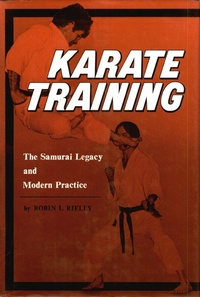
Karate Training
The Samurai Legacy and Modern Practice
Published on 21. February 2012
238 pages
978-1-4629-0400-6 (ISBN)
Description

This martial arts guide could actually be considered two books in one: a thorough history of Japanese karate-do and a profusely illustrated instruction manual for students of the martial art who have advanced beyond the beginning stages.
Part One:
Concerned about the misinterpretation of Japanese culture in general and karate in particular by many Western practitioners of karate, the author sets out in Part One of his book to trace the history of karate from its probable origins in India (or perhaps Greece) and its transmission in successively more developed forms to China, Okinawa, and then Japan.
In Part Two:
In this practical martial arts training manual the author first demonstrates important points of etiquette to be used in the karate dojo. He follows with well-illustrated instructions of kumite (sparring drills), including those involving two practitioners and those such as the doubleline drill and the circle drill which give practice in facing a number of opponents. Descriptions of many of these are not readily found in other English-language publications. He then presents nine kata, introductory the advanced kata, Sochin and Nijushiho.
Part One:
Concerned about the misinterpretation of Japanese culture in general and karate in particular by many Western practitioners of karate, the author sets out in Part One of his book to trace the history of karate from its probable origins in India (or perhaps Greece) and its transmission in successively more developed forms to China, Okinawa, and then Japan.
In Part Two:
In this practical martial arts training manual the author first demonstrates important points of etiquette to be used in the karate dojo. He follows with well-illustrated instructions of kumite (sparring drills), including those involving two practitioners and those such as the doubleline drill and the circle drill which give practice in facing a number of opponents. Descriptions of many of these are not readily found in other English-language publications. He then presents nine kata, introductory the advanced kata, Sochin and Nijushiho.
More details
Other editions
Additional editions

Robin L. Rielly
Karate Training
Book
12/1989
Tuttle Publishing
€44.19
Article exhausted; check different version
Content
- Intro
- Table of Contents
- List of Illustrations
- Foreword
- Preface
- Introduction
- PART ONE Karate and Tradition
- 1. The History of Karate
- The Origins of Karate
- From India to China
- Okinawan Karate
- Japanese Karate
- The Transmission of Karate to the United States
- 2. The Samurai and His Ethos
- The Origins of the Samurai
- The Consolidation of Military Power
- The Samurai Class
- Sushido: The Way of the Warrior
- The Zen Tradition
- 3. Samurai Customs and Traditions
- Seppuku
- Vendettas
- The Changing of Tradition
- The Samurai in Transition
- 4. Karate and Japanese Martial Arts Traditions
- Japanese Adaptations of Chinese Philosophy
- Jutsu and Do
- The Dojo KUn
- Martial Arts Sayings
- PART TWO Karate Training
- 5. Preparation and Etiquette
- The Standing Bow
- The Kneeling Bow
- 6. Kumite: Sparring Techniques
- Elements of Fighting
- Types of Drills
- Prearranged Drills
- Free-Style Fighting
- 7. Karate Kata
- Backgroud and Applications
- Kata Names and Origins
- Modern Practice of Kata
- Selected Kata
- Appendix: Karate Ranks
- Appendix: Karate Ranks
- What Judges Look For
- Belt System
- Note on the Higher Ranks
- Note on Junior Ranks
- Notes
- Selective Bibliography
- Index
