

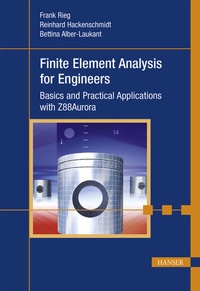
Finite Element Analysis for Engineers
Basics and Practical Applications with Z88Aurora
1st Edition
Published on 1. October 2014
736 pages
978-1-56990-488-6 (ISBN)
Description

The Finite Element Analysis today is the leading engineer's tool to analyze structures concerning engineering mechanics, i.e. statics, heat flows, eigenvalue problems and many more. Thus, this book wants to provide well-chosen aspects of this method for students of engineering sciences and engineers already established in the job in such a way, that they can apply this knowledge immediately to the solution of practical problems.
Over 30 examples along with all input data files on DVD allow a comprehensive practical training of engineering mechanics. Two very powerful FEA programs are provided on DVD, too: Z88, the open source finite elements program for static calculations, as well as Z88Aurora, the very comfortable to use and much more powerful freeware finite elements program which can also be used for non-linear calculations, stationary heat flows and eigenproblems, i.e. natural frequencies. Both are full versions with which arbitrarily big structures can be computed - only limited by your computer memory and your imagination. For Z88 all sources are fully available, so that the reader can study the theoretical aspects in the program code and extend it if necessary. Z88 and Z88Aurora are ready-to-run for Windows and LINUX as well as for Mac OS X. For Android devices there also exists an app called Z88Tina which can be downloaded from Google Play Store.
More details
Other editions
Additional editions
Frank Rieg | Reinhard Hackenschmidt | Bettina Alber-Laukant
Finite Element Analysis for Engineers
Basics and Practical Applications with Z88Aurora
Book
10/2014
1st Edition
Hanser Publications
€79.99
Article not available at the moment
Persons
Content
- Intro
- Finite Element Analysis for Engineers
- Preface
- 1 Introduction
- 2 The Basic Procedure
- 3 Some Elasticity Theory
- 3.1 Displacements and Strains
- 3.1.1 For the Truss
- 3.1.2 For Plane Stress
- 3.1.3 In Space
- 3.1.4 For the Plate
- 3.2 Stress-Strain Relations
- 3.3 Basics of Thermomechanical Loading
- 3.4 Basic Principles of Natural Vibration
- 3.5 Basic Principles of Non-linear Calculations
- 4 Finite Elements and Element Matrices
- 4.1 Basics of Element Stiffness Matrices
- 4.2 Constitutive Matrices
- 4.3 B Matrix
- 4.4 Shape Functions
- 4.5 Integration
- 4.6 The Application of Loads, Load Vectors
- 4.6.1 The Basic Procedure
- 4.6.2 Plate Elements
- 4.6.3 Volume Elements
- 4.6.4 Plane and Axial-Symmetrical State of Stress
- 4.6.5 Distributed Loads for Beams
- 4.6.6 Gerber Joints for Beams
- 4.7 A complete Element Stiffness Routine
- 4.8 Some Remarks on Modelling
- 4.8.1 Choice of Element Types
- 4.8.2 Polymers and Material Laws
- 4.8.3 Structural Optimization
- 4.9 Some Remarks on Shells
- 4.10 Element Matrices for Heat Transfer
- 4.11 Element Matrices for Vibration
- 4.12 Element Matrices of the Non-linear Finite Element Analysis
- 5 Compilation, Storage Schemes and Boundary Conditions
- 5.1 Compilation
- 5.2 Storage Schemes
- 5.2.1 Band Width Storage Scheme
- 5.2.2 The Skyline Storage Scheme
- 5.2.3 The Jennings Storage Scheme
- 5.2.4 The Non-Zero Storage Scheme
- 5.2.5 Summary of the Storage Schemes
- 5.3 Boundary Conditions
- 5.3.1 Single Forces and Single Displacements
- 5.3.2 Distributed Loads with Plates
- 5.3.3 Fixture of plates
- 5.3.4 Boundary Conditions in Temperature Analyses
- 5.3.5 Boundary Conditions with Vibration
- 5.3.6 Boundary Conditions in the Non-linear Finite Element Analysis
- 6 Solvers
- 6.1 Direct Solvers
- 6.1.1 The Cholesky Solver
- 6.2 Condition and Scaling
- 6.3 Iterative Solvers
- 6.3.1 The Jacobi Method
- 6.3.2 The Gauss-Seidel Method
- 6.3.3 The SOR Method and the JOR Method
- 6.3.4 The basic CG Solver
- 6.3.5 The CG Solver with Pre-conditioning
- 6.4 Solver for Thermomechanical Problems
- 6.5 Solver for Vibration Problems
- 6.6 Solver for the Non-linear Finite Element Analysis
- 7 Stresses and Nodal Forces
- 7.1 Stresses
- 7.2 Reduced Stresses
- 7.3 Nodal Forces
- 8 Mesh Generation of Curvilinear Finite Elements
- 8.1 Basis Considerations of the Procedure
- 8.2 Mathematical Foundations
- 8.3 Description of a Simple Mapped Mesher
- 9 Z88: The Basics
- 9.1 General Information
- 9.1.1 Summary of the Z88 Element Library
- 9.2 The Open Source FE Program Z88
- 9.2.1 Overview of the Z88 Program Modules
- 9.2.2 Dynamic Memory Z88
- 9.2.3 The Input and Output of Z88:
- 9.3 The Freeware FE Program Z88Aurora
- 9.3.1 Overview of the Z88Aurora Modules
- 9.3.2 Memory Requirement in Z88Aurora
- 9.3.3 The Input and Output of Z88Aurora
- 10 Z88: The Modules
- 10.1 The Linear Solver Z88R
- 10.1.1 Z88R: The Cholesky Solver
- 10.1.2 Z88R: The Sparse Matrix Solvers SICCG and SORCG
- 10.1.3 Z88R: The Sparse Matrix multi-core Solver PARDISO
- 10.1.4 Which Solver to choose?
- 10.1.5 Explanations for Stress Calculations
- 10.1.6 Explanations for Nodal Force Calculations
- 10.2 The Mapped Mesher Z88N
- 10.3 The Advanced Mapped Mesher in Z88Aurora
- 10.3.1 The Use of Z88N in Z88Aurora
- 10.3.2 Tetrahedron Refiner Z88MTV
- 10.3.3 The 2D Shell Thickener Z88MVS
- 10.4 The OpenGL Plot Program Z88O in Z88 V14 OS or the Post-Processor of Z88Aurora
- 10.5 The DXF Converter Z88X
- 10.6 The 3D Converter Z88G
- 10.7 The Ansys Converter Z88ASY in Z88Aurora
- 10.8The Abaqus Converter Z88INP in Z88Aurora
- 10.9 Das Cuthill-McKee Program Z88H
- 10.10 The STEP Import Z88GEOCON (STEP) in Z88Aurora
- 10.11 The STL Converter Z88GEOCON (STL) in Z88Aurora
- 10.12 The Tetrahedron Mesher in Z88Aurora
- 10.13 The Picking Module of Z88Aurora
- 10.14 The Material Data Base of Z88Aurora
- 10.15 Applying Boundary Conditions in Z88Aurora
- 10.16 The User Support with Spider in Z88Aurora
- 10.17 The Thermomechanical Solver in Z88Aurora
- 10.18 The free Vibration Solver in Z88Aurora
- 10.19 The Non-linear Solver Z88NL of Z88Aurora
- 11 Generating Input Files
- 11.1 General Information
- 11.2 General Structure Data File Z88I1.TXT
- 11.3 Boundary Condition File Z88I2.TXT
- 11.4 Surface and Pressure Loads File Z88I5.TXT
- 11.5 Material Parameters File Z88MAT.TXT
- 11.6 Material Data File *.TXT
- 11.7 Element Parameters File Z88ELP.TXT
- 11.8 Integration Order File Z88INT.TXT
- 11.9 Mapped Mesher Input File Z88NI.TXT
- 11.10 Solver Parameters File Z88MAN.TXT
- 11.11 Comparison of the different Z88 Data File Formats
- 12 The Finite Elements of Z88 and Z88Aurora
- 12.1 Hexahedron No.?1 with 8 Nodes
- 12.2 Beam No.?2 with 2 Nodes in Space
- 12.3 Plane Stress Element No.?3 with 6 Nodes
- 12.4 Truss No.?4 in Space
- 12.5 Shaft No.?5 with 2 Nodes
- 12.6 Torus No.?6 with 3 Nodes
- 12.7 Plane Stress Element No.?7 with 8 Nodes
- 12.8 Torus No.?8 with 8 Nodes
- 12.9 Truss No. 9 in the Plane
- 12.10 Hexahedron No.?10 with 20 Nodes
- 12.11 Plane Stress Element No.?11 with 12 Nodes
- 12.12 Torus No.?12 with 12 Nodes
- 12.13 Beam No.?13 in the Plane
- 12.14 Plane Stress Element No.?14 with 6 Nodes
- 12.15 Torus No.?15 with 6 Nodes
- 12.16 Tetrahedron No.16 with 10 Nodes
- 12.17 Tetrahedron No.?17 with 4 Nodes
- 12.18 Plate No.?18 with 6 Nodes
- 12.19 Plate No.?19 with 16 Nodes
- 12.20 Plate No.?20 with 8 Nodes
- 12.21 Shell No.?21 with 16 Nodes
- 12.22 Shell No.?22 with 12 Nodes
- 12.23 Shell No.?23 with 8 Nodes
- 12.24 Shell No.?24 with 6 Nodes
- 12.25 Element/Solver Overview Z88Aurora V2
- 13 Examples
- 13.1 Flat Wrench (Plate No.?7)
- 13.1.1 With Z88 V14
- 13.1.2With Z88Aurora V2
- 13.2 Crane Girder made of Trusses No.?4
- 13.2.1 With Z88 V14
- 13.2.2 With Z88Aurora V2
- 13.3 Gear Shaft with Shaft No.?5
- 13.3.1 With Z88 V14
- 13.3.2 With Z88Aurora V2
- 13.4 Bending Girder with Beam No.?13
- 13.4.1 With Z88 V14
- 13.4.2 With Z88Aurora V2
- 13.5 Plate Segment of Hexahedrons No.?1 and No.?10
- 13.5.1 With Z88 V14
- 13.5.2 With Z88Aurora V2
- 13.6 Pipe under Internal Pressure, Plain Stress Element No.?7
- 13.6.1 With Z88 V14
- 13.6.2 With Z88Aurora V2
- 13.7 Pipe under Internal Pressure, Torus No.?8
- 13.7.1 With Z88 V14
- 13.7.2 With Z88Aurora V2
- 13.8 Two-Stroke Engine Piston
- 13.8.1 With Z88 V14
- 13.8.2 With Z88Aurora V2
- 13.9 RINGSPANN Spring and Belleville Spring
- 13.9.1 With Z88 V14
- 13.9.2 With Z88Aurora V2
- 13.10 Liquid Gas Tank
- 13.10.1 With Z88 V14
- 13.10.2 With Z88Aurora V2
- 13.11 Motorcycle Crankshaft
- 13.11.1 With Z88 V14
- 13.11.2 With Z88Aurora V2
- 13.12 Torque-measuring hub
- 13.12.1 With Z88 V14
- 13.12.2 With Z88Aurora V2
- 13.13 Plane Frameworks
- 13.13.1 With Z88 V14
- 13.13.2 With Z88Aurora V2
- 13.14 Gearwheel
- 13.14.1 With Z88 V14
- 13.14.2 With Z88AuroraV2
- 13.15 3D Wrench
- 13.15.1 With Z88 V14
- 13.15.2 with Z88Aurora V2
- 13.16 Force Measuring Element, Plane Stress Elements No.?7
- 13.16.1 With Z88 V14
- 13.16.2 With Z88Aurora V2
- 13.17 Circular Plate, Plates No.?20
- 13.17.1 With Z88 V14
- 13.17.2 With Z88Aurora V2
- 13.18 Rectangular Plate with 16 Nodes Plates No.?19
- 13.18.1 With Z88 V14
- 13.18.2 With Z88Aurora V2
- 13.19 Four-stroke Engine Pistons with Tetrahedrons No.?16
- 13.19.1 With Z88 V14
- 13.19.2 With Z88Aurora V2
- 13.20 Motorcar Fan Wheel
- 13.20.1 With Z88 V14
- 13.20.2 With Z88Aurora V2
- 13.21 Diesel Piston
- 13.21.1 With Z88 V14
- 13.21.2 With Z88Aurora V2
- 13.22 Calculation of a Stress Concentration Factor
- 13.22.1 With Z88 V14
- 13.22.2 With Z88Aurora V2
- 13.23 Gear Root Stress
- 13.23.1 With Z88 V14
- 13.23.2 With Z88Aurora V2
- 13.24 Square Pipe, Shell No.?24
- 13.24.1 With Z88 V14
- 13.24.2 With Z88Aurora V2
- 13.25 Submarine made of Shells No.?22
- 13.26 Gear Wheel out of Tetrahedrons No.?17
- 13.27 Oscillating Drum
- 13.28 Modal Analysis Crankshaft
- 13.29 Thermo-mechanical Analysis of a Spoon
- 13.30 Thermal Analysis of a four-stroke Engine Piston
- 13.31 Non-linear Calculation of a Belleville Spring
- 13.32 Non-linear Calculation of a Hinge
- References and further reading
- Index
