

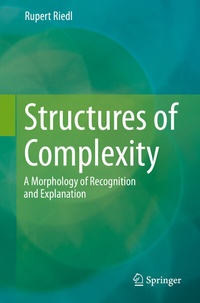
Structures of Complexity
Description

In this book, the author Rupert Riedl investigates the structural and functional correlations of issues considered as "complex". He brilliantly analyzes the definition of complexity, the occurrence of complexity, the meaning of complexity, and last-but-not-least the way complexity is dealt with professionally.
In recent years, our view of the world has been split into ever smaller segments - in part due to the increasing importance of the natural sciences and their associated analytical power. This calls for once again focusing on complexity and the holistic aspects, on interdisciplinary and synoptic approaches.
This book is a translation of the original German version "Strukturen der Komplexität", which was published in 2000. The discussion of complexity from the perspective of a biologist has long been overdue when it was published and is still up-to-date.
More details
Other editions
Additional editions
Person
Rupert Riedl (1925-2005) was an Austrian zoologist renowned for his work in the field of marine research (biology of marine caves, fauna and flora of the Mediterranean Sea) as well as for his contributions to the systems theory of evolution and evolutionary epistemology. Films such as "Das Leben im Riff" ("Life in the Reef", 1951), "Lichter unter Wasser" ("Lights under Water", 1952), and others also made him well known to a wider audience. He conducted his research at the University of Vienna. In 1967 he was appointed full professor and research professor of Marine Sciences at the University of North Carolina in Chapel Hill, USA.
Later in life he also dealt with social and environmental issues. Among other activities, he was founder of the Konrad Lorenz Institute for Evolution and Cognition Research and the founding president of the Club of Vienna .
Even after his retirement in 1995, he continued to hold lectures at the University of Vienna, withevolution being the main topic during that time. He criticized Darwin's determining factors as insufficient; he described mutation as a "blind constructor", selection as a "short-sighted opportunist". He already suspected some type of preselection in the realm of genes - a theory that he also expounded upon in his books.
Content
What will be discussed in this book - an introduction.- About the subject.- About the methods.- World and cognition as a problem.- What we consider reasonable.- How to gain cognition.- What kind of cognition have we gained?.- The Systems of cognition.- Prerequisites for cognition.- Accounting for succedaneous coincidences.- Accounting for simultaneous coincidences.- About structures and class hierarchies.- The Structures of recognition.- A Theory of the world.- The order of things.- The principles of morphology.- The principles of systematics.- The systems of explanation and comprehension.- The preconditions and their assets.- The change of cultural history.- The conditions of explanation.- The ways of comprehension.- The structuring of the things explained and comprehended.- The way of a dynamic order of the world.- The order of the reasons.- The principles of explanation.- The principles of comprehension.- Overview and outlook.
