

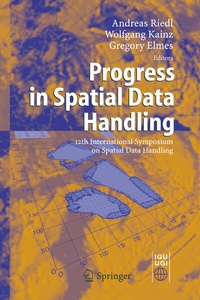
Progress in Spatial Data Handling
Description

Since the first symposium in 1984 the International Symposia on Spatial Data Handling (SDH) has become a major resource for recent advances in GIS research. The International Symposium on Spatial Data Handling is regarded as a premier international research forum for GIS. All papers are fully reviewed by an international program committee composed of experts in the field.
More details
Other editions
Additional editions
Persons
Andreas Riedl holds a graduate degree and a PhD in geography and cartography from the University of Vienna. He has been active in the field of cartography and GIS in Austria, Canada, Germany and the Netherlands. His research interests are in multimedia and geocommunication, applied GIS, animation, virtual reality and hyperglobes. Currently he is an assistant professor at the University of Vienna.
Wolfgang Kainz holds a graduate degree and a PhD in technical mathematics from the Graz University of Technology, Austria. Since 1981 he has been active in the field of GIS and spatial data handling in various functions at universities and research institutions in Austria, Brazil, Kuwait, Qatar, the USA, and the Netherlands. His research interest is in spatial databases, fuzzy logic and geodata policies. He is Professor of Cartography and Geoinformation at the University of Vienna.
Gregory Elmes holds a graduate degree in Geographic Information Systems from Edinburgh University and a PhD in Geography from the Pennsylvania State University. He is Professor of Geography at West Virginia University and has been active in GIS at universities in Sweden and Italy. His current research interests include the incorporation of spatio-temporal information in health and forensic science, and the implications of geographic information technologies in society at local and global scales.
