

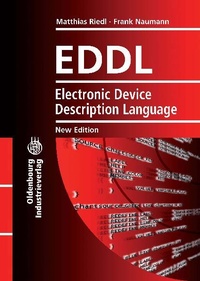
EDDL Electronic Device Description Language
2nd Edition
Published on 26. May 2011
320 pages
978-3-8356-3272-1 (ISBN)
Description

Die Akzeptanz von standardisierten und elektronisch verarbeitbaren Gerätebeschreibungen für die Inbetriebnahme von intelligenten Feldgeräten und Remote I/O- Systemen ist eine wichtige Grundlage für die Gestaltung heutiger und zukünftiger Automatisierungsstrukturen. Die Ära bisher notwendiger, manueller und damit kostenintensiver Implementierungen von Gerätetreibern für immer wieder neue Softwarewerkzeuge geht damit zu Ende. Gerätebeschreibungen können in verschiedenen Inbetriebnahmewerkzeugen und Engineeringsystemen wiederverwendet werden. Dieses Buch erläutert die Electronic Device Description Language (EDDL) sowohl für Hersteller als auch für Anwender von Feldgeräten. Neben einer Quickstart-Einführung erfolgt eine systematische Darstellung des zugrunde liegenden Gerätemodells und eine ausführliche Beschreibung der Sprache EDDL. Darüber hinaus spannt das Buch den Bogen über umfangreiche Gerätebeschreibungsbeispiele und verfügbare Inbetriebnahmewerkzeuge (z.B. SIMATIC-PDM® der Siemens AG) bis zu Integrationsmöglichkeiten in moderne Leitsysteme. Hauptzielgruppe sind MSR-Techniker und MSR-Ingenieure.
More details
Other editions
Additional editions
Matthias Riedl | Frank Naumann
EDDL Electronic Device Description Language
Book
05/2011
2nd Edition
Vulkan-Verlag
€89.00
Article exhausted; check different version
Persons
Content
- Intro
- Preface
- Who should read this book
- How the book is organised
- How to use this book
- Acknowledgments
- About the Authors
- Contents
- 1 Introduction
- 1.1 Motivation for Device Descriptions
- 1.2 History of Field Devices
- 1.3 Integration of Field Devices into the Automation System
- 1.4 History of the EDDL
- 2 Tool Overview
- 2.1 About this Chapter
- 2.2 Tools for Development
- 2.2.1 General Approach
- 2.2.2 The isEDD Workbench
- 2.2.3 The HCF Development Tools
- 2.2.4 The Fieldbus Foundation Development Tools
- 2.3 Compliance Tests
- 2.4 End User Tools
- 2.4.1 Approaches of EDD based End User Tools
- 2.4.2 SIMATIC PDM
- 2.4.3 isEDDView DTM
- 3 The EDD Language Concept
- 3.1 About this Chapter
- 3.2 Identification of an EDD
- 3.3 Language Conventions
- 3.3.1 Translation Phases
- 3.3.2 Preprocessor
- 3.3.3 Terminals
- 3.3.4 Dictionaries
- 3.3.5 Expressions
- 3.3.6 Conditionals
- 3.3.7 Referencing Items and their Attributes
- 3.4 Common Attributes
- 3.4.1 Label
- 3.4.2 Handling
- 3.4.3 Help
- 3.4.4 Validity
- 3.4.5 Members
- 3.4.6 Line Types and Colours
- 3.4.7 Height and Width
- 3.4.8 Response Codes
- 3.5 Data Modelling
- 3.5.1 Parameters
- 3.5.2 Arrays
- 3.5.3 Lists (Dynamic Arrays)
- 3.5.4 Collections
- 3.5.5 Records
- 3.5.6 Reference Arrays
- 3.5.7 Files
- 3.5.8 Relations
- 3.5.9 Blocks
- 3.5.10 Variable Lists
- 3.6 Communication
- 3.6.1 General
- 3.6.2 PROFIBUS / PROFINET
- 3.6.3 HART
- 3.6.4 FOUNDATION Fieldbus
- 3.7 Methods
- 3.7.1 Purpose and Syntax
- 3.7.2 TYPE
- 3.7.3 ACCESS
- 3.7.4 VALIDITY
- 3.7.5 CLASS
- 3.7.6 DEFINITION
- 3.7.7 Aborting
- 3.7.8 Signal Handler
- 3.8 Graphical User Interface
- 3.8.1 Introduction
- 3.8.2 The Idea behind
- 3.8.3 The MENU in Detail
- 3.8.4 Menus
- 3.8.5 Dialogues and Windows
- 3.8.6 Layout Rules
- 3.8.7 Images
- 3.8.8 Grids
- 3.8.9 Charts
- 3.8.10 Graphs
- 3.9 Reuse of Code
- 3.9.1 Objective
- 3.9.2 Importing external EDDs
- 3.9.3 Like
- 3.9.4 Template
- 4 Practical Usage
- 4.1 About this chapter
- 4.2 Only Prime Quality
- 4.2.1 Principles
- 4.2.2 Naming and Code Conventions
- 4.2.3 How to Comment the Source
- 4.2.4 Good Software Designs
- 4.2.5 Defense Programming
- 4.2.6 Source Control by means of Revision Control
- 4.3 How to find Failures in an EDD
- 4.3.1 General Idea to find the Defect
- 4.3.2 Order of Parameter Transfer
- 4.3.3 Wrong Parameter Values after Transfers
- 4.3.4 METHOD abort
- 4.4 Parameters of a Device and their Representation
- 4.4.1 Let us begin the Project
- 4.4.2 Using a Dictionary and Completion of the Parameters
- 4.4.3 A Simple User Interface
- 4.4.4 PROFIBUS
- 4.4.5 HART
- 4.4.6 FOUNDATION Fieldbus
- 4.4.7 Up- and Download
- 4.4.8 Validity
- 4.4.9 UNIT-Relation
- 4.5 Using the EDDL PROFIBUS PA IMPORT Library
- 4.6 Entry Points and User Roles
- 4.7 Advanced EDD Usage
- 4.7.1 How to write a Wizard?
- 4.7.2 Persistent Data Storage
- 5 Recent Works and Perspectives
- 5.1 About this Chapter
- 5.2 Modular Devices
- 5.2.1 Background
- 5.2.2 Components
- 5.2.3 Component Folders
- 5.2.4 Component References
- 5.2.5 Component Relations
- 5.2.6 Interfaces
- 5.3 EDDL and FDI
- 5.3.1 Overview
- 5.3.2 Basic Architecture
- 5.3.3 System Architecture
- 5.3.4 Advanced Harmonisation
- 5.4 Usage of EDD Technology in Wide Contexts
- 5.4.1 General
- 5.4.2 EDDL and SOA
- Bibliography
- Figures
- Tables
- Listings
- Abbreviations
- A Predefined return codes of Builtins
- B EDDL keywords
- C EDDL builtins
