

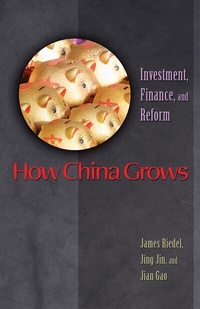
How China Grows
Investment, Finance, and Reform
1st Edition
Published on 26. October 2020
224 pages
978-0-691-22018-5 (ISBN)
Description

Why investment and financial reform are essential to China's continued economic well-being
Although China's economy has grown spectacularly over the last twenty-five years, economists disagree about how the Chinese economy is likely to fare in the short- and long-term future. Is China's growth sustainable, or has China relied too much on investment, which is subject to diminishing returns, and not enough on technological change? The first book on the relation between investment, finance, and growth in China, How China Grows dismisses this concern. James Riedel, Jing Jin, and Jian Gao argue that investment has not only been the engine of growth, but also the main source of technological progress and structural change in China.
What threatens future growth instead, the authors argue, are the weaknesses of China's financial system that undermine efficiency in investment allocation. Financial-sector reform and development are necessary, not only for sustaining long-term growth, but also for maintaining macroeconomic stability.
Although it includes some technical economic analysis, How China Grows is accessible to noneconomists and will benefit anyone who is interested in development finance in general and in China's economic growth in particular-whether economists, political scientists, bankers, or business people.
Although China's economy has grown spectacularly over the last twenty-five years, economists disagree about how the Chinese economy is likely to fare in the short- and long-term future. Is China's growth sustainable, or has China relied too much on investment, which is subject to diminishing returns, and not enough on technological change? The first book on the relation between investment, finance, and growth in China, How China Grows dismisses this concern. James Riedel, Jing Jin, and Jian Gao argue that investment has not only been the engine of growth, but also the main source of technological progress and structural change in China.
What threatens future growth instead, the authors argue, are the weaknesses of China's financial system that undermine efficiency in investment allocation. Financial-sector reform and development are necessary, not only for sustaining long-term growth, but also for maintaining macroeconomic stability.
Although it includes some technical economic analysis, How China Grows is accessible to noneconomists and will benefit anyone who is interested in development finance in general and in China's economic growth in particular-whether economists, political scientists, bankers, or business people.
More details
Other editions
Additional editions
Book
06/2023
Princeton University Press
€61.00
Shipment within 10-20 days
Book
04/2007
Princeton University Press
€92.85
Shipment within 10-20 days
Persons
James Riedel is Professor of International Economics at Johns Hopkins University's School of Advanced International Studies. Jing Jin is Director of China Strategy for UBS AG Hong Kong, and a professor at Beijing's Central University of Finance and Economics. Jian Gao is Vice-Governor of the China Development Bank in Beijing.
Content
- Cover Page
- Half-title Page
- Title Page
- Copyright Page
- Contents
- Preface
- Acknowledgments
- Chapter 1: Overview of Economic Reforms and Outcomes
- 1.1 Agricultural Reform: 1979-85
- 1.2 Industrial Reform: 1978-93
- 1.3 Transition to a Market Economy: 1994-2003
- 1.4 Foreign Trade and Investment
- 1.5 Financial Sector
- Chapter 2: The Source of Growth and the Role of Investment
- 2.1 Methodology of Growth Accounting
- 2.2 Measurement of TFPG in China
- 2.3 Production Function Estimates of TFPG in China
- 2.4 Explaining TFPG in China
- 2.5 The Contribution of Investment Reconsidered
- 2.6 Technological Change Reconsidered
- 2.7 Postscript: Investment versus Domestic Demand as a Source of Growth
- Chapter 3: Saving and the Financing of Investment in China
- 3.1 Investment
- 3.2 Financing Investment
- 3.3 Financial Flows between Sectors
- 3.4 Household Saving
- 3.5 Government Saving and Investment
- 3.6 Foreign Saving
- 3.7 Summary and Conclusions
- Chapter 4: Financial Sector Repression
- 4.1 Why Repress the Financial System?
- 4.2 How Repressed Is China's Financial System?
- 4.3 Finance and Growth in China
- 4.4 Strategy of Financial Development
- Chapter 5: Banking Sector Reform
- 5.1 Key Features of the Banking Sector
- 5.2 Problems of the Banking Sector
- 5.3 Measures Taken to Strengthen the Banking Sector
- Chapter 6: Developments in the Bond Market
- 6.1 The Role of a Bond Market
- 6.2 The Bond Market in China
- 6.3 Government Bonds
- 6.4 Corporate Bond Market
- 6.5 Conclusion
- Chapter 7: The Rise and Fall of the Stock Market
- 7.1 The Rise
- 7.2 The Fall
- 7.3 Conclusion
- Chapter 8: Macroeconomic Policy and Performance
- 8.1 Ups and Downs in the Macro Economy
- 8.2 Investment Spending as the Proximate Cause of Macroeconomic Cycles
- 8.3 Anatomy of Macro Cycles in China
- 8.4 Monetary Policy
- 8.5 Capital Flows and Exchange Rate Policy
- 8.6 Fiscal Policy
- 8.7 Conclusion
- References
- Index
