

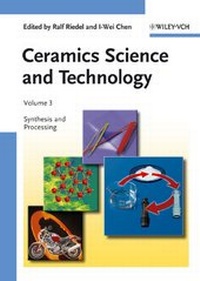
Ceramics Science and Technology
Volume 3: Synthesis and Processing
1st Edition
Published on 15. December 2011
XXII, 532 pages
978-3-527-63196-4 (ISBN)
Description

Although ceramics have been known to mankind literally for millennia, research has never ceased. Apart from the classic uses as a bulk material in pottery, construction, and decoration, the latter half of the twentieth century saw an explosive growth of application fields, such as electrical and thermal insulators, wear-resistant bearings, surface coatings, lightweight armour, or aerospace materials. In addition to plain, hard solids, modern ceramics come in many new guises such as fabrics, ultrathin films, microstructures and hybrid composites.
Built on the solid foundations laid down by the 20-volume series Materials Science and Technology, Ceramics Science and Technology picks out this exciting material class and illuminates it from all sides.
Materials scientists, engineers, chemists, biochemists, physicists and medical researchers alike will find this work a treasure trove for a wide range of ceramics knowledge from theory and fundamentals to practical approaches and problem solutions.
Built on the solid foundations laid down by the 20-volume series Materials Science and Technology, Ceramics Science and Technology picks out this exciting material class and illuminates it from all sides.
Materials scientists, engineers, chemists, biochemists, physicists and medical researchers alike will find this work a treasure trove for a wide range of ceramics knowledge from theory and fundamentals to practical approaches and problem solutions.
More details
Other editions
Additional editions
Book
11/2011
1st Edition
Wiley-VCH
€279.00
Article exhausted; check different version
Persons
Ralf Riedel has been a professor at the Institute of Materials Science at the Darmstadt University of Technology in Darmstadt since 1993. He received a Diploma degree in chemistry in 1984 and he finished his dissertation in Inorganic Chemistry in 1986 at the University of Stuttgart. After postdoctoral research at the Max-Planck-Institute for Metals Research and the Institute of Inorganic Chemistry at the University of Stuttgart he completed his habilitation in the field of Inorganic Chemistry in 1992. Prof. Riedel is Fellow of the American Ceramic Society and was awarded with the Dionyz Stur Gold Medal for merits in natural sciences. He is a member of the World Academy of Ceramics and Guest Professor at the Jiangsu University in Zhenjiang, China. In 2006 he received an honorary doctorate from the Slovak Academy of Sciences, Bratislava, Slovakia. In 2009 he was awarded with an honorary professorship at the Tianjin University in China. He published more than 300 papers and patents and he is widely known for his research in the field of polymer derived ceramics and on ultra high pressure synthesis of new materials.
I-Wei Chen has been Skirkanich Professor of Materials Innovation at the University of Pennsylvania since 1997, where he also gained his master's degree in 1975. He received his bachelor's degree in physics from Tsinghua University, Taiwan, in 1972, and earned his doctorate in metallurgy from the Massachusetts Institute of Technology in 1980. He taught at the University of Michigan (Materials) during 1986 - 1997 and MIT (Nuclear Engineering ; Materials) during 1980 - 1986. He began ceramic research studying martensitic transformations in zirconia nano crystals, which led to work on transformation plasticity, superplasticity, fatigue, grain growth and sintering in various oxides and nitrides. He is currently interested in solid oxide fuel cells, nanotechnology of resistance memory and ferroelectrics, and nanoparticle-based medical imaging and drug delivery. A Fellow of American Ceramic Society (1991) and recipient of its Ross Coffin Purdy Award (1994), Edward C. Henry Award (1999) and Sosman Award (2006), he authored over 90 papers in the Journal of the American Ceramic Society (1986 - 2006). He also received Humboldt Research Award for Senior U.S. Scientists (1997).
I-Wei Chen has been Skirkanich Professor of Materials Innovation at the University of Pennsylvania since 1997, where he also gained his master's degree in 1975. He received his bachelor's degree in physics from Tsinghua University, Taiwan, in 1972, and earned his doctorate in metallurgy from the Massachusetts Institute of Technology in 1980. He taught at the University of Michigan (Materials) during 1986 - 1997 and MIT (Nuclear Engineering ; Materials) during 1980 - 1986. He began ceramic research studying martensitic transformations in zirconia nano crystals, which led to work on transformation plasticity, superplasticity, fatigue, grain growth and sintering in various oxides and nitrides. He is currently interested in solid oxide fuel cells, nanotechnology of resistance memory and ferroelectrics, and nanoparticle-based medical imaging and drug delivery. A Fellow of American Ceramic Society (1991) and recipient of its Ross Coffin Purdy Award (1994), Edward C. Henry Award (1999) and Sosman Award (2006), he authored over 90 papers in the Journal of the American Ceramic Society (1986 - 2006). He also received Humboldt Research Award for Senior U.S. Scientists (1997).
Content
PART I: Powders
POWDER COMPACTION BY DRY PRESSING
Introduction
Fundamental Aspects of Dry Pressing
Practice of Uniaxial Compaction
Practice of Isostatic Compaction
Granulation of Ceramic Powders
TAPE CASTING
Use of the Tape Casting Process
Process Variations
Tape Casting Process
Components of the Slurry
Preparation of the Slurry and its Properties Tape Casting
Machining, Metallization, and Lamination
Binder Burnout
Firing
Summary
HYDROTHERMAL ROUTES TO ADVANCED CERAMIC POWDERS AND MATERIALS
Introduction to Hydrothermal Synthesis
Engineering Ceramic Synthesis in Hydrothermal Solution
Materials Chemistry of Hydrothermal Ceramic Powders
Ceramics Processed from Hydrothermally Synthesized Powders
Summary
LIQUID FEED-FLAME SPRAY PYROLYSIS (LF-FSP) IN THE SYNTHESIS OF SINGLE- AND MIXED-METAL OXIDE NANOPOWDERS
Introduction
Basic Concepts of Nanopowder Formation During LF-FSP
Can Nanoparticles Be Prepared That Consist of Mixed Phases?
Which Particle Morphologies Can be Accessed?
Can Nanopowders Be Doped?
SOL-GEL PROCESSING OF CERAMICS
Introduction
Principles of Sol-Gel Processing
Porous Materials
Hybrid Materials
Bioactive Sol-Gel Materials
PART II: Densification and Beyond
SINTERING
Sintering Phenomena
Solid-State Sintering
Liquid-Phase Sintering
Summary
HOT ISOSTATIC PRESSING AND GAS-PRESSURE SINTERING
Introduction
Sintering Mechanisms with Applied Pressure
Silicon Nitride Ceramics: Comparison of Capsule HIP and Sinter-HIP Technology
Other Applications
HOT PRESSING AND SPARK PLASMA SINTERING
Introduction Advantages of Sintering Under a Uniaxial Pressure
Conventional Hot Presses
SPS Set-Up
Unique Features and Advantages of the SPS Process
The Role of High Pressure
The Role of Rapid and Effective Heating
The Role of Pulsed Direct Current
Microstructural Prototyping by SPS
Potential Industrial Applications
FUNDAMENTALS AND METHODS OF CERAMIC JOINING
Introduction
Basic Phenomena in Ceramic Joining
Methods of Joining
Conclusions
MACHINING AND FINISHING OF CERAMICS
Introduction
Face and Profile Grinding
Current Status and Future Prospects
Double-Face Grinding with Planetary Kinematics
Ultrasonic-Assisted Grinding
Abrasive Flow Machining
Outlook
PART III: Films and Coatings
VAPOR-PHASE DEPOSITION OF OXIDES
Introduction
Summary
METAL-ORGANIC CHEMICAL VAPOR DEPOSITION OF METAL OXIDE FILMS AND NANOSTRUCTURES
Introduction
Metal Oxide Film Deposition
The Precursor Concept in CVD
Metal Oxide Coatings
Summary
PART IV: Manufacturing Technology
POWDER CHARACTERIZATION
Introduction
Chemical Composition and Surface Characterization Particle Sizing and Data Interpretation
Physical Properties
Summary
PROCESS DEFECTS
Introduction
Bulk Examination Methods
Characterization Methods for Green Compact
Process Defects in Ceramics
NONCONVENTIONAL POLYMERS IN CERAMIC PROCESSING: THERMOPLASTICS AND MONOMERS
Introduction: Ceramic Green Bodies as Filled Polymers
Thermoplastics in Ceramic Processing
A Brief Review of Thermoplastics Used in Ceramic Forming
Melt Spinning of Fibers
Single-Component Extrusion and "Plastics Processing"
Thermoplastic Green Machining
Thermoplastic Coextrusion
Crystallinity in Thermoplastics
Compounding Thermoplastic Blends Volumetric Changes in Thermoplastic-Ceramic Compounds
Polymer Formation by Polymerization of Suspensions in Monomers
Summary
MANUFACTURING TECHNOLOGY: RAPID PROTOTYPING
Introduction
Outline of Ceramic Processing
Solid Freeform Fabrication
Additive Prototyping Processes
Sheet-Based Processes
Formative Prototyping Methods
Casting Methods
Plastic-Forming Methods Subtractive Methods
Examples of SFF
Summary
PART V: Alternative Strategies to Ceramics
SINTERING OF NANOGRAIN CERAMICS
Introduction
Background: What Went Wrong With Conventional Thinking?
Two-Step Sintering of Y2O3
Two-Step Sintering of Other Ceramics
Conclusions
POLYMER-DERIVED CERAMICS
Introduction
Preceramic Polymers
Polymer-to
POWDER COMPACTION BY DRY PRESSING
Introduction
Fundamental Aspects of Dry Pressing
Practice of Uniaxial Compaction
Practice of Isostatic Compaction
Granulation of Ceramic Powders
TAPE CASTING
Use of the Tape Casting Process
Process Variations
Tape Casting Process
Components of the Slurry
Preparation of the Slurry and its Properties Tape Casting
Machining, Metallization, and Lamination
Binder Burnout
Firing
Summary
HYDROTHERMAL ROUTES TO ADVANCED CERAMIC POWDERS AND MATERIALS
Introduction to Hydrothermal Synthesis
Engineering Ceramic Synthesis in Hydrothermal Solution
Materials Chemistry of Hydrothermal Ceramic Powders
Ceramics Processed from Hydrothermally Synthesized Powders
Summary
LIQUID FEED-FLAME SPRAY PYROLYSIS (LF-FSP) IN THE SYNTHESIS OF SINGLE- AND MIXED-METAL OXIDE NANOPOWDERS
Introduction
Basic Concepts of Nanopowder Formation During LF-FSP
Can Nanoparticles Be Prepared That Consist of Mixed Phases?
Which Particle Morphologies Can be Accessed?
Can Nanopowders Be Doped?
SOL-GEL PROCESSING OF CERAMICS
Introduction
Principles of Sol-Gel Processing
Porous Materials
Hybrid Materials
Bioactive Sol-Gel Materials
PART II: Densification and Beyond
SINTERING
Sintering Phenomena
Solid-State Sintering
Liquid-Phase Sintering
Summary
HOT ISOSTATIC PRESSING AND GAS-PRESSURE SINTERING
Introduction
Sintering Mechanisms with Applied Pressure
Silicon Nitride Ceramics: Comparison of Capsule HIP and Sinter-HIP Technology
Other Applications
HOT PRESSING AND SPARK PLASMA SINTERING
Introduction Advantages of Sintering Under a Uniaxial Pressure
Conventional Hot Presses
SPS Set-Up
Unique Features and Advantages of the SPS Process
The Role of High Pressure
The Role of Rapid and Effective Heating
The Role of Pulsed Direct Current
Microstructural Prototyping by SPS
Potential Industrial Applications
FUNDAMENTALS AND METHODS OF CERAMIC JOINING
Introduction
Basic Phenomena in Ceramic Joining
Methods of Joining
Conclusions
MACHINING AND FINISHING OF CERAMICS
Introduction
Face and Profile Grinding
Current Status and Future Prospects
Double-Face Grinding with Planetary Kinematics
Ultrasonic-Assisted Grinding
Abrasive Flow Machining
Outlook
PART III: Films and Coatings
VAPOR-PHASE DEPOSITION OF OXIDES
Introduction
Summary
METAL-ORGANIC CHEMICAL VAPOR DEPOSITION OF METAL OXIDE FILMS AND NANOSTRUCTURES
Introduction
Metal Oxide Film Deposition
The Precursor Concept in CVD
Metal Oxide Coatings
Summary
PART IV: Manufacturing Technology
POWDER CHARACTERIZATION
Introduction
Chemical Composition and Surface Characterization Particle Sizing and Data Interpretation
Physical Properties
Summary
PROCESS DEFECTS
Introduction
Bulk Examination Methods
Characterization Methods for Green Compact
Process Defects in Ceramics
NONCONVENTIONAL POLYMERS IN CERAMIC PROCESSING: THERMOPLASTICS AND MONOMERS
Introduction: Ceramic Green Bodies as Filled Polymers
Thermoplastics in Ceramic Processing
A Brief Review of Thermoplastics Used in Ceramic Forming
Melt Spinning of Fibers
Single-Component Extrusion and "Plastics Processing"
Thermoplastic Green Machining
Thermoplastic Coextrusion
Crystallinity in Thermoplastics
Compounding Thermoplastic Blends Volumetric Changes in Thermoplastic-Ceramic Compounds
Polymer Formation by Polymerization of Suspensions in Monomers
Summary
MANUFACTURING TECHNOLOGY: RAPID PROTOTYPING
Introduction
Outline of Ceramic Processing
Solid Freeform Fabrication
Additive Prototyping Processes
Sheet-Based Processes
Formative Prototyping Methods
Casting Methods
Plastic-Forming Methods Subtractive Methods
Examples of SFF
Summary
PART V: Alternative Strategies to Ceramics
SINTERING OF NANOGRAIN CERAMICS
Introduction
Background: What Went Wrong With Conventional Thinking?
Two-Step Sintering of Y2O3
Two-Step Sintering of Other Ceramics
Conclusions
POLYMER-DERIVED CERAMICS
Introduction
Preceramic Polymers
Polymer-to
