

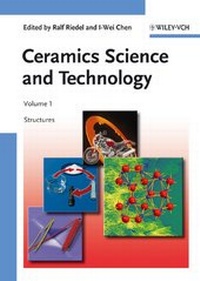
Ceramics Science and Technology
Volume 1: Structures
1st Edition
Published on 20. January 2011
XX, 592 pages
978-3-527-63193-3 (ISBN)
Description

Although ceramics have been known to mankind literally for millennia, research has never ceased. Apart from the classic uses as a bulk material in pottery, construction, and decoration, the latter half of the twentieth century saw an explosive growth of application fields, such as electrical and thermal insulators, wear-resistant bearings, surface coatings, lightweight armour, or aerospace materials. In addition to plain, hard solids, modern ceramics come in many new guises such as fabrics, ultrathin films, microstructures and hybrid composites.
Built on the solid foundations laid down by the 20-volume series Materials Science and Technology, Ceramics Science and Technology picks out this exciting material class and illuminates it from all sides.
Materials scientists, engineers, chemists, biochemists, physicists and medical researchers alike will find this work a treasure trove for a wide range of ceramics knowledge from theory and fundamentals to practical approaches and problem solutions.
Built on the solid foundations laid down by the 20-volume series Materials Science and Technology, Ceramics Science and Technology picks out this exciting material class and illuminates it from all sides.
Materials scientists, engineers, chemists, biochemists, physicists and medical researchers alike will find this work a treasure trove for a wide range of ceramics knowledge from theory and fundamentals to practical approaches and problem solutions.
Reviews / Votes
"This book will be a great tool for ceramic engineering students specifically and Materials Science and Engineering students in general. At the same time it will serve as an excellent reference source forindustrial researchers." (Journal of Metals, August 21, 2008)
More details
Other editions
Additional editions
Software
08/2011
Wiley-VCH
€413.05
No shipping information available
Book
02/2008
Wiley-VCH
€299.00
Article exhausted; check different version
Persons
Ralf Riedel has been a professor at the Institute of Materials Science of Darmstadt University of Technology since 1993. He received his degree in chemistry in 1984, followed by two years of dissertation work with Professor Ekkehard Fluck at the University of Stuttgart. After postdoctoral research at the Max-Planck Institute for Metals Research and the Institute of Inorganic Chemistry at the University of Stuttgart, he gained his lecturing qualification in the field of inorganic chemistry in 1992. He is a member of the World Academy of Ceramics and Guest Professor at the Jiangsu University in Zhenjiang, China, a Fellow of the American Ceramic Society and a recipient of the Dionyz Stur Gold Medal for merits in natural sciences. In 2006 he received an honorary doctorate from the Slovak Academy of Sciences, Bratislava, Slovakia. Professor Riedel has published more than 300 papers and patents and is widely known for his research in the field of polymer derived ceramics and on ultra high pressure synthesis of new materials.
I-Wei Chen is currently Skirkanich Professor of Materials Innovation at the University of Pennsylvania since 1997, where he also gained his master's degree in 1975. He received his bachelor's degree in physics from Tsinghua University, Taiwan, in 1972, and earned his doctorate in metallurgy from the Massachusetts Institute of Technology in 1980. He taught at the University of Michigan (Materials) during 1986-1997 and MIT (Nuclear Engineering; Materials) during 1980-1986. He began ceramic research studying martensitic transformations in zirconia nano crystals, which led to work on transformation plasticity, superplasticity, fatigue, grain growth and sintering in various oxides and nitrides. He is currently interested in nanotechnology of ferroelectrics, thin film memory devices, and nano particles for biomedical applications. A Fellow of American Ceramic Society (1991) and recipient of its Ross Coffin Purdy Award (1994), Edward C. Henry Award (1999) and Sosman Award (2006), he authored over 90 papers in the Journal of the American Ceramic Society (1986-2006). He also received Humboldt Research Award for Senior U.S. Scientists (1997).
I-Wei Chen is currently Skirkanich Professor of Materials Innovation at the University of Pennsylvania since 1997, where he also gained his master's degree in 1975. He received his bachelor's degree in physics from Tsinghua University, Taiwan, in 1972, and earned his doctorate in metallurgy from the Massachusetts Institute of Technology in 1980. He taught at the University of Michigan (Materials) during 1986-1997 and MIT (Nuclear Engineering; Materials) during 1980-1986. He began ceramic research studying martensitic transformations in zirconia nano crystals, which led to work on transformation plasticity, superplasticity, fatigue, grain growth and sintering in various oxides and nitrides. He is currently interested in nanotechnology of ferroelectrics, thin film memory devices, and nano particles for biomedical applications. A Fellow of American Ceramic Society (1991) and recipient of its Ross Coffin Purdy Award (1994), Edward C. Henry Award (1999) and Sosman Award (2006), he authored over 90 papers in the Journal of the American Ceramic Society (1986-2006). He also received Humboldt Research Award for Senior U.S. Scientists (1997).
Content
Preface
PART I: Introduction
MODERN TRENDS IN ADVANCED CERAMICS
Advanced Ceramics
Conventional Synthesis and Processing of Advanced Ceramics
Molecular Routes for the Synthesis and Processing of Advanced Ceramics
Methods for Characterization of Advanced Ceramic Materials
Applications of Advanced Ceramics
Outlook
PART II: Structure of Ceramic Materials: Atomic Level
MODELING AMORPHOUS CERAMIC STRUCTURES
Introduction
Computational Approach
Results
Summary and Conclusions
STRUCTURAL CHEMISTRY OF CERAMICS
Introduction
Crystal Chemistry of Binary Oxides
Complex Oxide Structures
Nitrides and Related Materials
DIFFUSION IN CERAMICS
General Introduction
Simple Oxides
Diffusion in Complex Oxides
Diffusion in Non-Oxide Ceramics
STRUCTURES OF CERAMIC MATERIALS: THERMODYNAMICS AND CONSTITUTION
Introduction
Experimental Phase Studies
Methods of Computational Thermodynamics
Case Studies
PART III: Structures of Ceramic Materials: Microstructural Level
MICROSTRUCTURAL DESIGN OF CERAMICS: THEORY AND EXPERIMENT
Overview
An Introduction to Ceramics
Determinants of Ceramic Microstructure
Factors in Microstructural Design
Amorphous Phases in Ceramics
Silicon Nitride Ceramics: A Model System
Theory and Modeling of Ceramics
A Case Study in Theory and Modeling: Intergranular Films in Silicon Nitride
Outlook
MESOSCOPIC CERAMIC STRUCTURES IN ONE, TWO, AND THREE DIMENSIONS
Ceramics at the Mesoscale
Synthetic Routes to Mesoscaled Ceramic Structures
One-Dimensional (1-D) Ceramic Structures
Two-Dimensional (2-D) Ceramic Structures
Three-Dimensional (3-D) Ceramic Structures
BULK CERAMIC NANOSTRUCTURES
Introduction
Materials and Related Nanocomposites
Formation of Nanoinclusions
Materials Preparation
Properties of Ceramic Nanocomposites
High-Temperature Properties
Electrical Properties
GLASS CERAMICS: SILICA- AND ALUMINA-BASED
Introduction
Theory of Nucleation and Crystal Growth
Glass Ceramics with Low Thermal Expansion Coefficients
Glass Ceramics for Mechanical Applications
Bioglass Ceramics
Oriented Glass Ceramics
Nano Glass Ceramics
CELLULAR STRUCTURES
Introduction
Structure
Properties
Fabrication Methods
Applications
Summary
CERAMIC THIN FILMS
Introduction
Fundamentals of the Chemical Solution Deposition Process
Structure-Property Relationships
The Application of CSD-Derived Ceramic Films
Conclusions
MULTIPHASE FIBER COMPOSITES
Introductory Remarks
Fibers for Ceramic Composites
Processes to Fabricate Ceramic Fiber Composites
Non-Brittle Composites and Associated Mechanisms
Properties of Ceramic Fiber Composites
Applications of Ceramic Fiber Composites
PART I: Introduction
MODERN TRENDS IN ADVANCED CERAMICS
Advanced Ceramics
Conventional Synthesis and Processing of Advanced Ceramics
Molecular Routes for the Synthesis and Processing of Advanced Ceramics
Methods for Characterization of Advanced Ceramic Materials
Applications of Advanced Ceramics
Outlook
PART II: Structure of Ceramic Materials: Atomic Level
MODELING AMORPHOUS CERAMIC STRUCTURES
Introduction
Computational Approach
Results
Summary and Conclusions
STRUCTURAL CHEMISTRY OF CERAMICS
Introduction
Crystal Chemistry of Binary Oxides
Complex Oxide Structures
Nitrides and Related Materials
DIFFUSION IN CERAMICS
General Introduction
Simple Oxides
Diffusion in Complex Oxides
Diffusion in Non-Oxide Ceramics
STRUCTURES OF CERAMIC MATERIALS: THERMODYNAMICS AND CONSTITUTION
Introduction
Experimental Phase Studies
Methods of Computational Thermodynamics
Case Studies
PART III: Structures of Ceramic Materials: Microstructural Level
MICROSTRUCTURAL DESIGN OF CERAMICS: THEORY AND EXPERIMENT
Overview
An Introduction to Ceramics
Determinants of Ceramic Microstructure
Factors in Microstructural Design
Amorphous Phases in Ceramics
Silicon Nitride Ceramics: A Model System
Theory and Modeling of Ceramics
A Case Study in Theory and Modeling: Intergranular Films in Silicon Nitride
Outlook
MESOSCOPIC CERAMIC STRUCTURES IN ONE, TWO, AND THREE DIMENSIONS
Ceramics at the Mesoscale
Synthetic Routes to Mesoscaled Ceramic Structures
One-Dimensional (1-D) Ceramic Structures
Two-Dimensional (2-D) Ceramic Structures
Three-Dimensional (3-D) Ceramic Structures
BULK CERAMIC NANOSTRUCTURES
Introduction
Materials and Related Nanocomposites
Formation of Nanoinclusions
Materials Preparation
Properties of Ceramic Nanocomposites
High-Temperature Properties
Electrical Properties
GLASS CERAMICS: SILICA- AND ALUMINA-BASED
Introduction
Theory of Nucleation and Crystal Growth
Glass Ceramics with Low Thermal Expansion Coefficients
Glass Ceramics for Mechanical Applications
Bioglass Ceramics
Oriented Glass Ceramics
Nano Glass Ceramics
CELLULAR STRUCTURES
Introduction
Structure
Properties
Fabrication Methods
Applications
Summary
CERAMIC THIN FILMS
Introduction
Fundamentals of the Chemical Solution Deposition Process
Structure-Property Relationships
The Application of CSD-Derived Ceramic Films
Conclusions
MULTIPHASE FIBER COMPOSITES
Introductory Remarks
Fibers for Ceramic Composites
Processes to Fabricate Ceramic Fiber Composites
Non-Brittle Composites and Associated Mechanisms
Properties of Ceramic Fiber Composites
Applications of Ceramic Fiber Composites
