

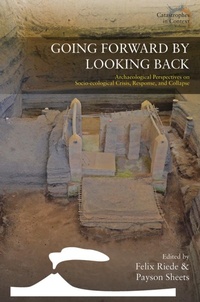
Going Forward by Looking Back
Description

Catastrophes are on the rise due to climate change, as is their toll in terms of lives and livelihoods as world populations rise and people settle into hazardous places. While disaster response and management are traditionally seen as the domain of the natural and technical sciences, awareness of the importance and role of cultural adaptation is essential. This book catalogues a wide and diverse range of case studies of such disasters and human responses. This serves as inspiration for building culturally sensitive adaptations to present and future calamities, to mitigate their impact, and facilitate recoveries.
More details
Other editions
Additional editions
Persons
Felix Riede is Professor of Archaeology at Aarhus University in Denmark. He heads the Laboratory for Past Disaster Science, and his research focuses on the Palaeolithic and Mesolithic of Europe.
Content
List of Illustrations, Figures and Tables
Introduction: Framing Catastrophes Archaeologically
Felix Riede and Payson Sheets
Section I: Fire
Chapter 1. Do Deep-Time Disasters Hold Lessons for Contemporary Understandings of Resilience and Vulnerability?: The Case of the Laacher See Volcanic Eruption
Felix Riede and Rowan Jackson
Chapter 2. Risky Business and the Future of the Past: Nuclear Power in the Ring of Fire
Karen Holmberg
Chapter 3. Do Disasters Always Enhance Inequality?
Payson Sheets
Chapter 4. Political Participation and Social Resilience to the 536/540 CE Atmospheric Catastrophe
Peter Neal Peregrine
Chapter 5. Collapse, Resilience, and Adaptation: An Archaeological Perspective on Continuity and Change in Hazardous Environments
Robin Torrence
Chapter 6. Continuity in the Face of a Slowly Unfolding Catastrophe: The Persistence of Icelandic Settlement Despite Large-Scale Soil Erosion
Andrew Dugmore, Rowan Jackson, David Cooper, Anthony Newton, Árni Daníel Júlíusson, Richard Streeter, Viðar Hreinsson, Stefani Crabtree, George Hambrecht, Megan Hicks and Tom McGovern
Chapter 7. Coping through Connectedness: A Network-Based Modeling Approach Using Radiocarbon Data from the Kuril Islands of Northeast Asia
Erik Gjesfjeld and William A. Brown
Section II: Water
Chapter 8. The Materiality of Heritage Post-disaster: Negotiating Urban Politics, People, and Place through Collaborative Archaeology
Kelly M. Britt
Chapter 9. Mound-Building and the Politics of Disaster Debris
Shannon Lee Dawdy
Chapter 10. Catastrophe And Collapse in the Late Pre-Hispanic Andes: Responding for Half a Millennium to Political Fragmentation And Climate Stress
Nicola Sharratt
Chapter 11. Beyond One-Shot Hypotheses: Explaining Three Increasingly Large Collapses in the Northern Pueblo Southwest
Timothy A. Kohler, Laura J. Ellyson, and R. Kyle Bocinsky
Chapter 12. Inherent Collapse? Social Dynamics and External Forcing in Early Neolithic and Modern Southwest Germany
Detlef Gronenborn, Hans-Christoph Strien, Kai Wirtz, Peter Turchin, Christoph Zielhofer, and Rolf van Dick
Chapter 13. El Niño as Catastrophe on the Peruvian Coast
Daniel H. Sandweiss and Kirk A. Maasch
Chapter 14. A Slow Catastrophe: Anthropocene Futures and Cape Town's "Day Zero"
Nick Shepherd
Conclusion: Rewriting the Disaster Narrative, an Archaeological Imagination
Mark Schuller
Index
