

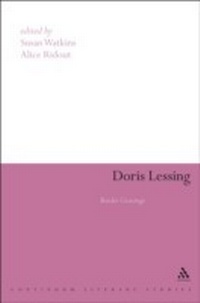
Doris Lessing
Border Crossings
1st Edition
Published on 13. August 2009
192 pages
978-1-4411-2102-8 (ISBN)
Description

Despite winning the Nobel Prize for Literature, Doris Lessing has received relatively little critical attention. One of the reasons for this is that Lessing has spent much of her lifetime and her long published writing career crossing both national and ideological borders.
This essay collection reflects and explores the incredible variety of Lessing's border crossings and positions her writing in its various social and cultural contexts. Lessing crosses literal national borders in her life and work, but more controversial have been her crossings of genre borders into sci-fi and "space fiction", and her crossing of ideological borders such as moving into and out of the Communist Party and from a colonial into a post-colonial world. This timely collection also considers a number of the most interesting recent critical and theoretical approaches to Lessing's writing, including work on maternity and abjection in relation to The Fifth Child and The Grass is Singing, eco-criticism in Lessing's 'Ifrakan' novels, and postcolonial re-writings of landscape in her African Stories.
This essay collection reflects and explores the incredible variety of Lessing's border crossings and positions her writing in its various social and cultural contexts. Lessing crosses literal national borders in her life and work, but more controversial have been her crossings of genre borders into sci-fi and "space fiction", and her crossing of ideological borders such as moving into and out of the Communist Party and from a colonial into a post-colonial world. This timely collection also considers a number of the most interesting recent critical and theoretical approaches to Lessing's writing, including work on maternity and abjection in relation to The Fifth Child and The Grass is Singing, eco-criticism in Lessing's 'Ifrakan' novels, and postcolonial re-writings of landscape in her African Stories.
Reviews / Votes
"This splendid collection of accessible, critical essays offers in-depth scrutiny of Lessing's persistent transgressing of literary, cultural, gender, and colonial boundaries. Through this lens Doris Lessing: Border Crossings appreciates the spectacular range of her work from The Grass is Singing to Alfred and Emily." - Dr Sandra Singer, University of Guelph, Canada "Doris Lessing's Border Crossings persuasively argues that Lessing's crossing of borders--cultural, political, biographic, generic and thematic--has been a persistent gesture. A valuable contribution to Doris Lessing Studies, this collection is innovative in grounding critiques of her work in British academic circles and current debates on the ideology of fictive forms, questions of authorship, commercial literary culture, aging and gender."- Professor Virginia Tiger, Department of English Chair, Rutgers University, USA Reviewed in The Year's Work in English Studies, Volume 90More details
Series
Edition
1. Auflage
Language
English
Place of publication
New York
United States
Target group
Professional and scholarly
ISBN-13
978-1-4411-2102-8 (9781441121028)
Copyright in bibliographic data and cover images is held by Nielsen Book Services Limited or by the publishers or by their respective licensors: all rights reserved.
Schweitzer Classification
Other editions
Additional editions
Book
12/2011
Continuum Publishing Corporation
€55.70
Shipment within 15-20 days
Persons
Alice Ridout is Assistant Professor in the English and Film Department at Algoma University, Sault St. Marie, Canada where she teaches in the fields of Contemporary, Canadian, Children's and Popular Literature. Her work has appeared in the journals Adaptation, Margaret Atwood Studies, Doris Lessing Studies, and the University of Toronto Quarterly. She is Website Editor for the Doris Lessing Society and was President from 2012-2015. She also serves on the Editorial Board for Doris Lessing Studies and was Book Reviews Co-editor for Contemporary Women's Writing from 2009-2011. Along with her two publications with Bloomsbury Publishing, she is also co-editor of Doris Lessing's The Golden Notebook After Fifty (2015).
Content
Note on Contributors
Introduction: Doris Lessing's Border Crossings, Alice Ridout and Susan Watkins (Leeds Metropolitan University, UK)
1. Horrors of the Breast: Cultural Boundaries and the Abject in The Grass is Singing, Edith Frampton (San Diego State University, USA)
2. Inside and Outside Colonial Spaces: Border Crossings in Doris Lessing's African Stories', Pat Louw (University of Zululand, SA)
3. Doris Lessing's The Golden Notebook: An Experiment in Critical Fiction, Nick Bentley (University of Keele, UK)
4. Doris Lessing's Fantastic Children, Roberta Rubenstein (American University, US)
5. The 'Jane Somers' Hoax: Aging, Gender and the Literary Marketplace, Susan Watkins (Leeds Metropolitan University, UK)
6. (Not Such) Great Expectations: Unmaking Maternal Ideals in The Fifth Child and We Need to Talk About Kevin, Ruth Robbins (Leeds Metropolitan University, UK)
7. Doris Lessing's Under My Skin: The Autobiography of a Cosmopolitan 'Third Culture Kid', Alice Ridout (University of Leeds, UK)
8. Environmental Fables? The eco-politics of Doris Lessing's 'Ifrik' novels, Fiona Becket, (University of Leeds, UK)
9. The Porous Border Between Fact and Fiction, Empathy and Identification in Doris Lessing's The Cleft, Phyllis Sternberg Perrakis (University of Ottawa, CA)
Afterword, Judith Kegan Gardiner
Index
Introduction: Doris Lessing's Border Crossings, Alice Ridout and Susan Watkins (Leeds Metropolitan University, UK)
1. Horrors of the Breast: Cultural Boundaries and the Abject in The Grass is Singing, Edith Frampton (San Diego State University, USA)
2. Inside and Outside Colonial Spaces: Border Crossings in Doris Lessing's African Stories', Pat Louw (University of Zululand, SA)
3. Doris Lessing's The Golden Notebook: An Experiment in Critical Fiction, Nick Bentley (University of Keele, UK)
4. Doris Lessing's Fantastic Children, Roberta Rubenstein (American University, US)
5. The 'Jane Somers' Hoax: Aging, Gender and the Literary Marketplace, Susan Watkins (Leeds Metropolitan University, UK)
6. (Not Such) Great Expectations: Unmaking Maternal Ideals in The Fifth Child and We Need to Talk About Kevin, Ruth Robbins (Leeds Metropolitan University, UK)
7. Doris Lessing's Under My Skin: The Autobiography of a Cosmopolitan 'Third Culture Kid', Alice Ridout (University of Leeds, UK)
8. Environmental Fables? The eco-politics of Doris Lessing's 'Ifrik' novels, Fiona Becket, (University of Leeds, UK)
9. The Porous Border Between Fact and Fiction, Empathy and Identification in Doris Lessing's The Cleft, Phyllis Sternberg Perrakis (University of Ottawa, CA)
Afterword, Judith Kegan Gardiner
Index
