

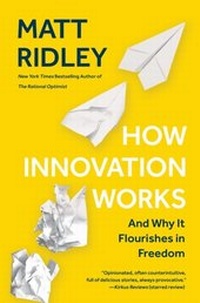
How Innovation Works
Description

Building on his national bestseller The Rational Optimist, Matt Ridley chronicles the history of innovation, and how we need to change our thinking on the subject.
Innovation is the main event of the modern age, the reason we experience both dramatic improvements in our living standards and unsettling changes in our society. Forget short-term symptoms like Donald Trump and Brexit, it is innovation that will shape the twenty-first century. Yet innovation remains a mysterious process, poorly understood by policy makers and businessmen alike.
Matt Ridley argues that we need to see innovation as an incremental, bottom-up, fortuitous process that happens as a direct result of the human habit of exchange, rather than an orderly, top-down process developing according to a plan. Innovation is crucially different from invention, because it is the turning of inventions into things of practical and affordable use to people. It speeds up in some sectors and slows down in others. It is always a collective, collaborative phenomenon, involving trial and error, not a matter of lonely genius. It happens mainly in just a few parts of the world at any one time. It still cannot be modeled properly by economists, but it can easily be discouraged by politicians. Far from there being too much innovation, we may be on the brink of an innovation famine.
Ridley derives these and other lessons from the lively stories of scores of innovations, how they started and why they succeeded or failed. Some of the innovation stories he tells are about steam engines, jet engines, search engines, airships, coffee, potatoes, vaping, vaccines, cuisine, antibiotics, mosquito nets, turbines, propellers, fertilizer, zero, computers, dogs, farming, fire, genetic engineering, gene editing, container shipping, railways, cars, safety rules, wheeled suitcases, mobile phones, corrugated iron, powered flight, chlorinated water, toilets, vacuum cleaners, shale gas, the telegraph, radio, social media, block chain, the sharing economy, artificial intelligence, fake bomb detectors, phantom games consoles, fraudulent blood tests, hyperloop tubes, herbicides, copyright, and even life itself.
All prices
More details
Other editions
Additional editions
Person
Matt Ridley's books-including The Red Queen, Genome, The Rational Optimist, The Evolution of Everything, How Innovation Works, and most recently, Viral: the Search for the Origin of Covid-19 (with Alina Chan)-have sold over a million copies, been translated into 31 languages, and won several awards. He sat in the House of Lords from 2013 and 2021, and was founding chairman of the International Centre for Life in Newcastle. He created the "Mind and Matter" column in the Wall Street Journal in 2010, and was a columnist for the Times. He is a fellow of the Royal Society of Literature and of the Academy of Medical Sciences, and a foreign honorary member of the American Academy of Arts and Sciences. He lives in Northumberland.
Content
- Intro
- Title Page
- Dedication
- Contents
- Introduction: The Infinite Improbability Drive
- 1. Energy
- Of heat, work and light
- What Watt wrought
- Thomas Edison and the invention business
- The ubiquitous turbine
- Nuclear power and the phenomenon of disinnovation
- Shale gas surprise
- The reign of fire
- 2. Public health
- Lady Mary's dangerous obsession
- Pasteur's chickens
- The chlorine gamble that paid off
- How Pearl and Grace never put a foot wrong
- Fleming's luck
- The pursuit of polio
- Mud huts and malaria
- Tobacco and harm reduction
- 3. Transport
- The locomotive and its line
- Turning the screw
- Internal combustion's comeback
- The tragedy and triumph of diesel
- The Wright stuff
- International rivalry and the jet engine
- Innovation in safety and cost
- 4. Food
- The tasty tuber
- How fertilizer fed the world
- Dwarfing genes from Japan
- Insect nemesis
- Gene editing gets crisper
- Land sparing versus land sharing
- 5. Low-technology innovation
- When numbers were new
- The water trap
- Crinkly tin conquers the Empire
- The container that changed trade
- Was wheeled baggage late?
- Novelty at the table
- The rise of the sharing economy
- 6. Communication and computing
- The first death of distance
- The miracle of wireless
- Who invented the computer?
- The ever-shrinking transistor
- The surprise of search engines and social media
- Machines that learn
- 7. Prehistoric innovation
- The first farmers
- The invention of the dog
- The (Stone Age) great leap forward
- The feast made possible by fire
- The ultimate innovation: life itself
- 8. Innovation's essentials
- Innovation is gradual
- Innovation is different from invention
- Innovation is often serendipitous
- Innovation is recombinant
- Innovation involves trial and error
- Innovation is a team sport
- Innovation is inexorable
- Innovation's hype cycle
- Innovation prefers fragmented governance
- Innovation increasingly means using fewer resources rather than more
- 9. The economics of innovation
- The puzzle of increasing returns
- Innovation is a bottom-up phenomenon
- Innovation is the mother of science as often as it is the daughter
- Innovation cannot be forced upon unwilling consumers
- Innovation increases interdependence
- Innovation does not create unemployment
- Big companies are bad at innovation
- Setting innovation free
- 10. Fakes, frauds, fads and failures
- Fake bomb detectors
- Phantom games consoles
- The Theranos debacle
- Failure through diminishing returns to innovation: mobile phones
- A future failure: Hyperloop
- Failure as a necessary ingredient of success: Amazon and Google
- 11. Resistance to innovation
- When novelty is subversive: the case of coffee
- When innovation is demonized and delayed: the case of biotechnology
- When scares ignore science: the case of weedkiller
- When government prevents innovation: the case of mobile telephony
- When the law stifles innovation: the case of intellectual property
- When big firms stifle innovation: the case of bagless vacuum cleaners
- When investors divert innovation: the case of permissionless bits
- 12. An innovation famine
- How innovation works
- A bright future
- Not all innovation is speeding up
- The innovation famine
- China's innovation engine
- Regaining momentum
- Acknowledgements
- Sources and further reading
- Index
- About the Author
- Also by Matt Ridley
- Copyright
- About the Publisher
