

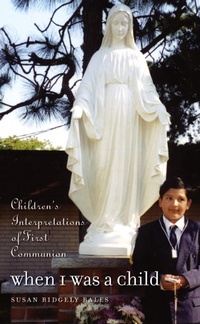
When I Was a Child
Description

First Communion is generally understood as a rite of passage in which seven- and eight-year-old Catholic children transform from baptized participants in the Church to members of the body of Christ, the universal Catholic Church. This official Church account, however, ignores what the rite actually may mean to its participants. In When I Was a Child, Susan Ridgely Bales demonstrates that the accepted understanding of a religious ritual can shift dramatically when one considers the often neglected perspective of child participants. Bales followed Faith Formation classes and interviewed communicants, parents, and priests in an African American parish and in a parish containing both white and Latino congregations. By letting the children speak for themselves through their words, drawings, and actions, When I Was a Child stresses the importance of rehearsal, the centrality of sensory experiences, and the impact of expectations in the communicants' interpretations of the Eucharist. In the first sustained ethnographic study of how children interpret and help shape their own faith, Bales finds that children’s perspectives give new contours to the traditional understanding of a common religious ritual. Ultimately, she argues that scholars of religion should consider age as distinct a factor as race, class, and gender in their analyses.
More details
Other editions
Additional editions
Person
Content
- Intro
- Contents
- Acknowledgments
- Introduction
- Rites of Passage
- Conceptions of Childhood
- Child-Centered Research
- 1 Children Seen and Heard: First Communion Celebrations
- Holy Cross's First Communion
- An Analysis of ''the Big Day''
- Blessed Sacrament's Bilingual Liturgy
- What First Communion Taught
- The Latino Communion Celebration
- Learning from the Spanish Mass
- Performing Heritage and Joining Parishes
- Catholicism in the Bible Belt
- Maintaining African American Identity
- Building a Unified Parish
- Conclusion
- 2 Drawing, Playing, Listening: A Method for Studying Children's Interpretations
- Children's Perceptions as Sources
- Finding Myself In Between
- Informing the Participants
- Drawing Conclusions
- 3 Learning the Mysteries of the Church
- First Communion: History and Ritual Practice
- Teaching: Principles, Practice, and Participation
- Receiving the Eucharist
- A Theology of Taste
- The Meaning of Consecration
- Decoding the Symbols
- Conclusion: Interpreting the Eucharist
- 4 Connecting to Parish and Family
- Learning Jesus' Love
- The Center of Attention
- Membership and Its Responsibilities
- Joining the Family
- Dressing the Part
- Conclusion: Focusing on Present Relationships
- Conclusion: Adding Children's Voices in Religious Studies
- The Ritual in Time and Scope
- Age as a Fourth Category of Analysis
- Learning Ritual
- (In)Voluntary Participation
- Children's Congregations
- Children's Interpretations
- Children in American Religion
- Appendix A: Structured Interview Questions for Parents and Catechists
- Appendix B: Child's Assent Forms
- Notes
- Bibliography
- Index
- A
- B
- C
- D
- E
- F
- G
- H
- I
- J
- K
- L
- M
- N
- O
- P
- Q
- R
- S
- T
- V
- W
