

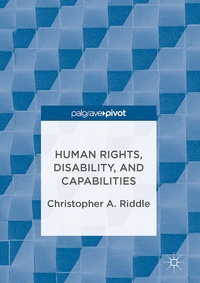
Human Rights, Disability, and Capabilities
Description

This book presents the argument that health has special moral importance because of the disadvantage one suffers when subjected to impairment or disabling barriers. Christopher A. Riddle asserts that ill health and the presence of disabling barriers are human rights issues and that we require a foundational conception of justice in order to promote the rights of people with disabilities. The claim that disability is a human rights issue is defended on the grounds that people with disabilities experience violations to their dignity, equality, and autonomy. Because human rights exist as a subset of other justice-based rights, Riddle contends that we must support a foundation of justice compatible with endorsing these three principles (equality, dignity, and autonomy). This volume argues that the "capabilities approach" is the best currency of justice for removing the disabling barriers that consistently violate approximately one billion people's human rights.
More details
Other editions
Additional editions
Person
Christopher A. Riddle is an Associate Professor & Chair of Philosophy and the Director of the Applied Ethics Institute at Utica College, NY. His work has been published in journals such as The Journal of Social Philosophy ; The American Journal of Bioethics ; Medicine, Healthcare, & Philosophy ; Topoi ; and Disability Studies Quarterly . He is also the author of Disability & Justice: The Capabilities Approach in Practice (2014) and the editor of From Disability Theory to Practice (2017).
