

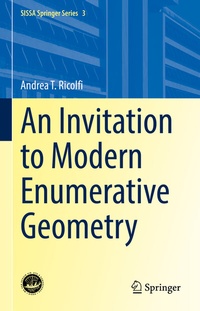
An Invitation to Modern Enumerative Geometry
Description

This book is based on a series of lectures given by the author at SISSA, Trieste, within the PhD courses Techniques in enumerative geometry (2019) and Localisation in enumerative geometry (2021). The goal of this book is to provide a gentle introduction, aimed mainly at graduate students, to the fast-growing subject of enumerative geometry and, more specifically, counting invariants in algebraic geometry. In addition to the more advanced techniques explained and applied in full detail to concrete calculations, the book contains the proofs of several background results, important for the foundations of the theory. In this respect, this text is conceived for PhD students or research "beginners" in the field of enumerative geometry or related areas. This book can be read as an introduction to Hilbert schemes and Quot schemes on 3-folds but also as an introduction to localisation formulae in enumerative geometry. It is meant to be accessible without a strong background in algebraic geometry; however, three appendices (one on deformation theory, one on intersection theory, one on virtual fundamental classes) are meant to help the reader dive deeper into the main material of the book and to make the text itself as self-contained as possible.
Reviews / Votes
"This book offers an introduction to modern enumerative geometry. As an active research area of algebraic geometry, enumerative geometry is closely linked with and shaped by many areas of mathematics and physics . . It provides a comprehensive and excellent resource for both classical and modern enumerative geometry." (Zhenbo Qin, Mathematical Reviews, July, 2025)
"The book under review is intended to be a gentle introduction to contemporary enumerative geometry. . The book is intended to be suitable for young graduate students and to be self-contained enough to be read in one piece. . I can definitely recommend it as a rather advanced invitation to enumerative geometry." (Piotr Pokora, zbMATH 1508.14001, 2023)
More details
Other editions
Additional editions
Person
Andrea T. Ricolfi obtained a PhD in Mathematics at the University of Stavanger (Norway) and is now an assistant professor at SISSA, Trieste. His research interests include the study of moduli spaces of sheaves on algebraic 3-folds and refined invariants attached to them, as well as derived categories of coherent sheaves, quiver representations and Grothendieck rings of varieties.
Content
1 Introduction.- 2 Counting in algebraic geometry.- 3 Background material.- 4 Informal introduction to Grassmannians.- 5 Relative Grassmannians, Quot, Hilb.- 6 The Hilbert scheme of points.- 7 Equivariant Cohomology.- 8 The Atiyah-Bott localisation formula.- 9 Applications of the localisation formula.- 10 The toy model for the virtual fundamental class and its localization.- 11 Degree 0 DT invariants of a local Calabi-Yau 3-fold.- 12 DT/PT correspondence and a glimpse of Gromov-Witten theory .- Appendix A: Deformation Theory.- Appendix B: Intersection Theory.- Appendix C: Perfect obstruction theories and virtual classes.
