

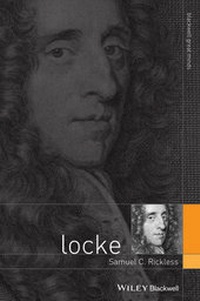
Locke
Description

Reviews / Votes
"Recommended. Lower-level undergraduates through researchers/faculty; general readers." (Choice, 1 July 2015) "Clearly and engagingly written, this book providesstudents with the best sort of model for writing about the historyof philosophy. Rickless shows both how to put a philosopher'sviews in historical context, and how to subject them to rigorousphilosophical assessment. The top choice for short introductions toLocke's philosophy." --Edwin McCann, University of Southern California "An excellent and elegantly written introduction toLocke's philosophy that is both comprehensive andconcise." --David Owen, University of ArizonaMore details
Other editions
Person
Content
chapter 2
the nature and role of ideas
In his masterwork, An Essay Concerning Human Understanding, Locke introduces and defends what has since come to be known as the “way of ideas.” It is difficult to overstate the influence and staying power of this mode of philosophical investigation. For years after Locke penned the Essay, philosophers were busy defending or attacking one or other aspect of his theory of ideas, in relation to philosophical subjects as diverse as ethics and epistemology. It is therefore of the utmost importance to understand how Locke conceives of ideas, for these entities lie at the heart of his philosophical system.
As we will see, ideas are the building blocks of Locke's theories of (i) perception, (ii) scientific classification, (iii) linguistic meaning, (iv) knowledge, and (v) judgment: (i) ideas are objects of perception; (ii) we classify substances (e.g., gold or water) into categories based on whether their qualities or properties match up with the ideas we associate with the relevant names (“gold” and “water”); (iii) the meaning of a linguistic term for a particular speaker is no more than the idea that the speaker associates with that term; (iv) knowledge is perception of agreement or disagreement between two ideas; and (v) judgment is presumption of the same sort of agreement or disagreement. There will be more on all these theories in the chapters that follow. But in order to understand them, we need to understand how Locke thinks of ideas. What, for Locke, is an idea?
It is commonly supposed that Locke holds that an idea is the object of perception or thought. The term “idea,” Locke tells us, “serves best to stand for whatsoever is the Object of the Understanding when a Man thinks, [or] whatever it is, which the Mind can be employ'd about in thinking” (E I.i.8: 47; also Draft B, 3: 103).1 It seems, then, that, for Locke, everything that I perceive or think of is an idea. And ideas, Locke goes on to say, are “Perceptions in our Minds” (E II.viii.7: 134). In this, ideas are to be distinguished from the properties or qualities of bodies that are external to the mind. As Locke puts the point in the title to a famous passage to which we shall return in Chapter 6: “Ideas in the Mind, Qualities in Bodies” (E II.viii.7–8: 134, section heading).
It might be objected to this view that, although it seems true to say that when Macbeth hallucinates a dagger the object perceived or thought of is an idea in Macbeth's mind, it seems false to say that when Hamlet sees Yorick's skull, what he is perceiving is something in his own mind. The skull and its various qualities are outside, not inside, Hamlet's mind; hence they cannot be ideas, as Locke understands the term.
This would be an excellent criticism, were it not for the fact that Locke actually speaks loosely in saying that everything a human being perceives is an idea. When he is being careful, Locke says this: “Whatsoever the Mind perceives in it self, or is the immediate object of Perception, Thought, or Understanding, that I call Idea” (E II.viii.8: 134; also E IV.i.1: 525; W4: 130, 134, 145, 233, 362). The emphasis here should be on the word “immediate.” Locke's considered view is that ideas are all immediate objects of perception. It does not follow from this that all objects of perception are ideas, for the view leaves open the possibility that (some) objects of mediate perception are not ideas.
But this raises the question of what differentiates immediate from mediate perception. Locke does not say much, if anything, about the nature of this distinction. But it is reasonable to suppose that mediate perception involves something that mediates between perceiver and perceived, in the following sense. An object O is mediately perceived by M when M perceives O by perceiving something numerically distinct from O that is in some way related to O; an object O is immediately perceived by M when M perceives O but not mediately. It is in a perfectly ordinary sense that I perceive my face mediately when I look at it in a mirror: I perceive my face by perceiving something else – namely an image of my face – in the mirror, an image that is related to my face by way of representing it. Locke's view seems to be that ideas are objects of perception that are not perceived this way: when I perceive an idea, I do not perceive it by perceiving something else to which it is related (e.g., by the relation of representation). I do not perceive ideas by perceiving images or representations of them: I perceive them, as it were, directly.
This view leaves open the possibility that tables and chairs, apples and pears, colors and shapes, and so on, are perceived without being ideas in our minds. And indeed, this is Locke's own view. The world that we experience is full of objects and properties external to our minds that are only mediately perceived, namely by perceiving ideas that conform to, or represent, them. Ideas themselves are only immediate objects of perception.2
Pointing out that when Locke speaks precisely he means to describe ideas as immediate objects of perception does not, however, tell us what ideas actually are. What sorts of things are immediate objects of perception? Are they substances or modes, mind-dependent or mind-independent, material or immaterial? The short answer here is that Locke takes ideas to be mind-dependent modes, while remaining agnostic about whether they are material or immaterial.
To understand this view, it helps to have a brief overview of Lockean ontology. According to Locke, everything that exists is either a substance, a mode, or a relation (E II.xii.3: 164; W8: 220). Locke writes that “[t]he Ideas of Substances are such combinations of simple Ideas, as are taken to represent distinct particular things subsisting by themselves” (E II.xii.6: 165), and thus treats substances as particular things that subsist by themselves. (In this, Locke joins all of his philosophical predecessors, most notably the Aristotelian Scholastics and the followers of Descartes.) Substances, then, are particular things (e.g., human beings, sheep, gold, and water) that can exist on their own – that is, things that do not depend for their existence on the existence of anything else. Modes, by contrast, “contain not in them the supposition of subsisting by themselves, but are considered as Dependences on, or Affections of Substances” (E II.xii.4: 165); that is, a mode is something that does depend for its existence on the existence of something else, namely a substance. Among modes, Locke counts, for example, distances and motions, gratitude, murder, and beauty. Relations are connections between modes (e.g., being longer than), between substances (e.g., being a sibling of), or between modes and substances (e.g., inhering in, being caused by).
Within this ontological framework, Locke's ideas are clearly mind-dependent modes, rather than substances or relations. For ideas are private and depend for their existence on the minds that perceive them.3 On Locke's view (as on Descartes's or Aristotle's), there is no such thing as a free-floating idea, an idea whose existence is completely independent of the existence of anything else. Were there no perceiving minds in the world, there would be no ideas. By contrast, minds could exist even if there were no ideas to speak of.4
As for whether ideas are material or immaterial, Locke tells us that he is not in any position to provide an answer to this question. In Draft B of the Essay, Locke writes:
I shall not at present medle with the physicall consideration of the minde or trouble my self to examin … by what motions of our spirits, or what alteration of our bodys we come to have any Ideas in our understanding & whether those Ideas be material or immateriall. These are speculations which however pleasant & profound I shall decline not only as lying out of my way in the designe I am now upon, but also out of my reach. (Draft B, 2: 102; see also E I.i.2: 43)
As we will see, Locke's agnosticism here is in keeping with the fundamental tenets of his epistemology. On Locke's view, knowledge consists in the perception of agreement or disagreement between two ideas (E IV.ii.15: 538). If, as Locke thinks, there is no agreement or disagreement to be perceived between the idea of an idea and the idea of materiality or immateriality, then it is impossible for us to know whether ideas are material or not. Indeed, the very nature or essence of ideas eludes the human understanding. We simply do not know what ideas are in themselves. To ask after the nature of ideas, then, is to ask a question that the human mind is unable to answer. Rather than push for an answer, we should “sit down in a quiet Ignorance” of an issue that is “beyond the reach of our Capacities” (E I.i.4: 45).5
Do we receive any more illumination from the fact that Locke tells us that he has used the term “idea” “to express whatever is meant by Phantasm, Notion, Species” (E I.i.8: 47)? Not much. Phantasms, notions, and species are theoretical posits that belong to the Aristotelian Scholastic theory of perception and knowledge to which Locke was exposed as an undergraduate at Oxford. A phantasm is (roughly) a sensible mental image that represents and resembles the external object...
