

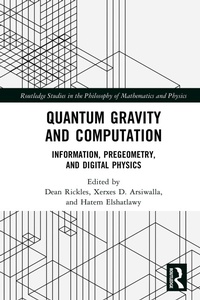
Quantum Gravity and Computation
Information, Pregeometry, and Digital Physics
Published on 23. December 2025
332 pages
978-1-040-58624-2 (ISBN)
Description

This volume argues that concepts from the theory of computation-including information theory, formal languages, and discrete structures-might provide novel paths towards a solution to the problem of quantum gravity. By combining elements of physics with computer science and mathematics, the volume proposes to transform the foundations of spacetime physics and bring it into the digital age.
In recent years, it has become increasingly apparent a new theoretical framework will be needed to solve the problem of quantum gravity. This kind of framework-sometimes referred to as "pregeometry" or even "prephysics"-goes beyond conventional mathematical conceptions of space, time, and matter, seeking their building blocks in more fundamental elements. The essays in this volume explore this approach from a variety of perspectives, including physics-based, mathematical, computational, and philosophical. The new formal frameworks needed to discuss such approaches have their roots in homotopy type theory, formal language theory, and higher category theory; the computational perspective is informed by connections between pregeometric structures and formal proofs and programs. The new philosophical fulcrum supporting these new avenues is inspired by constructivism and meta-structures. By probing at a level of structure beneath the ordinary structures used in general relativity and quantum mechanics, this volume seeks to find new ways of showing how these higher-order structures can be constructed from the deeper elements.
Quantum Gravity and Computation is an essential resource for scholars and graduate students interested in the philosophy of physics, quantum mechanics, and computational science.
In recent years, it has become increasingly apparent a new theoretical framework will be needed to solve the problem of quantum gravity. This kind of framework-sometimes referred to as "pregeometry" or even "prephysics"-goes beyond conventional mathematical conceptions of space, time, and matter, seeking their building blocks in more fundamental elements. The essays in this volume explore this approach from a variety of perspectives, including physics-based, mathematical, computational, and philosophical. The new formal frameworks needed to discuss such approaches have their roots in homotopy type theory, formal language theory, and higher category theory; the computational perspective is informed by connections between pregeometric structures and formal proofs and programs. The new philosophical fulcrum supporting these new avenues is inspired by constructivism and meta-structures. By probing at a level of structure beneath the ordinary structures used in general relativity and quantum mechanics, this volume seeks to find new ways of showing how these higher-order structures can be constructed from the deeper elements.
Quantum Gravity and Computation is an essential resource for scholars and graduate students interested in the philosophy of physics, quantum mechanics, and computational science.
More details
Series
Language
English
Place of publication
London
United Kingdom
Publishing group
Taylor & Francis Ltd
Target group
College/higher education
Illustrations
2 Tables, black and white; 39 Line drawings, black and white; 11 Halftones, black and white; 50 Illustrations, black and white
File size
24,13 MB
ISBN-13
978-1-040-58624-2 (9781040586242)
Copyright in bibliographic data and cover images is held by Nielsen Book Services Limited or by the publishers or by their respective licensors: all rights reserved.
Schweitzer Classification
Other editions
Additional editions
Dean Rickles | Xerxes D. Arsiwalla | Hatem Elshatlawy
Quantum Gravity and Computation
Information, Pregeometry, and Digital Physics
Book
approx. 12/2025
1st Edition
Routledge
€208.30
Not yet published
Persons
Dean Rickles is Professor of History and Philosophy of Modern Physics at the University of Sydney, where he is also Co-Director of the University's interdisciplinary Centre of Time. Recent books include Dual-Aspect Monism and the Deep Structure of Meaning (co-authored with Harald Atmanspacher; Routledge 2022); and Life is Short (2022).
Xerxes D. Arsiwalla is a Mathematical Physics Fellow at the Wolfram Institute for Computational Foundations of Science, working on quantum foundations, pregeometry, higher category theory, formal language, and consciousness. He is an Academic Director of Physics Programs at Wolfram Research USA and a Co-Founder of the Association for Mathematical Consciousness Science (AMCS).
Hatem Elshatlawy is an interdisciplinary researcher working at the intersection of theoretical physics, computation, and philosophy. Formerly a Research Consultant at Wolfram Research, he has contributed to developments in observer theory, multi-computation, and metamathematics. His interests include constructivist foundations of physics, physics of computation, and the computation of physics.
Xerxes D. Arsiwalla is a Mathematical Physics Fellow at the Wolfram Institute for Computational Foundations of Science, working on quantum foundations, pregeometry, higher category theory, formal language, and consciousness. He is an Academic Director of Physics Programs at Wolfram Research USA and a Co-Founder of the Association for Mathematical Consciousness Science (AMCS).
Hatem Elshatlawy is an interdisciplinary researcher working at the intersection of theoretical physics, computation, and philosophy. Formerly a Research Consultant at Wolfram Research, he has contributed to developments in observer theory, multi-computation, and metamathematics. His interests include constructivist foundations of physics, physics of computation, and the computation of physics.
Content
Part 1: Scene Setting 1. Open Questions at the Quantum Frontier Part 2: Locality, Non-locality, Observers, and Agents 2. Spacetime Events from the Inside Out 3. On the Role of Locality in the Bose-Marletto-Vedral Effect 4. Towards a Generalized Theory of Observers Part 3: Computational Languages for Physics 5. Topological QBits in Flux-Quantized Super-Gravity 6. Linear Homotopy Type Theory: A Computational Language for Quantum Physics 7. Pregeometry, Formal Language and Constructivist Foundations of Physics 8. Quantum Information Elements in Quantum Gravity States and Processes Part 4: Conceptual Issues for Computational Foundations 9. Do Simples Exist? The Light Shed by Computation on an Ancient Question 10. On the Nature of Time 11. The Prototime Interpretation of Quantum Mechanics 12. Ruliology: Linking Computation, Observers and Physical Law Part 5: Lattice and Hybrid Theories 13. Nonperturbative Quantum Gravity, Unlocked Through Computation 14. Structure and Statistical Properties of the Semiclassical Einstein Equations
